|
Reply |
Message 1 of 24 on the subject |
|
|
|
|
|
Reply |
Message 10 of 24 on the subject |
|
|
|
|
Reply |
Message 11 of 24 on the subject |
|
Does space "flow" like a river? There's an analogy in General Relativity ... Why The Theory of Relativity Doesn't Add Up (In Einstein's Own Words).
|
|
|
|
Reply |
Message 12 of 24 on the subject |
|
|
|
|
Reply |
Message 13 of 24 on the subject |
|
|
|
|
Reply |
Message 14 of 24 on the subject |
|
|
|
|
Reply |
Message 15 of 24 on the subject |
|
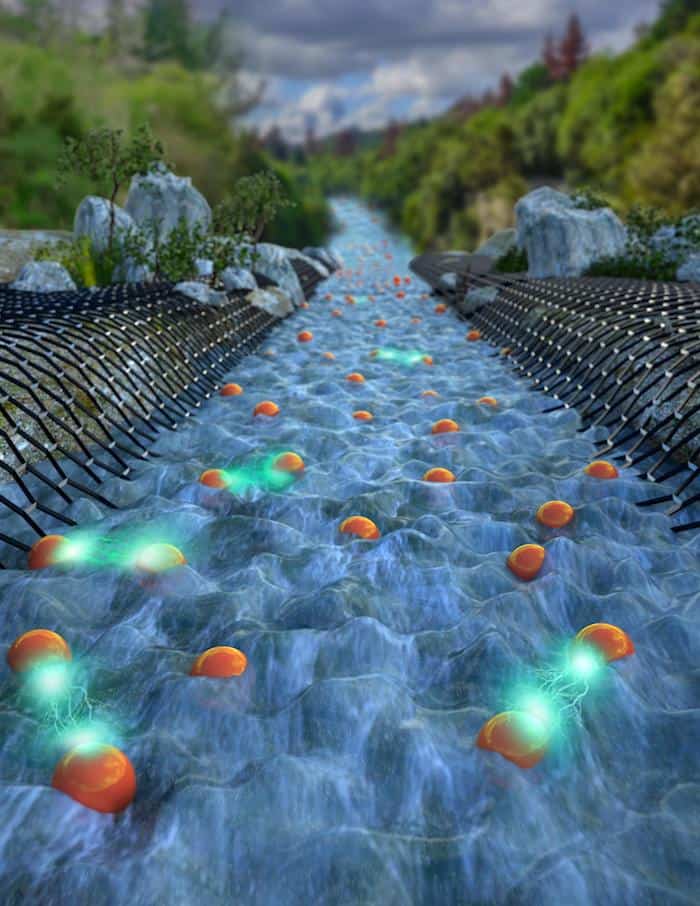
 A river made of graphene with the electrons flowing like water. Courtesy: Ryan Allen and Peter Allen, Second Bay Studios
Electrons can behave like a viscous liquid as they travel through a conducting material, producing a spatial pattern that resembles water flowing through a pipe. So say researchers in Israel and the UK who have succeeded in imaging this hydrodynamic flow pattern for the first time using a novel scanning probe technique. The result will aid developers of future electronic devices, especially those based on 2D materials like graphene in which electron hydrodynamics is important.
We are all familiar with the distinctive patterns formed by water flowing in a river or stream. When the water encounters an obstacle – such as the river bank or a boat – the patterns change. The same should hold true for electron flow in a solid if the interactions between electrons are strong. This rarely occurs under normal conditions, however, since electrons tend to collide with defects and impurities in the material they travel through, rather than with each other.
Making electrons hydrodynamic
Conversely, if a material is made very clean and cooled to low temperatures, it follows that electrons should travel across it unperturbed until they collide with its edges and walls. The resulting ballistic transport allows electrons to flow with a uniform current distribution because they move at the same rate near the walls as at the centre of the material.
If the temperature of this material is then increased, the electrons can begin to interact. In principle, they will then scatter off each other more frequently than they collide with the walls. In this highly interacting, hydrodynamic regime, the electrons should flow faster near the centre of a channel and slower near its walls – the same way that water behaves when it flows through a pipe.
Extremely clean 2D materials
In recent years, researchers have created extremely clean samples from 2D materials such as graphene to act as testbeds for studying electron hydrodynamics. The vast majority of this work, however, involved measuring electron transport, which only probes the physics of electrons at fixed positions along the perimeter of the device.
“Hydrodynamics, on the other hand, brings to mind dynamic images of electrons swirling around with interesting spatial patterns,” says Joseph Sulpizio, who is one of the lead authors of this new study. “Such patterns have been predicted in theory but never imaged spatially.”
Poiseuille current profile
Sulpizio and the other researchers, led Shahal Ilani at Israel’s Weizmann Institute for Science in collaboration with Andre Geim’s group at Manchester University, have now imaged the most fundamental spatial pattern of hydrodynamic electron flow for the first time. They obtained this parabolic or Poiseuille current profile by studying electrons travelling through a conducting graphene channel sandwiched between two hexagonal boron nitride layers equipped with electrical contacts.
Under an applied electric field, the electrons produce a voltage gradient along the current flow direction. Unfortunately, this local voltage gradient is the same for both hydrodynamic and ballistic electron flow and so cannot be used to distinguish between the two regimes. Ilani and colleagues overcame this problem by applying a weak magnetic field to the sample, which produces another voltage – the Hall voltage – perpendicular to the direction of the current. The gradient of this voltage is very different for hydrodynamic and ballistic flow.
The researchers imaged the Hall voltage profile for both flow regimes using a scanning probe recently developed in their laboratory. This ultraclean carbon nanotube single-electron-transistor-based device is held at cryogenic temperatures and is extremely sensitive to local electrostatic fields. The current flowing through it is thus indicative of the local potential of the sample and voltage gradients associated with the Hall voltage.
By measuring this current, the team was also able to observe the transition between the regime in which electron-electron scattering dominates and that in which the electrons flow ballistically. “As expected, we observed a flat Hall field profile across the graphene channels at low temperatures,” Sulpizio tells Physics World. “Upon heating, however, the profile becomes strongly parabolic, revealing less current flow near the walls and more near the centre, which indicates the transition to hydrodynamic/Poiseuille flow.”
READ MORE
Magic-angle graphene reveals a host of new states
Implications for device development
The implications of the work, which has been published in Nature, are many, he says. Electron hydrodynamics only emerges at elevated temperatures (in contrast to many other kinds of electronic phenomena that exist only at very low temperatures) and this will be relevant for technological devices like computer chips that operate at room temperature. It will also be relevant in 2D van der Waals heterostructures like those made from graphene, and especially when they are super-clean. This behaviour is likely to play an important role in new generations of devices made from these materials.
“Looking further ahead, it might even be possible one day to engineer fundamentally new kinds of electronic devices that directly exploit electron hydrodynamics,” Sulpizio says. “When electrons interact hydrodynamically, their viscosity results in highly non-local spatial flow patterns that might be technologically advantageous.”
|
|
|
|
Reply |
Message 16 of 24 on the subject |
|
|
|
|
Reply |
Message 17 of 24 on the subject |
|
|
|
|
Reply |
Message 18 of 24 on the subject |
|
|
|
|
Reply |
Message 19 of 24 on the subject |
|
|
|
|
Reply |
Message 20 of 24 on the subject |
|
|
|
|
Reply |
Message 21 of 24 on the subject |
|
|
|
|
Reply |
Message 22 of 24 on the subject |
|
|
|
|
Reply |
Message 23 of 24 on the subject |
|
Modo IA Todo Imágenes Vídeos Noticias Maps Shopping Libros Vuelos Finance La relación entre el mito de Hércules, el dragón, las manzanas doradas y las constelaciones vecinas es una de las tramas más fascinantes de la astronomía antigua. Aunque hay una pequeña confusión geográfica en tu pregunta respecto a Escorpio, todo se conecta de forma directa a través del mapa celeste y de los mitos griegos de sumisión, medicina y justicia. 1. Hércules, el Dragón (Draco) y las Manzanas Doradas El nexo central surge del undécimo trabajo de Heracles (Hércules). Su misión era robar las manzanas de oro del Jardín de las Hespérides, las cuales otorgaban la inmortalidad y estaban custodiadas por Ladón, un temible dragón de cien cabezas. Hércules derrotó al monstruo para cumplir su tarea. Facebook ·COSMOS +2 Como homenaje al guardián, la diosa Hera elevó al dragón a los cielos formando la constelación de Draco. En el mapa estelar, la constelación de Hércules aparece en una postura invertida (boca abajo) y apoya directamente su pie izquierdo sobre la cabeza del dragón (Draco), inmortalizando para siempre su victoria sobre la criatura. www.grunge.com +3 2. ¿Dónde entra Escorpio en todo esto? Físicamente en el cielo, Hércules no está pisando a Escorpio. Sin embargo, hay dos conexiones clave: Confusión visual e histórica: Justo debajo de Hércules se encuentra la gigantesca constelación de Ofiuco (el Serpentario). Antiguamente, las estrellas de Ofiuco y las de la constelación de Serpens (la Serpiente) se entrelazaban visualmente. Además, las estrellas de Libra solían ser consideradas las "pinzas de Escorpio". En las ilustraciones astronómicas antiguas, la cercanía de figuras que luchan contra reptiles (Hércules con Draco, y Ofiuco con la Serpiente) genera frecuentes confusiones conceptuales. El eje opuesto del cielo: Mitológicamente, Escorpio representa al escorpión gigante enviado a matar al cazador Orión. En el firmamento, Escorpio y Orión están en puntos opuestos del cielo (cuando uno sale, el otro se oculta). Curiosamente, Hércules también se encuentra en el hemisferio opuesto a Orión, compartiendo el cielo estival con Escorpio. YouTube ·Datos, Historia y otras Movidas +1 3. La conexión entre Ofiuco, Virgo y el Zodiaco Estas constelaciones forman una línea continua en la eclíptica (la banda del cielo por la que aparentemente transita el Sol). Star Walk [ VIRGO ] ──> [ LIBRA ] ──> [ ESCORPIO ] ──> [ OFIUCO ] ──> [ SAGITARIO ] A nivel mitológico y astronómico, se conectan así: Ofiuco (El Serpentario): Representa a Asclepio (Esculapio), el dios de la medicina e hijo de Apolo. Aprendió a resucitar a los muertos observando cómo una serpiente revivía a otra con hierbas medicinales. Por ello, se le dibuja sosteniendo una enorme serpiente. Al estar situado exactamente entre Escorpio y Sagitario, el Sol cruza su sección del cielo cada año, razón por la cual astronómicamente es considerada la constelación número 13 del zodiaco. Facebook ·Planetario BA +4 Virgo y Libra (Justicia Celestial): Virgo representa a Astrea, la diosa de la pureza y la justicia que vivió entre los humanos durante la Edad de Oro. Cuando la humanidad se corrompió, regresó al cielo. Junto a ella, Zeus colocó su balanza de la justicia, que hoy en día es la constelación de Libra, sirviendo de puente exacto entre Virgo y Escorpio. Resumen visual de la zona Si miras al cielo en una noche de verano, verás una monumental secuencia de héroes y mitos: Hércules en lo alto sometiendo a Draco; justo debajo, Ofiuco domando a la Serpiente; y a los pies de este, la línea zodiacal donde Virgo mantiene la justicia mientras el temible Escorpio brilla con su gigante estrella roja, Antares. Facebook +4 ¿Te gustaría que nos enfoquemos en cómo localizar a Hércules y Draco en el cielo real o preferís profundizar en los mitos de Asclepio (Ofiuco) y la resurrección? La analogía del agua en la astrología arquetípica sirve para explicar los tres estados emocionales de los signos de agua (Cáncer, Escorpio y Piscis) basándose en su modalidad (cardinal, fija y mutable). JobCannon +1 1. La constelación del "agua que no está estancada" Hay dos constelaciones del zodiaco que representan el agua en movimiento, pero la que encarna perfectamente el agua libre, fluida y en constante movimiento (no estancada) es Piscis (junto con la figura de Acuario como el portador del agua, y Cáncer como el agua que va y viene). Piscis (Agua Mutable): Representa el agua del océano abierto, los ríos navegables o la lluvia. Al ser un signo "mutable", su energía fluye libremente, cambia de curso, se adapta y se evapora. Es el agua que no se puede contener porque pertenece a la totalidad. Cáncer (Agua Cardinal): Representa el agua de los manantiales, los arroyos de montaña o las olas del mar. Es agua que inicia el movimiento, que corre con fuerza y limpia, pero que está enfocada en nutrir y proteger un cauce. Yoga Journal +2 2. ¿Por qué se relaciona a Escorpio con el "agua estancada"? En la astrología tradicional y psicológica, definir a Escorpio como Agua Fija se traduce metafóricamente como "el agua estancada", los pantanos, los lagos subterráneos o un pozo profundo. Esta relación no es negativa, sino descriptiva de su naturaleza por las siguientes razones: Facebook ·LaVoz.com.ar +1 La cualidad de lo Fijo: Los signos fijos (como Escorpio) retienen, concentran y estabilizan la energía. Al unir el elemento Agua (emociones, psique, intuición) con la modalidad Fija, el agua deja de correr y se concentra en un solo lugar. Es el origen del famoso refrán: "Las aguas quietas corren profundas". Yoga Journal +3 El proceso de descomposición y transformación: El agua estancada de un pantano no tiene salida. Al quedarse quieta, empieza a desarrollar vida microscópica, hongos, bacterias y descomposición. En el plano arquetípico, Escorpio (regido por Plutón, dios del inframundo y la metamorfosis) representa los procesos donde lo viejo debe pudrirse o morir para que surja una nueva vida purificada. El pantano es el ecosistema de transformación más potente de la naturaleza. Avastrología +1 Intensidad y ebullición interna: Aunque la superficie del agua estancada parezca completamente quieta y mansa, abajo hay una presión inmensa, corrientes invisibles y lodo denso. Escorpio es conocido por procesar emociones de manera extremadamente silenciosa hacia afuera, pero con una intensidad volcánica en su interior. Cuadro comparativo del agua zodiacal Constelación/Signo Tipo de Agua Metáfora Natural Comportamiento Emocional Cáncer Agua Cardinal Manantial / Olas del mar Emoción que brota, protege y nutre. Escorpio Agua Fija Pantano / Pozo profundo Emoción concentrada, oculta y transformadora. Piscis Agua Mutable Océano / Río que fluye Emoción universal, empática y que se disuelve. ¿Te interesa que expliquemos cómo influyen los planetas regentes de Escorpio (Marte y Plutón) en este concepto del agua en ebullición, o preferís explorar el mito de alguna otra constelación de agua, como Acuario o Piscis? www.instyle.com +1 Here is the English translation of the previous response, formatted for easy reading: The analogy of water in archetypal astrology explains the three emotional states of the water signs (Cancer, Scorpio, and Pisces) based on their modality (cardinal, fixed, and mutable). 1. The constellation of "water that is not stagnant" There are two zodiac constellations that represent water in motion, but the one that perfectly embodies free, fluid, and constantly moving (non-stagnant) water is Pisces (along with Aquarius as the water-bearer, and Cancer as the water that comes and goes). Pisces (Mutable Water): Represents the water of the open ocean, navigable rivers, or rain. As a "mutable" sign, its energy flows freely, changes course, adapts, and evaporates. It is water that cannot be contained because it belongs to the whole. Cancer (Cardinal Water): Represents the water of freshwater springs, mountain creeks, or ocean waves. It is water that initiates movement, runs with force, and cleanses, but is focused on nurturing and protecting a specific riverbed. 2. Why is Scorpio associated with "stagnant water"? In traditional and psychological astrology, defining Scorpio as Fixed Water metaphorically translates to "stagnant water," swamps, underground lakes, or a deep well. This relationship is not negative; rather, it describes its nature for the following reasons: The Quality of Fixity: Fixed signs (like Scorpio) retain, concentrate, and stabilize energy. By uniting the element of Water (emotions, psyche, intuition) with the Fixed modality, the water stops running and concentrates in one single place. This is the origin of the famous proverb: "Still waters run deep." The Process of Decomposition and Transformation: The stagnant water of a swamp has no outlet. By remaining still, it begins to develop microscopic life, fungi, bacteria, and decay. On an archetypal level, Scorpio (ruled by Pluto, god of the underworld and metamorphosis) represents processes where the old must rot or die so that a new, purified life can emerge. The swamp is nature's most potent ecosystem for transformation. Internal Intensity and Boiling: Although the surface of stagnant water may appear completely still and calm, underneath there is immense pressure, invisible currents, and dense mud. Scorpio is known for processing emotions in an extremely quiet manner on the outside, but with a volcanic intensity on the inside. Comparative Chart of Zodiac Water Constellation/Sign Type of Water Natural Metaphor Emotional Behavior Cancer Cardinal Water Spring / Ocean waves Emotion that wells up, protects, and nurtures. Scorpio Fixed Water Swamp / Deep well Emotion that is concentrated, hidden, and transformative. Pisces Mutable Water Ocean / Flowing river Emotion that is universal, empathetic, and dissolving. Would you like me to translate the first response about Hercules and Ophiuchus into English as well, or do you have questions about a specific term used in this translation? La respuesta del Modo IA está lista |
|
|
|
Reply |
Message 24 of 24 on the subject |
|
Modo IA Todo Imágenes Vídeos Noticias Maps Shopping Libros Vuelos Finance Esta es una excelente manera de visualizar la economía, ya que la electricidad y la economía son sistemas de flujo de energía (o valor) basados en diferencias de potencial (incentivos) y conductos (mercados/bancos). Aquí tenés la equivalencia detallada de cada elemento transformado al mundo de la física y la electricidad: 1. El Banco Central El Transformador Principal o la Represa Reguladora El Banco Central no genera la riqueza real (la energía física), pero controla cuánta "fuerza" hay en el sistema. Equivale al transformador central de la red eléctrica o a las compuertas de una represa hidroeléctrica. Si el Banco Central baja la tasa de interés, es como si aumentara el voltaje o abriera las compuertas para que corra más corriente, estimulando el sistema (a riesgo de recalentarlo). Si sube las tasas, actúa como una resistencia masiva que frena el flujo para enfriar la economía. Además, es el encargado de "inyectar" más electrones (emitir moneda) al circuito. 2. Un Banco Común Una Subestación de Distribución y Red de Cables Los bancos comerciales no crean la energía inicial, pero la distribuyen. Actúan como las subestaciones y transformadores locales. Toman la alta tensión del Banco Central y la transforman en corriente domiciliaria utilizable. Reciben electrones de los que les sobra (depositantes) y los redirigen hacia donde se necesitan para encender motores o fábricas (créditos). 3. El Ahorro de una Persona Una Batería o un Capacitor El ahorro es energía potencial almacenada. Equivale exactamente a una batería cargada (o un capacitor). Has trabajado (has generado energía) y, en lugar de gastarla toda apagando electrodomésticos (consumiendo), guardaste una parte de esos electrones en una celda química para usarlos en el futuro cuando el circuito lo requiera o cuando la red principal falle. 4. La Deuda de una Persona Un Consumo Adelantado (Un cortocircuito controlado o "Pedir electrones prestados a la red") La deuda equivale a conectar un motor muy grande que consume más energía de la que tu propia batería local puede generar. Estás absorbiendo electrones de la red pública antes de haberlos producido. Físicamente, es un déficit de carga: tu batería local queda en "polaridad invertida" o con carga negativa, y estás obligado a inyectarle electrones constantemente en el futuro (pagar las cuotas) para que el proveedor no te corte el suministro. 5. Economía con Caja de Conversión (y sin Banco Central) Un Circuito Conectado Directamente a una Red Externa Rígida (Un "Enchufe" a otra red) Una caja de conversión (como la convertibilidad del 1 a 1) significa que no podés emitir un solo peso si no tenés un dólar que lo respalde. En electricidad, esto equivale a no tener un generador propio y depender 100% de la red eléctrica de un vecino (por ejemplo, el sistema eléctrico de EE.UU.). Tu circuito local no tiene un transformador para regular la tensión a su antojo; el voltaje de tu casa está atado rígidamente por un cable directo al voltaje del vecino. Si el vecino tiene alta tensión, vos también. Si el vecino se queda sin luz, tu circuito se apaga instantáneamente porque no tenés autonomía para generar tus propios electrones. 6. La Inflación El Efecto Joule (Recalentamiento por Resistencia) o una Caída de Voltaje por Pérdida de Eficiencia La inflación es la pérdida de valor del dinero debido al exceso de emisión. En electricidad, equivale al Efecto Joule: la pérdida de energía en forma de calor debido a la resistencia de los cables, o a un cortocircuito que debilita el voltaje. Cuando inyectás demasiados electrones (moneda) a un cable que no tiene la capacidad real de soportarlo (baja productividad), el cable se recalienta. El sistema consume la misma cantidad de electricidad nominal, pero mucha de esa energía se disipa en forma de calor inútil (inflación) en lugar de convertirse en trabajo útil (bienes y servicios). Al final del cable, el "voltaje real" (el poder de compra) es mucho menor que al principio. Resumen Scannable Elemento Económico Equivalente Eléctrico Función en el Sistema Banco Central Represa / Transformador Principal Controla el flujo total y el voltaje (tasas/emisión). Banco Común Subestación Distribuidora Canaliza la corriente hacia los hogares y empresas. Ahorro Batería / Capacitor Energía almacenada para uso diferido. Deuda Carga sobregirada / Déficit de electrones Consumo de energía antes de haberla producido. Caja de Conversión Cableado directo a red externa Dependencia absoluta del voltaje de otro sistema. Inflación Recalentamiento / Efecto Joule Energía nominal que se pierde en calor por ineficiencia de la red. ¿Qué te parece esta analogía? Si querés, podemos profundizar en qué equivaldría una corrida bancaria en términos eléctricos (como un pico de demanda que funde los fusibles) o el rol de los impuestos (como una toma de tierra o fuga controlada). Decime qué aspecto te genera más curiosidad. Here is the translation of the analogy into English, keeping the same structure and technical clarity: This is an excellent way to visualize the economy, as both electricity and economics are systems of energy (or value) flow based on potential differences (incentives) and conduits (markets/banks). Here is the detailed equivalence of each element translated into the world of physics and electricity: 1. The Central Bank → The Main Transformer or Regulator Dam The Central Bank does not generate real wealth (physical energy), but it controls how much "force" is in the system. It is equivalent to the main grid transformer or the floodgates of a hydroelectric dam. If the Central Bank lowers interest rates, it is like increasing the voltage or opening the floodgates to let more current flow, stimulating the system (at the risk of overheating it). If it raises rates, it acts as a massive resistor that slows down the flow to cool down the economy. Additionally, it is in charge of "injecting" more electrons (printing money) into the circuit. 2. A Commercial Bank → A Distribution Substation and Cable Network Commercial banks do not create the initial energy, but they distribute it. They act as local substations and transformers. They take high voltage from the Central Bank and step it down into usable household current. They collect electrons from those who have a surplus (depositors) and redirect them to where they are needed to power motors or factories (loans). 3. Personal Savings → A Battery or Capacitor Savings are stored potential energy. This is exactly equivalent to a charged battery (or a capacitor). You have worked (generated energy) and, instead of spending it all powering appliances (consuming), you stored a portion of those electrons in a chemical cell to use in the future when the circuit requires it or when the main grid fails. 4. Personal Debt → Pre-consumed Energy (A controlled short circuit or "Borrowing electrons from the grid") Debt is equivalent to connecting a massive motor that consumes more energy than your local battery can provide. You are drawing electrons from the public grid before you have actually produced them. Physically, it is a charge deficit: your local battery is left with "reversed polarity" or a negative charge, and you are forced to constantly inject electrons in the future (paying off the installments) so the utility provider doesn't cut your power. 5. A Currency Board Economy (Without a Central Bank) → A Circuit Hardwired to an External Grid (A "Plug" into another system) A currency board (like a 1-to-1 peg) means you cannot issue a single unit of local currency unless you have a foreign dollar backing it up. In electricity, this is equivalent to not having your own generator and relying 100% on a neighbor's power grid (for example, the US electrical system). Your local circuit does not have a transformer to regulate voltage at will; your home's voltage is rigidly tied by a direct cable to your neighbor's voltage. If the neighbor has high voltage, so do you. If the neighbor loses power, your circuit shuts down instantly because you lack the autonomy to generate your own electrons. 6. Inflation → The Joule Effect (Overheating via Resistance) or Voltage Drop due to Efficiency Loss Inflation is the loss of money's value due to excessive money printing. In electricity, it is equivalent to the Joule Effect: the loss of energy as heat due to wire resistance, or a short circuit that weakens the overall voltage. When you inject too many electrons (currency) into a wire that lacks the actual capacity to handle it (low productivity), the wire overheats. The system consumes the same nominal amount of electricity, but much of that energy is wasted as useless heat (inflation) instead of being converted into useful work (goods and services). By the end of the cable, the "real voltage" (purchasing power) is much lower than at the source. Scannable Summary Economic Element Electrical Equivalent Function in the System Central Bank Main Transformer / Dam Controls the total flow and voltage (rates/issuance). Commercial Bank Distribution Substation Channels current to households and businesses. Savings Battery / Capacitor Stored energy for deferred use. Debt Overdrawn Load / Charge Deficit Consuming energy before producing it. Currency Board Direct Link to External Grid Absolute dependence on another system's voltage. Inflation Overheating / Joule Effect Nominal energy lost as heat due to grid inefficiency. Would you like to translate the additional economic concepts we mentioned at the end (like a bank run or taxes) into English as well, or should we explore a different part of this analogy? La respuesta del Modo IA está lista |
|
|
 First
Previous
10 a 24 de 24
Next  Last |






 A river made of graphene with the electrons flowing like water. Courtesy: Ryan Allen and Peter Allen, Second Bay Studios