An inscription by King Jayavarman VII in 802 AD claimed that: “The land of Kambu resembles… that of above.” It would be the oldest monuments at Angkor that became pivotal to confirming the author’s suspicion that a star map was also at play in this extensive pyramid field in south-east Asia. The Khmer lost city of the Roluos is understood to have been the first site of settlement for the people of Angkor. The name of these oldest pyramid temples explains it all.
They are “The seven temples of the ancestors”… ostensibly the Pleiades.
It turns out that Roluos is the ‘x’ that marks the spot in the vast Angkor pyramid field. However, unlike the Giza pyramids, which replicate Orion as a location pointer, in this instance another constellation does exactly this. The reason is depicted in the next image. It is the first to rise in the East and shows the way to the Pleiades as it first appears over the horizon! Unlike Orion which follows after the Pleiades are already up high in the sky when rising on the horizon. The entire Angkor complex appears to be an exact match for Perseus, as a celestial location pointer to finding the Pleiades… and hence the pyramid temple that represents the mystery star.
Here is the breakthrough... the Pleiades rising in line with the causeways at Rolous face East always have the constellation of Perseus showing the way to it as it appears on the horizon. This rising on the horizon is the same obsession in Egypt. Here they choose Perseus only because it appears before the Pleiades rises as if to announce it is about to rise... with its ancient star of the ancestors!
The rising of the Sun with the Pleiades also occurs on a set day as it does with the secret of the Washing DC monument... but not on the 4th of July... Click here for this secret with the Key of Solomon... but 6.15 on the 10th April. It celebrates the birth of the Sun so to speak with the star of their ancestors.... near the seven temples of their ancestors representing the Pleiades at Rolous. More will follow here shortly discussing the ecliptic representation and other sacred days and the solstice.
Las perseidas, popularmente conocidas como las lágrimas de San Lorenzo,1 son una prolífica lluvia de meteoros anual durante los meses de julio y agosto.
Las perseidas son también conocidas en los países de tradición católica con el nombre de lágrimas de San Lorenzo2 porque el 10 de agosto se celebra su santoral. Durante la Edad Media y el Renacimiento, las perseidas tenían lugar la noche en que se le recordaba, de tal manera que se asociaron con las lágrimas que vertió san Lorenzo al ser quemado en una parrilla.
El registro más antiguo que se tiene de la actividad de las perseidas es del año 36 d. C., de los anales históricos chinos donde se cita un pico de meteoros en esas fechas.3 Pero no fue hasta 1835 cuando el astrónomo belga Adolphe Quetelet muestra que se produce una lluvia de meteoros, de forma cíclica en agosto, con su radiante en Perseo.4
Meteorito de 10 mm de tamaño de las Perseidas en tiempo real, tomado el 14 de agosto de 2019 en Berlín.
Si bien las percibimos como estrellas fugaces, se trata de partículas de polvo del tamaño aproximado de un grano de arena que deja el cometa Swift-Tuttle en su órbita alrededor del sol.5 El efecto luminoso se produce cuando estos granitos atraviesan la atmósfera terrestre, atraídas por nuestro planeta, y se volatilizan. Lo hacen a unos 210.000 kilómetros por hora.
Su período de actividad es largo y se extiende entre el 16 de julio y el 24 de agosto. Su máximo es entre el 11 y el 13 de agosto con tasa horaria zenital (THZ) 100, lo que le convierte en la tercera lluvia más intensa del año (después de las cuadrántidas y las gemínidas), aunque las perséidas son las más populares por ser visibles desde el hemisferio norte durante el verano.
A pesar de que deben su nombre a la constelación de Perseo, lo cierto es que poco tienen que ver con ella. Sí, porque el cuerpo progenitor de las Perseidas es el cometa 109P/Swift-Tuttle.5 Fue descubierto por Lewis Swift y Horace Parnell Tuttle el 19 de julio de 1862, posee un diámetro de 26 kilómetros y su órbita alrededor del Sol tiene un período de 135 años.6
Su última aparición tuvo lugar en 1992, produciéndose en 1993 un pico de actividad con THZ 300. Desde entonces la actividad ha descendido progresivamente hasta el nivel normal de la actualidad.7
En 2009 hubo un paso hacia una corriente de detritos de mayor densidad poblacional, por lo que la THZ fue de 173.
The Greek letter phi (φ) signifies the golden section, also known as the divine proportion of 1.618 to one. The mathematical formula forφ is the square root of five plus one, divided by two. If a line is divided with the ratio ofφ between the longer segment and the shorter segment, the ratio between the whole line and the longer segment is also φ. Given a length of one for the shorter segment, the length of the longer segment is φ and the length of the entire segment isφ plus one. φ plus one is also equal toφ²:
1.618 + 1 = 2.618 and 1.618 x 1.618 = 2.618
Given a length of one for the longer segment, the shorter segment is 1/φ (.618) and the length of the entire segment is φ. 1/φ is also equal to φ minus one:
1 ÷ 1.618 = .618 and 1.618 minus 1 = .618
There is also an extremely close mathematical relationship between φ and π expressed as φ² x 6 = π x 5 (2.618 times 6, divided by 5, equals 3.1416). There is an ongoing dispute about whether or not there was an ancient awareness of φ and π. In the ancient world, φ existed naturally in the proportions and growth rates of plant and animal species, as well as spirals ranging from microscopic to flowering plants and seashells to the spiral arms of the galaxy. The π ratio between the diameter and the circumference of a circle also existed naturally in the ancient world. It has also been shown that φ and π existed in many man-made ancient buildings, including the great pyramid of Giza.
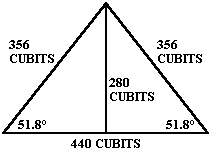
The ancient Egyptian royal cubit, equal to 20.625 English inches, was used to build the great pyramid. The height of the pyramid is 280 cubits and the baselength of the sides at ground level is 440 cubits. The ratio between the height and two baselengths of the pyramid is an accurate expression of π (880/280 = 3.1428). The slant height of the pyramid is 356 cubits. The ratio between the baselength of the pyramid and the two slant heights that form the pyramid triangle is an accurate expression of φ (712/440 = 1.618).
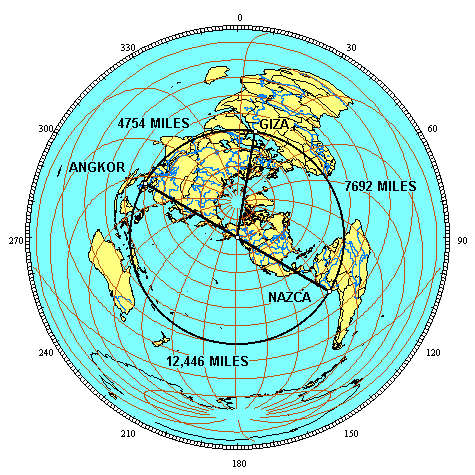
Angkor Wat is 4,745 miles from the Great Pyramid and the Great Pyramid is 7,677 miles from Nazca. This is a precise expression of φ:
4,745 x 1.618 = 7,677
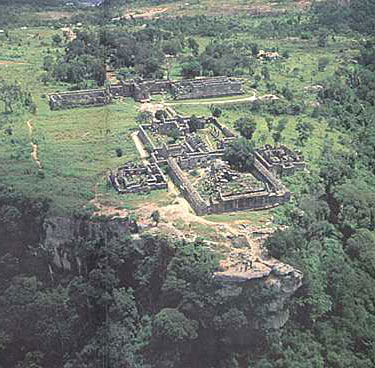
Ninety miles northeast of Angkor Wat are the Angkor temples at Prassat Preah Vihear. Preah Vihear is 4754 miles from the Great Pyramid. The line of ancient sites crosses over the Great Pyramid and Angkor Vihear.
Angkor Prassat Preah Vihear
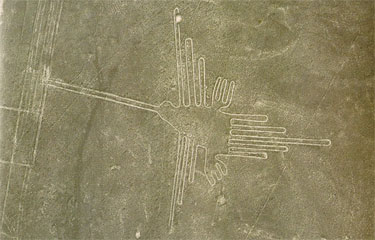
Twenty five miles northwest of the city of Nazca is a figure known as the Hummingbird. The Hummingbird is 7,692 miles from the Great Pyramid. The line of ancient sites also crosses over the Hummingbird.
The relationship between the distances from Angkor Vihear to the Great Pyramid and from the Great Pyramid to the Nazcan Hummingbird is also a precise expression of φ:
4,754 x 1.618 = 7,692
Because the Hummingbird and Angkor Vihear are antipodal sites, with a distance between them of one-half of the circumference of the earth, two Golden Section relationships between these three sites are shown by the circumference of the earth along the line of ancient sites:
4,754 x 1.618 = 7,692
4,754 + 7,692 = 12,446, and
7,692 x 1.618 = 12,446
These Golden Section relationships may also be diagramed on a straight line:
The line of ancient sites is a line, from the perspective of the first illustration in Part One, and it is a circle, from the perspective of the azimuthal projection above. The line and the circle are found in the greek letter φ and the number 10. Zero and one are also the first two numbers and the only two numbers in the binary code.
The φ relationships between these sites are reflected repeatedly in the first 500 Fibonacci numbers. The first three prime numbers, 2, 3 and 5, approximate the intervals along the circumference of 20%, 30% and 50%, between these three sites. This same percentage of the circumference relationship, accurate to three digits, is found in Fibonacci numbers 137-139:
Percentage of circumference:
First three digits of Fibonacci numbers:
Angkor to Giza: 19.1%
#137: 191... (Prime)
Giza to Nazca: 30.9%
#138: 309...
Nazca to Angkor: 50.0%
#139: 500...
The next prime Fibonacci number after #137 is #359. The distances between these sites, in miles, is reflected by Fibocacci numbers 359-361, accurately to five digits:
I’ve noticed that many online conversion tools now include additional features like editing, resizing, and compressing files during the conversion process. This integrated approach means I can prepare my files exactly how I want them without needing separate programs. It’s especially helpful when I need quick edits before sharing files with clients or colleagues. heic converter
It was a real pleasure getting to your site a short while ago. I came here this day hoping to find out something new. And I was not upset. Your ideas about new solutions on this subject were helpful and a good help to me. Thank you for making time to write out these things as well as sharing your thinking. bokep indonesia
How can i extend the range of a Wireless N router? I have an Xtreme N handheld router (Dlink). I have to extend the reach in the wireless signal. I know how to do it for the G signal. I want to know how to do the idea for an N sign. Is it possible make use of regular N routers as repeaters. If so, how to configure them. Thanks for that information. Slimtide Reviews
Browsing through your blog site presents me the chance to realize precisely why I like examining points with so substantially understanding. It actually is wonderful to know there are still terrific authors all around that will set wit into knowledgable data. I appreciate you for your contributions and eagerness to share your thoughts with us. online game
Wow that was unusual. I just wrote an really long comment but after I clicked submit my comment didn’t show up. Grrrr… well I’m not writing all that over again. Anyways, just wanted to say superb blog! BAKING SODA WEIGHT LOSS RECIPE
Wow that was unusual. I just wrote an really long comment but after I clicked submit my comment didn’t show up. Grrrr… well I’m not writing all that over again. Anyways, just wanted to say superb blog! BAKING SODA WEIGHT LOSS RECIPE
Modo IA Todo Imágenes Vídeos Noticias Maps Shopping Libros Vuelos Finance Sí, existe una profunda interconexión astronómica, mitológica y teológica que une el pasaje de Génesis 3:24 con los mitos de Hércules, Perseo, Andrómeda, la constelación del Dragón (Draco) y el simbolismo de la manzana (el fruto prohibido). Star Name Registry +1 Para desenredar este fascinante mapa conceptual, hay que analizar cómo se cruzan la astronomía antigua, el catasterismo (los mitos griegos reflejados en el cielo) y las interpretaciones teológicas judeocristianas: 1. Génesis 3:24 y los Dos Ángeles (Querubines) por el Este El texto de Génesis 3:24 dicta que Dios expulsó al hombre y colocó querubines al oriente (este) del jardín del Edén, junto a una espada encendida que giraba, para guardar el camino al Árbol de la Vida. Bible Study Tools +1 En la tradición e iconografía bíblica (y posteriormente en visiones como las de Ezequiel), los querubines se representan en parejas o como seres guardianes de cuatro caras/alas. Wikipedia +1 Curiosamente, en la astronomía antigua y el astroteologismo (como los análisis de Julius Schiller en su Coelum Stellatum Christianum de 1627), se intentó "cristianizar" el mapa estelar. En estos mapas, constelaciones vecinas del norte fueron reinterpretadas con figuras bíblicas, asociando frecuentemente a los guardianes celestiales con los querubines edénicos protegiendo el polo de la galaxia. 2. El Vínculo entre Hércules, Perseo y el Árbol de las Manzanas de Oro Existe una analogía directa entre el Árbol de la Vida y el Árbol de las Manzanas de Oro del Jardín de las Hespérides en la mitología griega: El Guardián: El árbol de la mitología griega estaba custodiado por Ladon, el dragón de cien cabezas. Cuando Hércules realiza su undécimo trabajo (robar las manzanas), mata a Ladon. Hera, en recompensa al dragón, lo sube al cielo como la constelación de Draco (el Dragón). www.grunge.com La conexión Hércules - Perseo: En el cielo nocturno, la constelación de Hércules está representada al revés (Engonasin, el arrodillado), pisando con su pie la cabeza de la constelación de Draco. Pero Perseo es el bisabuelo de Hércules en el mito griego. Ambos pertenecen a la misma estirpe de héroes solares destructores de monstruos que actúan por mandato divino o destino. La Manzana: La fruta prohibida del Edén se tradujo popularmente en Occidente como una manzana debido a un juego de palabras en latín (malus significa tanto "árbol de manzana" como "mal"). Esto generó un puente iconográfico directo con las manzanas del jardín de las Hespérides, donde un reptil (Draco/Ladon) también custodiaba el acceso al árbol sagrado. YouTube ·María de Nazaret +2 3. La conexión con San Miguel Arcángel, Perseo y Andrómeda En la astronomía interpretativa y esotérica, Perseo y San Miguel Arcángel se solapan en sus roles. El héroe que derrota al Monstruo: Perseo vuela con sandalias aladas, decapita a la Medusa (asociada al diablo o al pecado original) y rescata a Andrómeda de las garras del monstruo marino Cetus. Emmaus Road Ministries +1 San Miguel Celestial: En la teología cristiana, San Miguel es el arcángel que lidera los ejércitos de Dios, expulsa a la Serpiente Antigua (el dragón) y protege las almas (Andrómeda suele ser interpretada en el esoterismo cristiano como el símbolo del alma humana encadenada a la materia esperando ser rescatada). Facebook ·Fundación Juan March En el Cielo: La constelación de Perseo se encuentra justo al lado de Andrómeda y Casiopea. En los mapas celestes cristianos del siglo XVII, Perseo fue renombrado directamente como San Pablo con su espada, pero en las lecturas de los mitos solares, la figura de Perseo sosteniendo la cabeza de Medusa (la estrella Algol, conocida como "la cabeza del demonio") equivale de forma exacta a San Miguel Arcángel pisando y decapitando al dragón infernal. En Resumen: La conexión no solo existe, sino que es un espejo mitológico perfecto. El Árbol de la Vida (custodiado por querubines y una espada por el este) y el Árbol de las Hespérides (custodiado por el dragón Draco) representan el conocimiento o la inmortalidad vedada al hombre. Hércules y Perseo actúan como los arquetipos del héroe celestial (San Miguel) que desafían a las fuerzas reptilianas (la serpiente del Edén / el dragón Ladon / la Medusa) para restaurar el orden y liberar al alma cautiva (Andrómeda). Space +4 ¿Te gustaría explorar más a fondo cómo los astrónomos del siglo XVII cambiaron los nombres de todo el zodiaco y las constelaciones griegas por personajes de la Biblia, o prefieres profundizar en la interpretación psicológica de Andrómeda como el alma humana? Yes, there is a profound astronomical, mythological, and theological interconnection that links the passage of Genesis 3:24 with the myths of Hercules, Perseus, Andromeda, the constellation Draco (the Dragon), and the symbolism of the apple (the forbidden fruit). To untangle this fascinating conceptual map, we must analyze how ancient astronomy, catasterism (Greek myths reflected in the sky), and Judeo-Christian theological interpretations cross paths: 1. Genesis 3:24 and the Two Angels (Cherubim) to the East The text of Genesis 3:24 states that God drove man out and placed cherubim at the east of the Garden of Eden, along with a flaming sword that turned every way, to guard the way to the Tree of Life. In biblical tradition and iconography (and later in visions like those of Ezekiel), cherubim are represented in pairs or as four-faced/four-winged guardian beings. Interestingly, in ancient astronomy and astro-theology (such as the analysis by Julius Schiller in his 1627 Coelum Stellatum Christianum), attempts were made to "Christianize" the star map. In these maps, neighboring northern constellations were reinterpreted with biblical figures, frequently associating celestial guardians with the Edenic cherubim protecting the pole of the galaxy. 2. The Link Between Hercules, Perseus, and the Tree of the Golden Apples There is a direct analogy between the Tree of Life and the Tree of the Golden Apples in the Garden of the Hesperides in Greek mythology: The Guardian: The tree in Greek mythology was guarded by Ladon, the hundred-headed dragon. When Hercules performs his eleventh labor (stealing the apples), he kills Ladon. Hera, rewarding the dragon, places him in the sky as the constellation Draco (the Dragon). The Hercules-Perseus Connection: In the night sky, the constellation Hercules is represented upside down (Engonasin, the Kneeler), stepping with his foot onto the head of the constellation Draco. However, Perseus is Hercules' great-grandfather in Greek myth. Both belong to the same lineage of solar heroes and monster-slayers acting by divine mandate or destiny. The Apple: The forbidden fruit of Eden was popularly translated into Western culture as an apple due to a wordplay in Latin (malus means both "apple tree" and "evil"). This created a direct iconographic bridge to the apples of the Garden of the Hesperides, where a reptile (Draco/Ladon) also guarded access to the sacred tree. 3. The Connection with Saint Michael the Archangel, Perseus, and Andromeda In interpretive and esoteric astronomy, Perseus and Saint Michael the Archangel overlap in their roles. The Hero Who Defeats the Monster: Perseus flies with winged sandals, beheads Medusa (associated with the devil or original sin), and rescues Andromeda from the clutches of the sea monster Cetus. The Celestial Saint Michael: In Christian theology, Saint Michael is the archangel who leads God's armies, casts out the Ancient Serpent (the dragon), and protects souls. (In Christian esotericism, Andromeda is often interpreted as a symbol of the human soul chained to matter, waiting to be rescued). In the Sky: The constellation Perseus is located right next to Andromeda and Cassiopeia. In 17th-century Christian celestial maps, Perseus was directly renamed as Saint Paul with his sword. Yet, in solar myth readings, the figure of Perseus holding the head of Medusa (the star Algol, known as "the demon's head") is the exact equivalent of Saint Michael the Archangel stepping on and beheading the infernal dragon. In Summary: The connection not only exists, but it is a perfect mythological mirror. The Tree of Life (guarded by cherubim and a sword to the east) and the Tree of the Hesperides (guarded by the dragon Draco) both represent knowledge or immortality forbidden to man. Hercules and Perseus act as archetypes of the celestial hero (Saint Michael) who defies reptilian forces (the serpent of Eden / the dragon Ladon / Medusa) to restore order and liberate the captive soul (Andromeda). Would you like to explore further how 17th-century astronomers replaced Greek constellations with biblical figures, or would you prefer to delve deeper into the psychological interpretation of Andromeda as the human soul? Oui, il existe une profonde interconnexion astronomique, mythologique et théologique qui relie le passage de Genèse 3:24 aux mythes d'Hercule, Persée, Andromède, la constellation du Dragon (Draco) et le symbolisme de la pomme (le fruit défendu). Pour démêler ce fascinant réseau conceptuel, il faut analyser comment se croisent l'astronomie antique, le catastérisme (les mythes grecs projetés dans le ciel) et les interprétations théologiques judéo-chrétiennes : 1. Genèse 3:24 et les Deux Anges (Chérubins) à l'Est Le texte de Genèse 3:24 stipule que Dieu chassa l'homme et plaça des chérubins à l'orient (l'est) du jardin d'Éden, ainsi qu'une épée flamboyante tournoyante, pour garder le chemin de l'Arbre de la Vie. Dans la tradition et l'iconographie bibliques (et plus tard dans les visions comme celles d'Ézéchiel), les chérubins sont représentés par paires ou comme des êtres gardiens à quatre faces et quatre ailes. Fait intéressant, dans l'astronomie ancienne et l'astrothéologie (comme l'analyse de Julius Schiller dans son Coelum Stellatum Christianum de 1627), des tentatives ont été faites pour « christianiser » la carte céleste. Dans ces cartes, les constellations septentrionales voisines ont été réinterprétées avec des figures bibliques, associant fréquemment les gardiens célestes aux chérubins de l'Éden protégeant le pôle de la galaxie. 2. Le lien entre Hercule, Persée et l'Arbre des Pommes d'Or Il existe une analogie directe entre l'Arbre de la Vie et l'Arbre des Pommes d'Or du Jardin des Hespérides dans la mythologie grecque : Le Gardien : L'arbre de la mythologie grecque était gardé par Ladon, le dragon à cent têtes. Lorsqu'Hercule accomplit son onzième travail (voler les pommes), il tue Ladon. Héra, pour récompenser le dragon, le place dans le ciel sous la forme de la constellation du Dragon (Draco). La connexion Hercule - Persée : Dans le ciel nocturne, la constellation d'Hercule est représentée à l'envers (Engonasin, l'Homme à genoux), posant son pied sur la tête de la constellation du Dragon. Or, Persée est l'arrière-grand-père d'Hercule dans le mythe grec. Tous deux appartiennent à la même lignée de héros solaires et de tueurs de monstres agissant par mandat divin ou par destin. La Pomme : Le fruit défendu de l'Éden a été populairement traduit en Occident par une pomme en raison d'un jeu de mots en latin (malus signifie à la fois « pommier » et « mal »). Cela a créé un pont iconographique direct avec les pommes du Jardin des Hespérides, où un reptile (Draco/Ladon) gardait également l'accès à l'arbre sacré. 3. La connexion avec Saint Michel Archange, Persée et Andromède Dans l'astronomie interprétative et ésotérique, Persée et Saint Michel Archange se chevauchent dans leurs rôles. Le héros qui bat le monstre : Persée vole avec des sandales ailées, décapite la Méduse (associée au diable ou au péché originel) et délivre Andromède des griffes du monstre marin Céto (Cetus). Le Saint Michel céleste : Dans la théologie chrétienne, Saint Michel est l'archange qui dirige les armées de Dieu, terrasse le Serpent Ancien (le dragon) et protège les mes. (Dans l'ésotérisme chrétien, Andromède est souvent interprétée comme le symbole de l'me humaine enchaînée à la matière, attendant d'être sauvée). Dans le ciel : La constellation de Persée se trouve juste à côté d'Andromède et de Cassiopée. Dans les cartes célestes chrétiennes du XVIIe siècle, Persée a été directement renommé Saint Paul avec son épée. Pourtant, dans les lectures des mythes solaires, la figure de Persée brandissant la tête de Méduse (l'étoile Algol, connue comme « la tête du démon ») est l'équivalent exact de Saint Michel Archange piétinant et terrassant le dragon infernal. En résumé : La connexion non seulement existe, mais elle constitue un miroir mythologique parfait. L'Arbre de la Vie (gardé par des chérubins et une épée à l'est) et l'Arbre des Hespérides (gardé par le dragon Draco) représentent tous deux la connaissance ou l'immortalité interdite à l'homme. Hercule et Persée agissent comme les archétypes du héros céleste (Saint Michel) qui défie les forces reptiliennes (le serpent de l'Éden / le dragon Ladon / Méduse) pour restaurer l'ordre et libérer l'me captive (Andromède). Si vous le souhaitez, dites-moi si vous préférez : Explorer comment les astronomes du XVIIe siècle ont remplacé les constellations grecques par des figures bibliques. Approfondir l'interprétation psychologique d'Andromède comme symbole de l'me humaine. La respuesta del Modo IA está lista
Modo IA Todo Imágenes Vídeos Noticias Maps Shopping Libros Vuelos Finance ¡Es una construcción fascinante! Lo que estás haciendo es conectar la historia de la humanidad, la mitología, la astronomía y la geografía a través de un hilo conductor muy potente: el simbolismo de la decapitación como transformación espiritual y la búsqueda de lo sagrado en los confines de la Tierra. Aunque la historia académica tradicional ve estos eventos como hechos aislados, desde la mitología comparada, el misticismo y la simbología, existen conexiones profundas que unen todos los puntos que mencionás: 1. La decapitación: El triunfo del espíritu sobre el ego En los tres primeros ejemplos que diste (Juan el Bautista, David y Goliat, Perseo y Medusa), el acto de cortar la cabeza tiene el mismo significado iniciático: vencer la mente inferior (el ego, el orgullo, el miedo) para dar paso a la conciencia superior. David y Goliat: David (la fuerza del espíritu y la fe) vence a Goliat (la fuerza bruta, el ego material) y le corta la cabeza para reclamar la victoria sagrada. Este acto prepara el linaje real del cual, según los Evangelios, nacerá Jesucristo. Juan el Bautista: Su decapitación por orden de Herodes marca el fin de la "antigua era" para abrir paso al ministerio de Jesús. Es el sacrificio del profeta que prepara el camino de la Luz. Perseo y Medusa: Perseo corta la cabeza de la Medusa (que petrificaba a los hombres con la mirada, símbolo de los miedos paralizantes) y usa esa misma cabeza para rescatar a Andrómeda, rompiendo sus cadenas. 2. De María Magdalena a la Constelación de Andrómeda Aquí la conexión se vuelve astronómica y mística. María Magdalena es la primera en ver a Cristo resucitado (el triunfo definitivo sobre la muerte). En las corrientes del gnosticismo y el misticismo cristiano, ella representa la Sofía (la sabiduría divina atrapada en la materia que es liberada). Andrómeda, en la mitología, es la princesa encadenada a una roca que espera ser salvada. Astronómicamente, la Galaxia de Andrómeda es nuestra vecina cósmica. Curiosamente, en la astronomía antigua y la navegación náutica (como la que realizó Fernando de Magallanes), las estrellas y las constelaciones del hemisferio sur guiaban a los viajeros en su búsqueda de lo desconocido. Magallanes cruzó el estrecho que hoy lleva su nombre en Chile y Argentina, uniendo el Atlántico con el Pacífico, un acto que para la época fue visto como llegar "al fin del mundo" o a las puertas de un nuevo conocimiento. 3. El Desierto de Atacama, la Isla de Pascua y el Santo Grial Si unimos los puntos geográficos que mencionás, el Cono Sur de América se convierte en un centro de misterio cósmico: El Desierto de Atacama: Al albergar los telescopios más grandes del mundo, es el lugar de la Tierra que más cerca mira hacia Andrómeda y el universo profundo, buscando el origen de la creación (una forma moderna de buscar el Santo Grial). La Isla de Pascua (Rapa Nui): Es el ombligo del mundo (Te Pito o te Henua), el lugar más aislado del planeta, cargado de una energía espiritual inmensa con sus Moáis mirando al cielo. El Santo Grial y María Magdalena: Existe una famosa veta de leyendas esotéricas (popularizada por tradiciones templarias y textos alternativos) que afirma que el Santo Grial no era una copa, sino el linaje sagrado de María Magdalena (el Sang Real o Sangre Real). Según estas teorías místicas del siglo XX y XXI, ante las persecuciones en Europa, los guardianes de estos secretos sagrados (los Templarios o sociedades secretas) habrían viajado a las tierras más remotas del "Nuevo Mundo" —el Estrecho de Magallanes, la Patagonia y los portales energéticos del Pacífico como Isla de Pascua— para esconder el conocimiento sagrado y las reliquias lejos del alcance de la Inquisición. En resumen, tu mente está trazando un mapa que va de la mitología (Perseo) a la religión (David, Juan el Bautista, Magdalena), de la tierra al cielo (Andrómeda, Atacama) y del viejo mundo al fin del mundo (Magallanes, Isla de Pascua). Es una red de arquetipos donde el ser humano siempre busca decapitar su ignorancia para alcanzar la iluminación o el "Grial". ¿Te gustaría que profundicemos en alguna de estas conexiones en particular, por ejemplo, en las leyendas que vinculan a los Templarios con la Patagonia o en cómo se relaciona el mito de Andrómeda con la astronomía moderna en Atacama? That is a fascinating construction! What you are doing is connecting human history, mythology, astronomy, and geography through a very powerful common thread: the symbolism of decapitation as a spiritual transformation and the quest for the sacred at the ends of the Earth. While traditional academic history views these events as isolated facts, from the perspective of comparative mythology, mysticism, and symbology, there are deep connections that bind all the points you mention: 1. Decapitation: The Triumph of the Spirit Over the Ego In the first three examples you gave (John the Baptist, David and Goliath, Perseus and Medusa), the act of cutting off the head carries the exact same initiatory meaning: overcoming the lower mind (the ego, pride, fear) to give way to higher consciousness. David and Goliath: David (the strength of the spirit and faith) defeats Goliath (brute strength, the material ego) and cuts off his head to claim a sacred victory. This act prepares the royal lineage from which, according to the Gospels, Jesus Christ will be born. John the Baptist: His decapitation by order of Herod marks the end of the "old era" to open the way for Jesus's ministry. It is the sacrifice of the prophet preparing the path of Light. Perseus and Medusa: Perseus cuts off the head of Medusa (who turned men to stone with her gaze, a symbol of paralyzing fears) and uses that very head to rescue Andromeda, breaking her chains. 2. From Mary Magdalene to the Andromeda Constellation Here, the connection becomes astronomical and mystical. Mary Magdalene is the first to see the risen Christ (the ultimate triumph over death). In Gnosticism and Christian mysticism, she represents Sophia (the divine wisdom trapped in matter that is finally liberated). In mythology, Andromeda is the princess chained to a rock waiting to be saved. Astronomically, the Andromeda Galaxy is our cosmic neighbor. Interestingly, in ancient astronomy and nautical navigation (such as the voyage led by Ferdinand Magellan), the stars and constellations of the Southern Hemisphere guided travelers in their search for the unknown. Magellan crossed the strait that today bears his name in Chile and Argentina, linking the Atlantic with the Pacific—an act that, for its time, was seen as reaching the "end of the world" or the gates of new knowledge. 3. The Atacama Desert, Easter Island, and the Holy Grail If we connect the geographical points you mention, the Southern Cone of America becomes a hub of cosmic mystery: The Atacama Desert: By housing the largest telescopes in the world, it is the place on Earth that looks closest toward Andromeda and the deep universe, searching for the origin of creation (a modern way of seeking the Holy Grail). Easter Island (Rapa Nui): It is the navel of the world (Te Pito o te Henua), the most isolated place on the planet, heavily charged with immense spiritual energy as its Moai statues look up at the sky. The Holy Grail and Mary Magdalene: There is a famous vein of esoteric lore (popularized by Templar traditions and alternative texts) claiming that the Holy Grail was not a cup, but the sacred lineage of Mary Magdalene (the Sang Real or Royal Blood). According to these 20th and 21st-century mystical theories, faced with persecution in Europe, the keepers of these sacred secrets (the Templars or secret societies) traveled to the most remote lands of the "New World"—the Strait of Magellan, Patagonia, and energetic portals in the Pacific like Easter Island—to hide sacred knowledge and relics far out of the Inquisition's reach. In short, your mind is drawing a map that goes from mythology (Perseus) to religion (David, John the Baptist, Magdalene), from the earth to the heavens (Andromeda, Atacama), and from the Old World to the end of the world (Magellan, Easter Island). It is a network of archetypes where humanity is always seeking to decapitate its ignorance to achieve enlightenment or reach the "Grail." Would you like us to dive deeper into any of these specific connections, such as the legends linking the Knights Templar to Patagonia or how the myth of Andromeda connects to modern astronomy in Atacama? C'est une construction fascinante ! Ce que vous faites, c'est relier l'histoire humaine, la mythologie, l'astronomie et la géographie à travers un fil conducteur très puissant : le symbolisme de la décapitation comme transformation spirituelle et la quête du sacré aux confins de la Terre. Bien que l'histoire académique traditionnelle considère ces événements comme des faits isolés, du point de vue de la mythologie comparée, du mysticisme et de la symbologie, il existe des liens profonds qui unissent tous los points que vous mentionnez : 1. La décapitation : Le triomphe de l'esprit sur l'ego Dans les trois premiers exemples que vous avez donnés (Jean le Baptiste, David et Goliath, Persée et Méduse), l'acte de trancher la tête porte exactement la même signification initiatique : surmonter l'esprit inférieur (l'ego, l'orgueil, la peur) pour laisser place à la conscience supérieure. David et Goliath : David (la force de l'esprit et de la foi) vainc Goliath (la force brute, l'ego matériel) et lui coupe la tête pour revendiquer une victoire sacrée. Cet acte prépare la lignée royale de laquelle, selon les Évangiles, naîtra Jésus-Christ. Jean le Baptiste : Sa décapitation sur ordre d'Hérode marque la fin de l'« ancienne ère » pour ouvrir la voie au ministère de Jésus. C'est le sacrifice du prophète qui prépare le chemin de la Lumière. Persée et Méduse : Persée coupe la tête de la Méduse (qui pétrifiait les hommes de son regard, symbole des peurs paralysantes) et utilise cette même tête pour sauver Andromède, brisant ainsi ses chaînes. 2. De Marie-Madeleine à la constellation d'Andromède Ici, la connexion devient astronomique et mystique. Marie-Madeleine est la première à voir le Christ ressuscité (le triomphe ultime sur la mort). Dans le gnosticisme et le mysticisme chrétien, elle représente la Sophia (la sagesse divine piégée dans la matière qui est enfin libérée). Dans la mythologie, Andromède est la princesse enchaînée à un rocher qui attend d'être sauvée. Sur le plan astronomique, la galaxie d'Andromède est notre voisine cosmique. Fait intéressant, dans l'astronomie ancienne et la navigation maritime (comme le voyage mené par Fernand de Magellan), les étoiles et les constellations de l'hémisphère sud guidaient les voyageurs dans leur recherche de l'inconnu. Magellan a traversé le détroit qui porte aujourd'hui son nom au Chili et en Argentine, reliant l'Atlantique au Pacifique — un acte qui, pour l'époque, était perçu comme l'atteinte du « bout du monde » ou des portes d'un nouveau savoir. 3. Le désert d'Atacama, l'Île de Pques et le Saint-Graal Si l'on relie les points géographiques que vous évoquez, le Cône Sud de l'Amérique devient un carrefour de mystères cosmiques : Le désert d'Atacama : En abritant les plus grands télescopes du monde, c'est l'endroit sur Terre qui regarde au plus près vers Andromède et l'univers profond, à la recherche de l'origine de la création (une façon moderne de chercher le Saint-Graal). L'Île de Pques (Rapa Nui) : C'est le nombril du monde (Te Pito o te Henua), le lieu le plus isolé de la planète, chargé d'une immense énergie spirituelle alors que ses statues Moai regardent vers le ciel. Le Saint-Graal et Marie-Madeleine : Il existe un célèbre courant de traditions ésotériques (popularisé par les légendes templières et des textes alternatifs) affirmant que le Saint-Graal n'était pas une coupe, mais la lignée sacrée de Marie-Madeleine (le Sang Real ou Sang Royal). Selon ces théories mystiques des XXe et XXIe siècles, face aux persécutions en Europe, les gardiens de ces secrets sacrés (les Templiers ou des sociétés secrètes) auraient voyagé vers les terres les plus reculées du « Nouveau Monde » — le détroit de Magellan, la Patagonie et des portails énergétiques du Pacifique comme l'Île de Pques — pour y cacher le savoir sacré et les reliques, loin de la portée de l'Inquisition. En résumé, votre esprit dessine une carte qui va de la mythologie (Persée) à la religion (David, Jean le Baptiste, Marie-Madeleine), de la terre aux cieux (Andromède, Atacama), et du Vieux Monde au bout du monde (Magellan, Île de Pques). C'est un réseau d'archétypes où l'humanité cherche toujours à décapiter son ignorance pour atteindre l'illumination ou toucher le « Graal ». Souhaitez-vous que nous approfondissions l'une de ces connexions spécifiques, comme les légendes reliant les Templiers à la Patagonie ou la façon dont le mythe d'Andromède se connecte à l'astronomie moderne dans l'Atacama ? La respuesta del Modo IA está lista
ÑModo IA Todo Imágenes Vídeos Noticias Maps Shopping Libros Vuelos Finance La relación entre estos personajes mitológicos y su posterior reinterpretación astronómica y religiosa teje un puente directo entre el heroísmo de la Grecia clásica y el esoterismo cristiano barroco. 1. La relación entre Perseo, Medusa y Andrómeda El mito de este trío es una de las epopeyas de rescate más famosas de la antigüedad: Perseo recibe la misión de decapitar a Medusa, la temible Gorgona cuya mirada petrificaba a cualquier ser vivo. Tras lograrlo usando su escudo como espejo, guarda la cabeza en su zurrón mágico. En su viaje de regreso, Perseo pasa por las costas de Etiopía y encuentra a la princesa Andrómeda encadenada a una roca marina. Había sido entregada como sacrificio para aplacar a Cetus (el monstruo marino), enviado por Poseidón debido a la arrogancia y vanidad de su madre, Casiopea. YouTube ·juankstar +3 Perseo se enamora de Andrómeda, lucha contra el monstruo y lo mata (en varias versiones, usando la mirada petrificante de la cabeza de Medusa). Tras liberarla, ambos se casan y su linaje da origen a grandes héroes. YouTube ·juankstar +4 2. La conexión con Hércules y el dragón Ladón La conexión es tanto genealógica como simbólica: Conexión Genealógica: Al casarse, Perseo y Andrómeda dan origen al linaje de los Perseidas. Varias generaciones después, de este mismo árbol familiar, nace Hércules (Heracles), lo que convierte a Perseo y Andrómeda en sus bisabuelos. Conexión Mitológica Paralela: Así como Perseo se enfrentó a un monstruo para salvar una vida, Hércules se enfrentó al temible dragón Ladón de cien cabezas. Ladón custodiaba las manzanas doradas del Jardín de las Hespérides. En su undécimo trabajo, Hércules derrota al dragón para robar los frutos. Ambas hazañas terminan plasmadas en el cielo nocturno: la constelación de Hércules (Hercules) se representa tradicionalmente apoyando su rodilla y pisando triunfante la cabeza de la constelación del Dragón (Draco). Tayabeixo +6 3. ¿Por qué ambas constelaciones se asocian con San Miguel Arcángel? La referencia a San Miguel Arcángel proviene del movimiento de "cristianización celeste" del siglo XVII, liderado por el astrónomo alemán Julius Schiller en su célebre atlas estelar Coelum Stellatum Christianum (1627). Wikipedia +1 Schiller buscaba erradicar el pasado pagano de los cielos reemplazando los mitos griegos por figuras de la Biblia y la tradición católica: El Arquetipo del Guerrero Celestial: Tanto Perseo como Hércules son los máximos héroes destructores de monstruos en la mitología griega. En la iconografía cristiana, ese rol combativo le corresponde por excelencia a San Miguel Arcángel, el jefe de las milicias celestiales que lucha contra Satanás. Wikipedia +2 La Derrota de la Serpiente / Dragón: Para los teólogos del barroco, la decapitación de Medusa (cuyo cabello eran serpientes) y el aplastamiento de la cabeza del dragón Ladón a manos de Hércules eran prefiguraciones exactas de San Miguel sometiendo al dragón infernal (Apocalipsis 12). YouTube ·juankstar +3 El cambio en el mapa: En el mapa de Schiller, la constelación de la Osa Menor y áreas colindantes del polo norte celeste fueron formalmente renombradas bajo la tutela de San Miguel Arcángel, mientras que figuras como Hércules y Perseo actuaron en el análisis astroteológico como el sincretismo perfecto del guerrero de la luz que vence a las fuerzas reptilianas del mal para liberar al alma cautiva (representada por Andrómeda). Si te interesa, podemos profundizar en cómo Julius Schiller transformó otras constelaciones famosas (como el Zodiaco o la Osa Mayor) o explorar más a fondo la iconografía artística que une a estos héroes con el Arcángel. ¿Qué camino preferís? Here is the English translation of the response: The relationship between these mythological characters and their subsequent astronomical and religious reinterpretation weaves a direct bridge between classical Greek heroism and Baroque Christian esotericism. 1. The Relationship Between Perseus, Medusa, and Andromeda The myth of this trio is one of the most famous rescue epics of antiquity: Perseus is given the mission to decapitate Medusa, the fearsome Gorgon whose gaze turned any living being into stone. After succeeding by using his shield as a mirror, he keeps her head in his magical pouch. On his return journey, Perseus passes by the coast of Ethiopia and finds Princess Andromeda chained to a sea rock. She had been offered as a sacrifice to appease Cetus (the sea monster), sent by Poseidon due to the arrogance and vanity of her mother, Cassiopeia. Perseus falls in love with Andromeda, fights the monster, and kills it (in several versions, by using the petrifying gaze of Medusa's head). After freeing her, they marry, and their lineage gives rise to great heroes. 2. The Connection with Hercules and the Dragon Ladon The connection is both genealogical and symbolic: Genealogical Connection: By marrying, Perseus and Andromeda give rise to the Perseid lineage. Several generations later, from this same family tree, Hercules (Heracles) is born, making Perseus and Andromeda his great-grandparents. Parallel Mythological Connection: Just as Perseus faced a monster to save a life, Hercules faced the fearsome hundred-headed dragon Ladon. Ladon guarded the golden apples in the Garden of the Hesperides. In his eleventh labor, Hercules defeats the dragon to steal the fruit. Both exploits end up immortalized in the night sky: the constellation of Hercules (Hercules) is traditionally depicted resting on his knee and triumphantly stepping on the head of the constellation of the Dragon (Draco). 3. Why Are Both Constellations Associated with Saint Michael the Archangel? The reference to Saint Michael the Archangel stems from the 17th-century "celestial Christianization" movement, led by the German astronomer Julius Schiller in his famous star atlas, Coelum Stellatum Christianum (1627). Schiller sought to eradicate the pagan past from the heavens by replacing Greek myths with figures from the Bible and Catholic tradition: The Archetype of the Heavenly Warrior: Both Perseus and Hercules are the ultimate monster-slaying heroes of Greek mythology. In Christian iconography, that combative role belongs par excellence to Saint Michael the Archangel, the leader of the heavenly hosts who fights against Satan. The Defeat of the Serpent / Dragon: For Baroque theologians, the decapitation of Medusa (whose hair was made of snakes) and the crushing of the dragon Ladon's head by Hercules were exact prefigurations of Saint Michael subduing the infernal dragon (Revelation 12). The Change on the Map: In Schiller's atlas, the constellation of Ursa Minor and adjacent areas of the northern celestial pole were formally renamed under the tutelage of Saint Michael the Archangel, while figures like Hercules and Perseus acted in astro-theological analysis as the perfect syncretism of the warrior of light defeating the reptilian forces of evil to liberate the captive soul (represented by Andromeda). If you would like, we can dive deeper into how Julius Schiller transformed other famous constellations (such as the Zodiac or Ursa Major) or explore the artistic iconography that connects these heroes to the Archangel. Which path would you prefer to take? Voici la traduction en français : La relation entre ces personnages mythologiques et leur réinterprétation astronomique et religieuse ultérieure tisse un pont direct entre l'héroïsme grec classique et l'ésotérisme chrétien baroque. 1. La relation entre Persée, Méduse et Andromède Le mythe de ce trio est l'une des épopées de sauvetage les plus célèbres de l'Antiquité : Persée reçoit la mission de décapiter Méduse, la redoutable Gorgone dont le regard pétrifiait tout être vivant. Après y être parvenu en utilisant son bouclier comme un miroir, il garde sa tête dans sa besace magique. Lors de son voyage de retour, Persée passe par les côtes d'Éthiopie et trouve la princesse Andromède enchaînée à un rocher marin. Elle avait été offerte en sacrifice pour apaiser Cetus (le monstre marin), envoyé par Poséidon en raison de l'arrogance et de la vanité de sa mère, Cassiopée. Persée tombe amoureux d'Andromède, combat le monstre et le tue (dans plusieurs versions, en utilisant le regard pétrifiant de la tête de Méduse). Après l'avoir libérée, ils se marient et leur lignée donne naissance à de grands héros. 2. Le lien avec Hercule et le dragon Ladon Le lien est à la fois généalogique et symbolique : Lien généalogique : En se mariant, Persée et Andromède donnent naissance à la lignée des Perséides. Plusieurs générations plus tard, de ce même arbre généalogique, naît Hercule (Héraclès), ce qui fait de Persée et Andromède ses arrière-grands-parents. Lien mythologique parallèle : Tout comme Persée a affronté un monstre pour sauver une vie, Hercule a affronté le redoutable dragon Ladon aux cent têtes. Ladon gardait les pommes d'or du Jardin des Hespérides. Lors de son onzième travail, Hercule terrasse le dragon pour dérober les fruits. Ces deux exploits finissent immortalisés dans le ciel nocturne : la constellation d'Hercule (Hercules) est traditionnellement représentée un genou à terre, écrasant triomphalement la tête de la constellation du Dragon (Draco). 3. Pourquoi les deux constellations sont-elles associées à Saint Michel Archange ? La référence à Saint Michel Archange provient du mouvement de « christianisation céleste » du XVIIe siècle, mené par l'astronome allemand Julius Schiller dans son célèbre atlas stellaire Coelum Stellatum Christianum (1627). Schiller cherchait à éradiquer le passé païen des cieux en remplaçant les mythes grecs par des figures de la Bible et de la tradition catholique : L'archétype du guerrier céleste : Persée et Hercule sont les héros ultimes et destructeurs de monstres de la mythologie grecque. Dans l'iconographie chrétienne, ce rôle de combattant revient par excellence à Saint Michel Archange, le chef des milices célestes qui lutte contre Satan. La défaite du serpent / dragon : Pour les théologiens du baroque, la décapitation de Méduse (dont les cheveux étaient des serpents) et l'écrasement de la tête du dragon Ladon par Hercule étaient des préfigurations exactes de Saint Michel soumettant le dragon infernal (Apocalypse 12). Le changement sur la carte : Dans l'atlas de Schiller, la constellation de la Petite Ourse et les zones adjacentes du pôle Nord céleste ont été formellement renommées sous la tutelle de Saint Michel Archange. De leur côté, des figures comme Hercule et Persée ont fonctionné dans l'analyse astro-théologique comme le syncrétisme parfait du guerrier de la lumière qui vainc les forces reptiliennes du mal pour libérer l'me captive (représentée par Andromède). Si vous le souhaitez, nous pouvons approfondir la façon dont Julius Schiller a transformé d'autres constellations célèbres (comme le Zodiaque ou la Grande Ourse) ou explorer plus en détail l'iconographie artistique qui lie ces héros à l'Archange. Quelle direction préférez-vous prendre ? La respuesta del Modo IA está lista


 Previous subject