Home  |  Contact  

Email:

Password:

Sign Up Now!

Forgot your password?

Secreto Masonico
 
What’s New
  Join Now
  Message Board 
  Image Gallery 
 Files and Documents 
 Polls and Test 
  Member List
 EL SECRETO DE LA INICIACIÓN 
 Procesos Secretos del Alma 
 Estructura Secreta del Ritual Masónico 
 Los extraños Ritos de Sangre 
 Cámara de Reflexiones 
 
 
  Tools
 
General: SOPHIA-ROBOT-HUMANOIDE (NEXO APPLE/CODIGO DA VINCI)
Choose another message board
Previous subject  Next subject
Reply  Message 1 of 36 on the subject 
From: BARILOCHENSE6999  (Original message) Sent: 18/09/2019 19:28


First  Previous  22 to 36 of 36  Next   Last  
Reply  Message 22 of 36 on the subject 
From: BARILOCHENSE6999 Sent: 25/05/2020 04:11


Reply  Message 23 of 36 on the subject 
From: BARILOCHENSE6999 Sent: 22/11/2020 14:48


Reply  Message 24 of 36 on the subject 
From: BARILOCHENSE6999 Sent: 22/11/2020 14:48


Reply  Message 25 of 36 on the subject 
From: BARILOCHENSE6999 Sent: 29/11/2020 22:48


Reply  Message 26 of 36 on the subject 
From: BARILOCHENSE6999 Sent: 11/02/2022 03:58


Reply  Message 27 of 36 on the subject 
From: BARILOCHENSE6999 Sent: 16/11/2024 15:11

Hagia Sophia

 
From Wikipedia, the free encyclopedia
 
Hagia Sophia
Hagia Sophia Church was built in 537 AD, with minarets added in the 15th–16th centuries when it became a mosque.[1]

41°00′30″N 28°58′48″E
Location Fatih, Istanbul, Turkey
Designer
Type
Material Ashlar, Roman brick
Length 82 m (269 ft)
Width 73 m (240 ft)
Height 55 m (180 ft)
Beginning date c. 346
Completion date 360; 1664 years ago
Dedicated date 15 February 360
Restored date
  • 415
  • 23 February 532–27 February 537
  • 1847–1849
  • 2002–2006
Dedicated to The Holy Wisdom, a reference to the second person of the Trinity, or Jesus Christ[2]
Website  
UNESCO World Heritage Site
Part of Historic Areas of Istanbul
Criteria Cultural: i, ii, iii, iv
Reference 356
Inscription 1985 (9th Session)

Hagia Sophia (Turkish: Ayasofya; Ancient Greek: Ἁγία Σοφία, romanized: Hagía Sophía; Latin: Sancta Sapientia; lit. 'Holy Wisdom'), officially the Hagia Sophia Grand Mosque (Turkish: Ayasofya-i Kebir Cami-i Şerifi; Greek: Μεγάλο Τζαμί της Αγίας Σοφίας),[3] is a mosque and former church serving as a major cultural and historical site in Istanbul, Turkey. The last of three church buildings to be successively erected on the site by the Eastern Roman Empire, it was completed in AD 537. The site was an Eastern rite church from AD 360 to 1453, except for a brief time as a Latin Catholic church between the Fourth Crusade and 1261.[4] After the fall of Constantinople in 1453, it served as a mosque until 1935, when it became a museum. In 2020, the site once again became a mosque.

The current structure was built by the Byzantine emperor Justinian I as the Christian cathedral of Constantinople for the Byzantine Empire between 532 and 537, and was designed by the Greek geometers Isidore of Miletus and Anthemius of Tralles.[5] It was formally called the Church of God's Holy Wisdom (Greek: Ναὸς τῆς Ἁγίας τοῦ Θεοῦ Σοφίας, romanized: Naòs tês Hagías toû Theoû Sophías)[6][7] and upon completion became the world's largest interior space and among the first to employ a fully pendentive dome. It is considered the epitome of Byzantine architecture[8] and is said to have "changed the history of architecture".[9] The present Justinianic building was the third church of the same name to occupy the site, as the prior one had been destroyed in the Nika riots. As the episcopal see of the ecumenical patriarch of Constantinople, it remained the world's largest cathedral for nearly a thousand years, until the Seville Cathedral was completed in 1520. Beginning with subsequent Byzantine architecture, Hagia Sophia became the paradigmatic Orthodox church form, and its architectural style was emulated by Ottoman mosques a thousand years later.[10] It has been described as "holding a unique position in the Christian world"[10] and as an architectural and cultural icon of Byzantine and Eastern Orthodox civilization.[10][11][12]

The religious and spiritual centre of the Eastern Orthodox Church for nearly one thousand years, the church was dedicated to the Holy Wisdom.[13][14][15] It was where the excommunication of Patriarch Michael I Cerularius was officially delivered by Humbert of Silva Candida, the envoy of Pope Leo IX in 1054, an act considered the start of the East–West Schism. In 1204, it was converted during the Fourth Crusade into a Catholic cathedral under the Latin Empire, before being returned to the Eastern Orthodox Church upon the restoration of the Byzantine Empire in 1261. Enrico Dandolo, the doge of Venice who led the Fourth Crusade and the 1204 Sack of Constantinople, was buried in the church.

After the fall of Constantinople to the Ottoman Empire in 1453,[16] it was converted to a mosque by Mehmed the Conqueror and became the principal mosque of Istanbul until the 1616 construction of the Sultan Ahmed Mosque.[17][18] Upon its conversion, the bells, altar, iconostasis, ambo, and baptistery were removed, while iconography, such as the mosaic depictions of Jesus, Mary, Christian saints and angels were removed or plastered over.[19] Islamic architectural additions included four minarets, a minbar and a mihrab. The Byzantine architecture of the Hagia Sophia served as inspiration for many other religious buildings including the Hagia Sophia in Thessaloniki, Panagia Ekatontapiliani, the Şehzade Mosque, the Süleymaniye Mosque, the Rüstem Pasha Mosque and the Kılıç Ali Pasha Complex. The patriarchate moved to the Church of the Holy Apostles, which became the city's cathedral.

The complex remained a mosque until 1931, when it was closed to the public for four years. It was re-opened in 1935 as a museum under the secular Republic of Turkey, and the building was Turkey's most visited tourist attraction as of 2019.[20]

In July 2020, the Council of State annulled the 1934 decision to establish the museum, and the Hagia Sophia was reclassified as a mosque. The 1934 decree was ruled to be unlawful under both Ottoman and Turkish law as Hagia Sophia's waqf, endowed by Sultan Mehmed, had designated the site a mosque; proponents of the decision argued the Hagia Sophia was the personal property of the sultan. The decision to designate Hagia Sophia as a mosque was highly controversial. It resulted in divided opinions and drew condemnation from the Turkish opposition, UNESCO, the World Council of Churches and the International Association of Byzantine Studies, as well as numerous international leaders, while several Muslim leaders in Turkey and other countries welcomed its conversion into a mosque.

History

[edit]

Church of Constantius II

[edit]
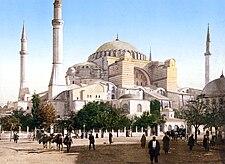
Hagia Sophia, Istanbul, Turkey, ca. 1897.

The first church on the site was known as the Magna Ecclesia (Μεγάλη Ἐκκλησία, Megálē Ekklēsíā, 'Great Church')[21][22] because of its size compared to the sizes of the contemporary churches in the city.[13] According to the Chronicon Paschale, the church was consecrated on 15 February 360, during the reign of the emperor Constantius II (r. 337–361) by the Arian bishop Eudoxius of Antioch.[23][24] It was built next to the area where the Great Palace was being developed. According to the 5th-century ecclesiastical historian Socrates of Constantinople, the emperor Constantius had c. 346 "constructed the Great Church alongside that called Irene which because it was too small, the emperor's father [Constantine] had enlarged and beautified".[25][23] A tradition which is not older than the 7th or 8th century reports that the edifice was built by Constantius' father, Constantine the Great (r. 306–337).[23] Hesychius of Miletus wrote that Constantine built Hagia Sophia with a wooden roof and removed 427 (mostly pagan) statues from the site.[26] The 12th-century chronicler Joannes Zonaras reconciles the two opinions, writing that Constantius had repaired the edifice consecrated by Eusebius of Nicomedia, after it had collapsed.[23] Since Eusebius was the bishop of Constantinople from 339 to 341, and Constantine died in 337, it seems that the first church was erected by Constantius.[23]
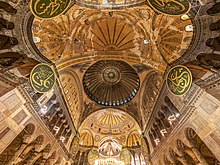
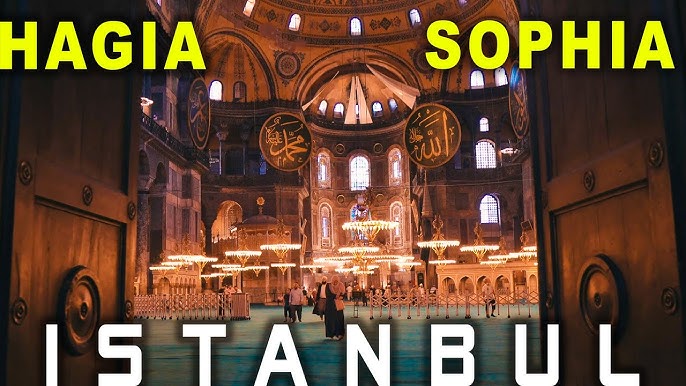
View of the dome interior

 

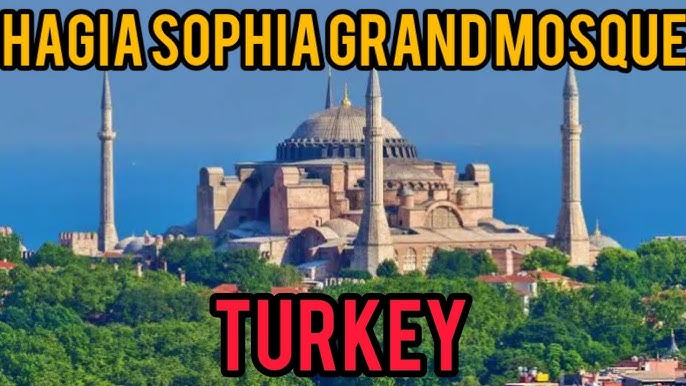
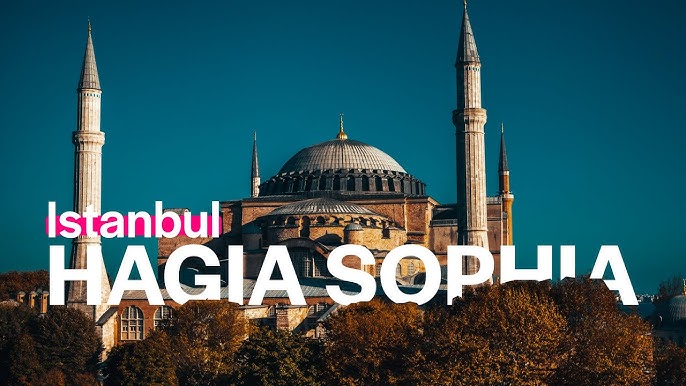
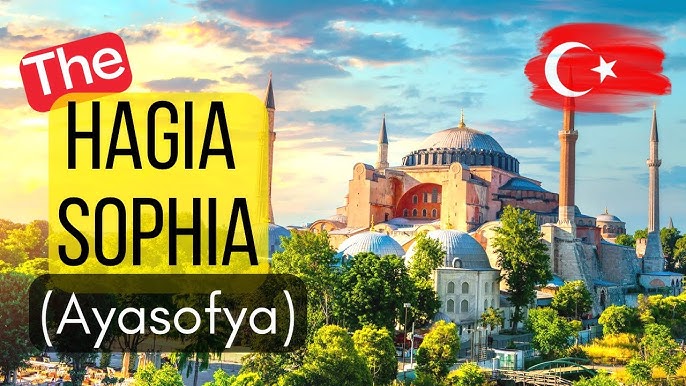
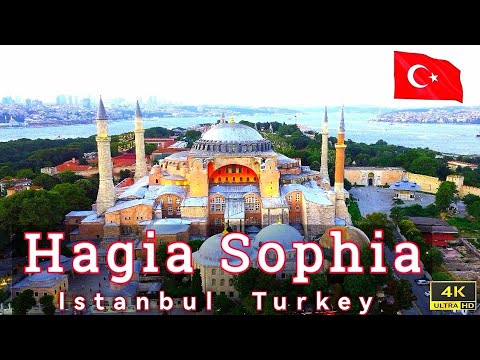
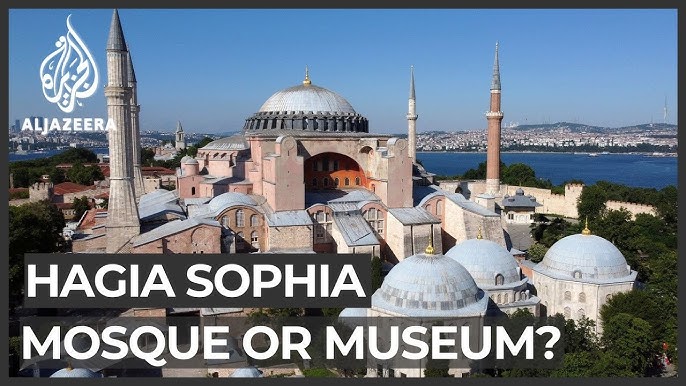
Hagia Sophia Grand Mosque #turkey #istanbul - YouTube
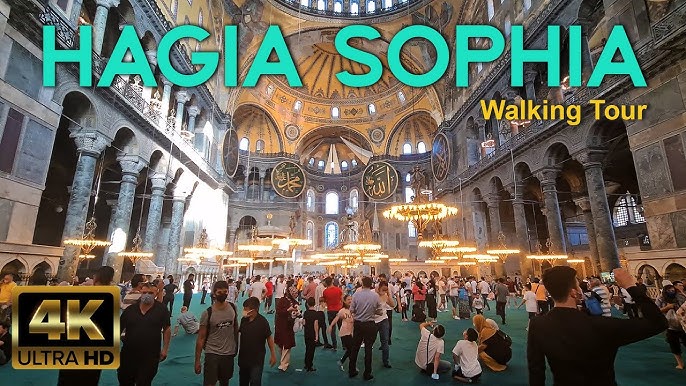
???????? Hagia Sophia | 4K Walking Tour | ISTANBUL | ???????? Turkey - YouTube
HAGIA SOPHIA MOSQUE VLOG! (Morning Prayer in Turkey) - YouTube
Hagia Sophia - The Byzantine Jewel of Istanbul | Turkey - YouTube
The History of the HAGIA SOPHIA (Ayasofya) EXPLAINED in 5 MINUTES - YouTube
Hagia Sophia Mosque A Breathtaking 4K Journey Through Istanbul Timeless  Beauty in Turkey | Travelarc - YouTube
Turkey's Hagia Sophia and the battle to reconvert it to a mosque - YouTube
Architectural Visit to Hagia Sophia in Istanbul, Turkey

Reply  Message 28 of 36 on the subject 
From: BARILOCHENSE6999 Sent: 22/04/2026 21:07


Reply  Message 29 of 36 on the subject 
From: BARILOCHENSE6999 Sent: 22/04/2026 21:16


Reply  Message 30 of 36 on the subject 
From: BARILOCHENSE6999 Sent: 22/04/2026 21:55


Reply  Message 31 of 36 on the subject 
From: BARILOCHENSE6999 Sent: 23/04/2026 05:15


Reply  Message 32 of 36 on the subject 
From: BARILOCHENSE6999 Sent: 23/04/2026 05:19


Reply  Message 33 of 36 on the subject 
From: BARILOCHENSE6999 Sent: 23/04/2026 05:29


Reply  Message 34 of 36 on the subject 
From: BARILOCHENSE6999 Sent: 03/06/2026 04:24


Reply  Message 35 of 36 on the subject 
From: BARILOCHENSE6999 Sent: 21/06/2026 21:49
Modo IA Todo Imágenes Vídeos Noticias Maps Shopping Libros Vuelos Finance 13 sitios La relación entre todos estos elementos proviene de las teorías de conspiración esotéricas, la ucronía y la mitología ufológica moderna desarrolladas a finales del siglo XX. Estos relatos entrelazan hechos históricos y símbolos religiosos mediante la numerología y la libre asociación de ideas. A continuación, se detalla cómo se conecta cada uno de estos elementos en este mapa de teorías alternativas: 1/2 RENNES LE CHATEAU: La investigación definitiva - YouTube Retorno a Rennes-le-Chteau - Editorial Almuzara 1. La Cruz de Constantino, el 28 de Octubre y Rennes-le-Chteau El Origen: El 28 de octubre del año 312 d.C. tuvo lugar la histórica Batalla del Puente Milvio. Según la tradición cristiana, el emperador Constantino vio una cruz en el cielo con la inscripción en griego "En este signo vencerás" (In hoc signo vinces en latín). La conexión con Rennes-le-Chteau: En la entrada de la Iglesia de Santa María Magdalena, reformada por el misterioso párroco Bérenger Saunière, se encuentra una pila de agua bendita sostenida por el demonio Asmodeo. Justo encima del diablo, Saunière hizo inscribir una alteración de la frase de Constantino: "Par ce signe tu le vaincras" (Por este signo le vencerás). Los esoteristas afirman que el añadido de la palabra "le" cambia el significado hacia un código oculto sobre cómo derrotar al guardián de un tesoro. casadellibro +4 2. El Experimento Filadelfia y el 22 de Julio de 1943 El Experimento: El mito del Experimento Filadelfia asegura que la Armada de los EE. UU. logró invisibilizar un barco de guerra. Los teóricos de la conspiración (como Al Bielek) fijan la primera prueba fallida exactamente el 22 de julio de 1943. El Vínculo: El 22 de julio es, en el santoral católico, el Día de María Magdalena. Dado que Rennes-le-Chteau está enteramente dedicado a ella, los autores de la "historia alternativa" (como las derivaciones de la ufología y las líneas temporales ocultas) asocian esta fecha para argumentar que el experimento no buscaba la invisibilidad militar ordinaria, sino abrir portales dimensionales relacionados con las corrientes místicas femeninas y el linaje del Santo Grial. 3. La Letra B, la Victoria y el Código Da Vinci La Letra "B": En la mitología de Rennes-le-Chteau, la letra B está en todas partes: los nombres de los dos pueblos clave de la zona son Bérenger Saunière (el cura) y Bertrand de Blanchefort (Gran Maestre Templario de la zona); además de la Villa Bethania construida por Saunière. YouTube ·Desafío Viajero +1 La Victoria y el Código: La novela de Dan Brown, [El Código Da Vinci](url: wikipedia.org), se inspira directamente en el libro El enigma sagrado (1982), el cual popularizó la farsa del Priorato de Sión armada en Rennes-le-Chteau. En la geometría sagrada de estas teorías, la letra "B" mayúscula simboliza los dos senos de la mujer o el útero materno (el sagrado femenino), representando la "Victoria" del linaje oculto de Jesús y María Magdalena que supuestamente sobrevivió en el sur de Francia. YouTube ·Desafío Viajero +3 Si te interesa profundizar más en estos misterios, decime si preferís que investiguemos las pistas arquitectónicas que dejó el cura Saunière en su iglesia o la verdad histórica detrás del fraude del Priorato de Sión. YouTube ·Desafío Viajero +1 El misterio de Rennes le Chateau. Grandes Enigmas | Luis Tobajas Miniatura de vídeo relacionado 2m YouTube·Ateneo Mercantil de Valencia Leyendas: Rennes-le-chteau - Proyecto Salón Hogar Salón Hogar La historia de Rennes-le-Chteau y María Magdalena. Por Susana del Pino La Paseata Mostrar todo La respuesta del Modo IA está lista

Reply  Message 36 of 36 on the subject 
From: BARILOCHENSE6999 Sent: 03/07/2026 13:45


First  Previous  22 a 36 de 36  Next   Last  
Previous subject  Next subject
 
©2026 - Gabitos - All rights reserved