The house is located outside Genoa's 14th-century walls. During the Renaissance, the area became subject to intense building, mainly consisting of public housing.[2]
Columbus was born in 1451, and historical documents indicated that Columbus lived here between approximately 1455 and 1470. At this time, the house had two or maybe three stories, with a shop on the ground floor, and the front door to the left of the shop.[2]
According to historian Marcello Staglieno, the original house was most likely destroyed in the French Bombardment of Genoa in 1684. It was rebuilt in the early 18th century on the basis of the original ruins.[3] The rebuilt structure had a height of five stories. However, the upper stories were built by placing their beams on the neighboring buildings. When the neighboring buildings were demolished around 1900, as part of the construction of Via XX Settembre, the upper stories of this building were removed, and it was reduced to its current height of two stories.[4]
Currently the building operates as a museum, under the management of the "Porta Soprana" Genovese cultural association. Its central location and nearby parking make it a popular meeting place for the Genovese.[2]
La casa se encuentra fuera de las murallas de Génova del siglo xiv. Durante el Renacimiento, la zona se convierte en una zona densamente construida, formada principalmente por viviendas abiertas al público.2
Colón nació en 1451 y los documentos históricos indicaban que Colón vivió, entre 1455 y 1470 aproximadamente, en la zona destruida por el bombardeo de 1864. En ese momento, la casa tenía dos o quizás tres pisos, con una tienda en la planta baja, y la puerta de entrada a la izquierda de la tienda.3
Según el historiador Marcello Staglieno, la casa original fue destruida durante el bombardeo francés de Génova en 1684. Fue reconstruida a principios del siglo xviii sobre las ruinas de la casa, que por la documentación coetánea, se consideró como la casa original y de la que quedaban sólo los cimientos.4 La estructura reconstruida tenía una altura de cinco pisos. Sin embargo, los pisos superiores se construyeron colocando sus vigas sobre los edificios vecinos. En el derribo de los edificios vecinos hacia el año 1900, en el marco de la construcción de la Vía XX Settembre, se retiraron los pisos superiores de este edificio, y se redujo a la altura actual de dos pisos.1
Actualmente el edificio funciona como museo, bajo la gestión de la asociación cultural genovesa "Porta Soprana". Su ubicación céntrica y el aparcamiento cercano le convierten en un lugar de encuentro popular entre los genoveses.2
"[T]his makes it rather clear that Janet Jackson, via exposing her right breast and her juxtaposition with Beyonce (representing the American spirit), was 'designed' to embody Lady Justice/Liberty - signifying or prompting the rebirth of the spirit of 'Columbia'. The prevalent 'blackness' additionally alludes to the pertinence of another related figure Mary Magdalene, recently made popular by the huge success of the book The Da Vinci Code, as this biblical/esoteric 'wife' of Jesus - embodying the feminine and sexuality - was sometimes portrayed as the 'Black Madonna'."
Integrarme al equipo de COSTASALVAJE en plena temporada de avistamiento de la ballena gris trabajando en un lugar como Bahía Magdalena, supera todas mis expectativas. La misión de COSTASALVAJE de conservar ecosistemas costeros y marinos y su vida silvestre a través del desarrollo comunitario (junto con otras herramientas), es el sueño de conservacionistas que, como yo, han sido inspirados por la maravillosa biodiversidad de sitios como Bahía Magdalena.
Supe que quería ser bióloga desde que era una adolescente. De niña, me gustaba mucho ver documentales de animales pero mis favoritos eran los de ballenas y delfines. En la Universidad, tuve la oportunidad de vivir en las Islas Canarias (España) trabajando con un equipo de veterinarios que atendía varamientos de cetáceos y durante la maestría trabajé en las islas del Pacífico en Baja California con lobos marinos y focas. Pero nada de eso había satisfecho mi gusto por la conservación de mamíferos marinos y mi necesidad de aportar algo a la sociedad.
Así que me emociona comenzar a trabajar con la gente de las comunidades de Bahía Magdalena. Aunque se ha avanzado en muchos aspectos, el que la Bahía no sea un Área Natural Protegida implica que los esfuerzos deben redoblarse para proteger a estos imponentes y a la vez vulnerables cetáceos. El trabajo comunitario es clave, pues son los habitantes de Puerto San Carlos, Puerto Adolfo López Mateos y las Islas los protagonistas para la conservación de los recursos naturales presentes.
Cría de ballena gris en Puerto López Mateos, B.C.S.
Es por ello que finalmente las ballenas grises están teniendo suerte. Sus anfitriones, es decir, los habitantes de los lugares a donde llega cada año a dar a luz y reproducirse, están influenciados por su compañía y eso los ha motivado a participar y unir esfuerzos para su protección. Por si esto fuera poco, su imponente presencia en estos tranquilos y prácticamente prístinos lugares, además de su carisma, inspira a muchos visitantes que han tenido la oportunidad de verlas de cerca a jugar un papel más activo en pro de la conservación de ésta y otras especies y lugares del planeta.
No te pierdas la oportunidad de ir a verlas. Te reto a tratar de imaginarte la dimensión que tienen mientras estás en la panga. Escucha un soplo y mientras te giras sobre ti mismo para ver de dónde provino, ve de reojo como otro ejemplar saca la cola. Si tienes suerte y alguna se acerca (ver “¿Cómo ser un eco-turista comprometido?”) trata de no sentir empatía y compasión por un animal que no desconfía de los humanos cuando está a merced de todas las agresiones que cometemos contra él y el océano en donde vive. No intentes resistirte. Déjate inspirar por las ballenas grises de Bahía Magdalena para hacer algo a favor de la conservación de nuestro Planeta.
-Mónica Franco
Madre y cría de ballena gris. Foto: Eric D. Zimmerman
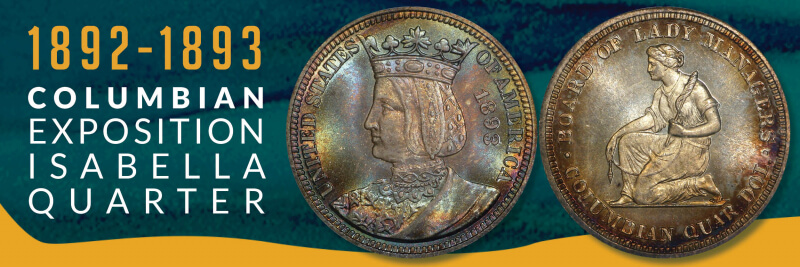
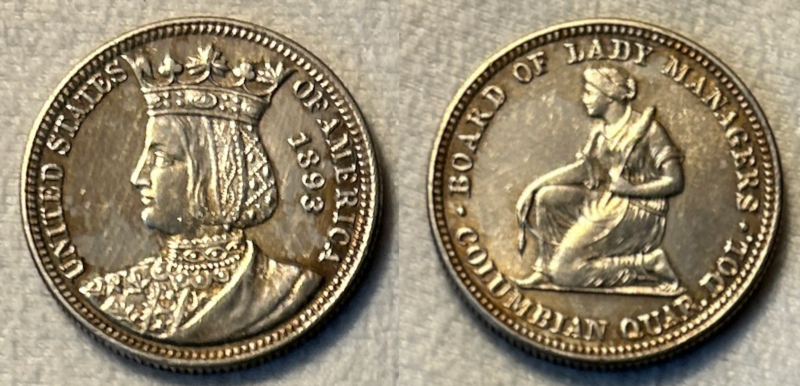
1893 Queen Isabella Commemorative Quarter. (Image via me)
A few things I’ve picked up from researching early commemorative coins:
The people behind them always hope they can raise a ton of money for a pet project or monument or expo. They rarely do.
The designs usually get denigrated by the numismatic press – oftentimes with a venom critics reserve for Limp Bizkit albums or Michael Bay movies.
The mint melts down the excess/unsold coins. As a result, the ones that did sell end up becoming valuable decades later – screwing over collectors on a budget like yours truly.
Those issues were all in play for the 1893 Isabella Quarter.
The Queen Isabella commemorative quarter traces its beginnings to the World’s Fair: Columbian Exposition, held in Chicago in 1893. Congress had already authorized the minting of a commemorative half dollar featuring Christopher Columbus, but a group of women, led by Bertha Palmer, whose husband, Potter, owned the famed Palmer House hotel in Chicago, thought they could do better.
Spearheaded by renowned women’s rights activist, and future $1 coin subject, Susan B. Anthony, the Board of Lady Managers had been awarded $10,000 in federal funds to help manage the Columbian Expo. In early 1893, the Board went before the House Appropriations Committee to ask that the $10,000 could be paid to them in the form of 40,000 specially designed commemorative quarters, which they could then sell at a profit. Congress obliged and the Board set about becoming “the authors of the first really beautiful and artistic coin that has ever been issued by the government of the United States.”
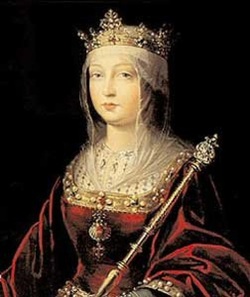
Obviously, the Board wanted a female on the obverse and decided on Queen Isabella I of Castile, who had provided vital financial support for Columbus’s voyages. Putting a foreign monarch on U.S. currency was unprecedented (indeed, there had a been a revolution over it), but according to Coin Week, the main source of conflict was over design.
Caroline Peddle, a former student of famed artist and coin designer Augustus Saint-Gaudens, was hired by the Board to design the coin. However, her sketches, which included a seated Isabella on the obverse and the inscription “Commemorative coin issued for the Board of Lady Managers of the World’s Columbian Exposition by Act of Congress, 1492–1892” on the reverse, were deemed to look too token-like and rejected. Rather than be allowed to redesign the coin, the Mint took away the reverse side and gave it to one of their in-house artists, Charles Barber, to design.
After some more back-and-forth and additional restrictions imposed by the Mint, Peddle resigned. The Mint then cobbled together some portraits of Isabella and ultimately produced an image of a young Isabella wearing a crown on her head for the obverse. On the reverse, the Mint went with an image of a woman kneeling while holding a distaff and spindle- symbolizing her industry. The Board had suggested an image of the Woman’s Building at the Expo, and Palmer later stated that the Board disliked the Mint’s reverse image because “we did not consider [it] typical of the woman of the present day.” However, the Mint made the final decision and approved the coin design.
To say that the reception for the commemorative quarter was not warm is a bit like saying that the American public didn’t embrace Apple’s Newton. The American Journal of Numsimatics was particularly brutal:
[W]e do not know who designed it, but in this instance, as in the half dollar, the contrast between examples of the numismatic art of the nation, as displayed on the Columbian coins, on the one hand, and the spirited and admirable work of the architects of the buildings, for instance, on the other, is painful. If these coins really represent the highest achievements of our medalist and our mints, under the inspiration of an opportunity without restrictions, the like of which has never been presented hitherto in the history of our national coinage, we might as well despair of its future…
The American Journal of Numismatics in October 1893, quoted by PCGS.
The Journal also drew a “mournful” comparison between the reverse design of the kneeling woman holding the distaff and spindle and the well-known “Am I Not a Woman and a Sister?” anti-slavery Hard Times Token. Surely, the Board felt vindicated by that line – although there’s no evidence Palmer or anyone else affiliated with them ever wrote to the Mint to say: “See? I told you we should gone with the building on the reverse.”
1838 HT-81 “Am I Not A Woman & A Sister?” (Image via me)
Sales figures, meanwhile, were disappointing. Of the 40,000 coins minted, a little more than half (21,180) ended up selling. According to NGC, the quarter’s sales were cannibalized by the Columbian Expo half dollar, which sold for the same price and was more widely available at the fair (5 million Columbian Expo half dollars were minted – 125 times as many compared to the Isabella quarter). While it didn’t come close to selling out, Coin Week points out that the quarters, which sold for $1 each, ended up being profitable for the Board. A $20,000-plus stream of revenue may not have been much, but it was double the original federal appropriation awarded to the Board. Of the remaining 19,000-plus quarters, approximately 15,000 went back to the Mint for melting.
1893 Columbian Expo Half Dollar. (Image via me)
In recent years, the coin’s reputation has been rehabilitated and has become a highly sought-after collector’s item. Contemporary reviewers have praised its quaint design and its uniqueness among U.S. commemorative coins (until the modern commemoratives came around, it held the distinction as the only commemorative quarter in U.S. history – as well as the only one to depict a foreign monarch). Even the reverse of the coin has been somewhat vindicated. Art historian Cornelius Vermeule argued that the design wasn’t necessarily evocative of the anti-slavery token and even traced elements of it back to antiquities. “[S]ome details of drapery to a servant girl from the East Pediment of the Temple of Zeus at Olympia, work of about 460 B.C. with additions and revisions in the first or second centuries A.D.,” he wrote.
I love the design and how it distinguishes this coin from other early commemoratives. Too many coins from that era have a generic male bust on the obverse and either an eagle or state symbol on the reverse. Because of the relative scarcity of this coin, buying one wasn’t cheap (this one had been cleaned, which lowered its value, but it still ended up costing over $100). The price tag was worth it, as this has become one of my favorite coins.
So I guess the lesson here is that I should buy more modern commemoratives – even those that I think are ugly. After all, maybe they’ll skyrocket in value in 100 years…
In 1485, Columbus presented his plans of crossing the Atlantic to John II, King of Portugal. He proposed that the king equip three sturdy ships and grant Columbus one year's time to sail out into the Atlantic, search for a western route to the Orient, and return.
Columbus also requested he be made "Great Admiral of the Ocean", appointed governor of any and all lands he discovered, and given one-tenth of all revenue from those lands.
The king submitted Columbus' proposal to his experts, who rejected it. It was their considered opinion that Columbus' estimation of a travel distance of 2,400 miles (3,860 km) was, in fact, far too low.
In 1488, Columbus appealed to the court of Portugal once again, and once again, John II invited him to an audience. That meeting also proved unsuccessful, in part because not long afterwards Bartolomeu Dias returned to Portugal with news of his successful rounding of the southern tip of Africa (near the Cape of Good Hope). With an eastern sea route to Asia apparently at hand, King John was no longer interested in Columbus's far-fetched project.
Columbus traveled from Portugal to both Genoa and Venice, but he received encouragement from neither. Columbus had also dispatched his brother Bartholomew to the court of Henry VII of England, to inquire whether the English crown might sponsor his expedition, but also without success.
Columbus had sought an audience from the monarchs Ferdinand II of Aragon and Isabella I of Castile, who had united many kingdoms in the Iberian Peninsula by marrying, and were ruling together. On 1 May 1486, permission having been granted, Columbus presented his plans to Queen Isabella, who, in turn, referred it to a committee. After the passing of much time, the savants of Spain, like their counterparts in Portugal, replied that Columbus had grossly underestimated the distance to Asia. They pronounced the idea impractical and advised their Royal Highnesses to pass on the proposed venture.
However, to keep Columbus from taking his ideas elsewhere, and perhaps to keep their options open, the Catholic Monarchs gave him an annual allowance of 12,000 maravedis and, in 1489, furnished him with a letter ordering all cities and towns under their domain to provide him food and lodging at no cost.
After continually lobbying at the Spanish court and two years of negotiations, he finally had success in January 1492. Ferdinand and Isabella had just conquered Granada, the last Muslim stronghold on the Iberian Peninsula, and they received Columbus in Córdoba, in the Alcázar castle. Isabella turned Columbus down on the advice of her confessor, and he was leaving town by mule in despair, when Ferdinand intervened. Isabella then sent a royal guard to fetch him, and Ferdinand later claimed credit for being "the principal cause why those islands were discovered".
About half of the financing was to come from private Italian investors, whom Columbus had already lined up.
La primera expedición en llegar al polo sur geográfico fue liderada por el explorador noruego Roald Amundsen. Él, junto a otros cuatro noruegos que integraron la expedición (Olav Bjaaland, Helmer Hanssen, Sverre Hassel y Oscar Wisting), llegaron al polo sur el 14 de diciembre de 1911 y plantaron la bandera noruega. Amundsen denominó Haakon VII's Vidde al total de la meseta polar que rodea el polo sur y la reclamó para el rey Haakon VII de Noruega. Sin embargo, el Gobierno noruego no aceptó la reclamación del polo sur debido a que contradecía sus posiciones en la disputa con la Unión Soviética en el ártico, al haber rechazado la teoría de los sectores polares.
El empresario ballenero Lars Christensen financió 9 expediciones a la Antártida realizadas con los barcos Odd, Norvegia y Torshavn con el objetivo de explorar en busca de cetáceos. El Odd al mando de Anton S. Anderssen y de Eyvind Tofte expedicionó en 1927 a las Shetland del Sur y al mar de Bellingshausen. El Norvegia realizó 4 expediciones: en 1927-1928 al mando de Harald Horntvedt a las islas Georgias del Sur y Bouvet; en 1928-1929 al mando de Nils Larsen a las islas Bouvet, Shetland del Sur y Pedro I; en 1929-1930 al mando de Hjalmar Riiser-Larsen y de Nils Larsen a la isla Bouvet y la Tierra de Enderby en donde el 22 de diciembre de 1929 plantaron la bandera noruega, y luego descubrieron y mapearon la costa del Príncipe Olaf y la costa de la Princesa Marta; y en 1930-1931 al mando de Gunnar Isachsen y de Hjalmar Riiser-Larsen a la costa de la Princesa Ragnhild.[4] El Torshavn realizó 4 expediciones entre 1931-1937. En esas expediciones el 1 de diciembre de 1927 Noruega reclamó la subantártica isla Bouvet y el 2 de febrero de 1929 la isla Pedro I. El área costera desde los 37° Este hasta los 49°30′ de longitud Este descubierta en 1930 por Hjalmar Riiser-Larsen como parte de los esfuerzos por cartografiar la Antártida fue denominada Dronning Maud Land en homenaje a la reina Maud (1869–1938), esposa del rey Haakon VII de Noruega.
Hjalmar Riiser-Larsen, Finn Lützow-Holm y Viggo Widerøe realizaron fotografías aéreas y mapearon la Tierra de la Reina Maud entre 1929 y 1937. Estas expediciones exploraron completamente la costa de la Tierra de la Reina Maud entre los 16°30′ O y los 45° E, incluyendo gran parte del interior. Durante la expedición de 1936-1937 Viggo Widerøe voló sobre la zona costera llamada costa del Príncipe Harald.
Reclamación de Noruega
El 15 de abril de 1929 el Gobierno noruego expresó mediante una nota a los Estados Unidos que sobre la base de los descubrimientos realizados por Amundsen en el polo sur, tenía:[5]
base válida para una reivindicación de prioridad para adquirir esos territorios siempre que las exigencias del derecho internacional en cuanto a la ocupación efectiva de un nuevo territorio se hayan cumplido.
Luego de conversaciones en 1934 Noruega obtuvo tácitamente el consentimiento británico a reclamar los territorios entre las Dependencias de las Islas Malvinas y el Territorio Antártico Australiano, pero no lo hizo efectivo hasta que en diciembre de 1938 el Gobierno noruego tomó conocimiento de la partida en secreto de la Expedición Antártica Alemana dirigida por Alfred Ritscher hacia la Tierra de la Reina Maud con propósitos de anexión del área. Esta situación hizo que Noruega hiciera efectiva su declaración de soberanía sobre la Tierra de la Reina Maud mediante un decreto real del 14 de enero de 1939 (aprobado unánimemente por el parlamento el 3 de marzo de 1939):[6]
Kongen samtykkjer og skriv under eit framlagt utkast til kongeleg kunngjering om at den parten av fastlandsstranda i Antarktis som tøyer seg ifrå grensa for Falkland Islands Dependencies i vest (grensa for Coats Land) til grensa for Australian Antarctic Dependency i aust (45° austleg lengd) med det landet som ligg innafor denne stranda og det havet som ligg innåt, blir dregen inn under norsk statsvelde Traducción: El Rey aprueba y firma un borrador del Real Orden que proclama que la parte de la costa continental de la Antártida que se extiende desde los límites de las Dependencias de las islas Malvinas en el oeste (el límite de la Tierra de Coats) a los límites del Territorio Antártico Australiano en el este (45° de longitud este), con la tierra situada en la costa y el mar circundante, se pondrá bajo la soberanía de Noruega.
Los derechos aducidos por Noruega para reclamar el área estaban justificados por la exploración geográfica llevada a cabo por ciudadanos noruegos en ella, así como por el interés noruego sobre la pesca de cetáceos en vista de prevenir que otras naciones pudieran tomar allí medidas para impedirla. El Gobierno noruego tuvo cuidado de dejar en claro que su reclamación no constituía un sector polar, ya que desde principios del siglo XX el rechazo de la teoría de los sectores polares era una de sus principales políticas exteriores, por lo que el decreto real no definió el límite sur de la reclamación ni la extensión del área marítima. El decreto dio al ministro de Justicia autoridad para establecer regulaciones en el área.
Noruega comunicó el decreto real a países con los que tenía relaciones diplomáticas, de los cuales recibió objeciones de Estados Unidos, Chile, la Unión Soviética y Alemania. El Reino Unido respondió el 1 de septiembre de 1939 aceptando la reclamación y sugiriendo que el límite oeste fuera fijado en los 20° Oeste, ya que la definición en el límite de la Tierra de Coats era vaga, lo cual fue aceptado por Noruega.[7] En una nota del ministro de Asuntos Exteriores de Alemania, Joachim von Ribbentrop, de 23 de enero de 1939, el Gobierno alemán disputó el reclamo noruego. Ritscher llegó a la costa de la Princesa Martha el 19 de enero de 1939 y los expedicionarios alemanes fotografiaron un área de aproximadamente 350 000 km² que fue denominada Neuschwabenland (Nueva Suabia), hasta su partida de regreso el 6 de febrero de 1939. Fuentes noruegas afirman que Alemania habría anunciado la formación de un Sector Antártico Alemán en agosto de 1939, entre los 4°59′ E y los 16°30′ E y hasta los 75° S.[8]
En respuesta a la proclamación, el 27 de enero de 1939 el Comisariado Popular de Asuntos Exteriores de la Unión Soviética rechazó categóricamente todos los actos unilaterales en relación con la soberanía sobre los territorios antárticos y subrayó sus derechos históricos al descubrimiento de la Antártida en virtud de las expediciones de Bellingshausen y Lázarev.[9] La reclamación noruega solo fue reconocida explícitamente por cuatro países: Francia, Australia, Nueva Zelanda y el Reino Unido, todos los cuales reconocen mutuamente sus reclamaciones antárticas.[10][11]
Desde la entrada en vigor el 23 de junio de 1961 del Tratado Antártico -del que Noruega es miembro signatario original- ninguna reclamación territorial preexistente puede ampliarse, por lo que el área de la reclamación permanece indefinida. Sin embargo, el Gobierno noruego sostiene que el propósito de su reclamación fue el de establecer la posesión de la tierra que hasta entonces había estado sin gobierno y que nadie más que los noruegos habían estudiado y mapeado, por lo que las autoridades noruegas no se oponen a la interpretación de que el reclamo noruego se extiende hasta el polo sur.[12][13]
El 21 de junio de 1957 el parlamento noruego definió el estatus de la Tierra de la Reina Maud como dependencia, enmendando la ley del 27 de febrero de 1930 que dio ese estatus a las islas Bouvet y Pedro I. Un área con el estado de dependencia es parte del territorio noruego, pero no forma parte del Reino de Noruega.
Entre 1949 y 1952 se llevó a cabo la primera expedición internacional noruego-sueco-británica, comúnmente llamada expedición Maudheim, liderada por el noruego John Giæver. La expedición realizó una serie de investigaciones científicas basadas en la estación de investigación Maudheim, construida en febrero de 1949 en la barrera de hielo Jelbart en la costa de la Princesa Marta. El 15 de enero de 1952 la base Maudheim fue abandonada.[15]
Extendiendo los sectores limitados por meridianos hasta el Polo Sur, según el Comité Consultivo sobre Nomenclatura Antártica de Estados Unidos la Tierra de la Reina Maud comprende las áreas expresadas en la siguiente tabla (de oeste a este):
Los límites intermedios pasaron a ser de oeste a este: Lengua de hielo Troll/Trolltunga, cabo Sedov/Sedovodden, fondo de la bahía Vestvika, y glaciar Shirase/Shirasebreen.
En 1948 Noruega y el Reino Unido acordaron que el nombre Tierra de la Reina Maud se redujera al sector noruego y no se extendiera al Territorio Antártico Británico, mientras que el nombre británico Tierra de Coats fue omitido en el sector noruego y reducida hasta el límite entre ambas reclamaciones. La costa Bruce, que era la parte de la Tierra de Coats que se hallaba al oriente de los 20° Este, desapareció de la cartografía británica.[17]


 الفقرة السابقة






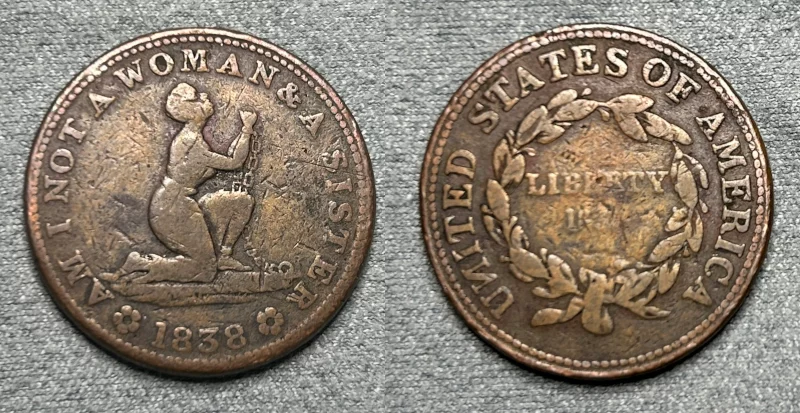 1838 HT-81 “Am I Not A Woman & A Sister?” (Image via me)
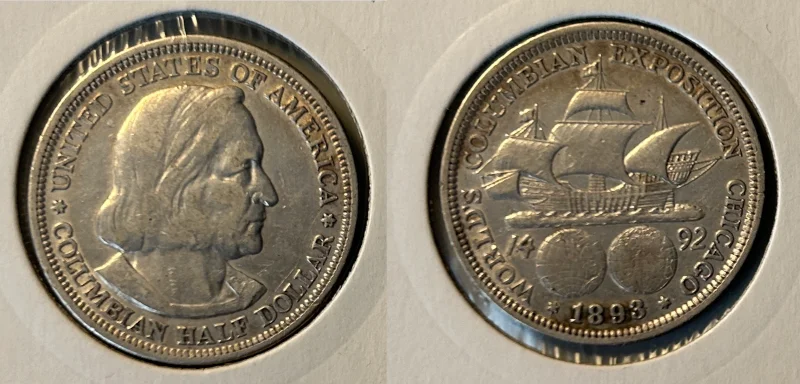 1893 Columbian Expo Half Dollar. (Image via me)