Página principal  |  Contacto  

Correo electrónico:

Contraseña:

Registrarse ahora!

¿Has olvidado tu contraseña?

DESENMASCARANDO LAS FALSAS DOCTRINAS
 
Novedades
  Únete ahora
  Panel de mensajes 
  Galería de imágenes 
 Archivos y documentos 
 Encuestas y Test 
  Lista de Participantes
 YHWH (DIOS PADRE) EL UNICO DIOS 
 JESUCRISTO NUESTRO MESIAS JUDIO 
 LOS DIEZ MANDAMIENTOS DE LA BIBLIA 
 MEJORE SU CARACTER Y SU VIDA 
 YOU TUBE-MAOR BA OLAM-LINKS 
 YOU TUBE-MAOR BA OLAM-LINKS II 
 BIBLIAS/CONCORDANCIA/LIBROS 
 MAYOR ENEMIGO DEL HOMBRE ES UNO MISMO 
 ¿LA TORA ES MACHISTA? -MENSAJE ESOTERICO Y EXOTERICO 
 ¿ES INMORTAL EL ALMA?- FALACIA DE LA ENCARNACION Y REENCARNACION 
 EL ISLAM TIENE ORIGEN UNITARIO ADOPCIONISTA 
 ANTIGUO TESTAMENTO-ESTUDIO POR VERSICULOS 
 NUEVO TESTAMENTO-ESTUDIOS POR VERSICULOS 
 NUEVO TESTAMENTO II-ESTUDIOS POR VERSICULOS 
 NUEVO TESTAMENTO III-ESTUDIOS POR VERSICULOS 
 CRISTO NO TUVO PREEXISTENCIA 
 ¿QUE ES EL ESPIRITU SANTO? 
 
 
  Herramientas
 
FRANCOMASONERIA-TEMPLARIOS-CONSPIRACION-: FREEMASONRY AND BUENOS AIRES’ MOST IMPORTANT BUILDINGS
Elegir otro panel de mensajes
Tema anterior  Tema siguiente
Respuesta  Mensaje 1 de 47 en el tema 
De: BARILOCHENSE6999  (Mensaje original) Enviado: 30/08/2021 02:31

FREEMASONRY AND BUENOS AIRES’ MOST IMPORTANT BUILDINGS

Buenos Aires is known for its varied and often schizophrenic architecture; high-rise apartment block sit alongside ancient casa chorizos or tower above PHs, ornate French baroque palaces lounge against charmless 1980’s office buildings, all on the one cuadra. But in the historical centre of the city, numerous buildings have more than a few unifying characteristics; the symbolic flourishes of Freemasonry.

Freemasonry has a long history in Argentina: many important figures throughout the ages including Sarmiento, Belgrano and San Martin were Masons, as were a total of 14 Argentine presidents. Although mired in mythology because of its clandestine nature, being a Mason is really nothing more than being part of an adult fraternity. The fundamental Masonic principles are even “Liberty, Equality, Fraternity”, like the motto of the French Revolution. And this in itself is interesting, because one of the reasons that Masons became so prominent in Argentina was precisely because of the European Masons that emigrated to the Southern Cone, predominantly the Italians. They were known to be more liberal than most Masonic societies by allowing men of any faith and social class to become a member, something that allowed for the expansion of the order in Argentina.

Symbols are a pillar of Masonic culture, representing various ideals, creeds and ethics that the Masons use in both their teachings and apply to their daily lives. The most well known symbol is the Masonic emblem of the square and compass, representing morality and boundaries respectively. These are the tools of the stonemason, and are often seen with a capital G in the middle, meaning geometry, or God, who is the “Great Architect of the Universe”. So naturally, the built environment is a perfect vehicle through which to physically express the values and virtues of Freemasonry in the most enduring way possible.

Palacio Barolo

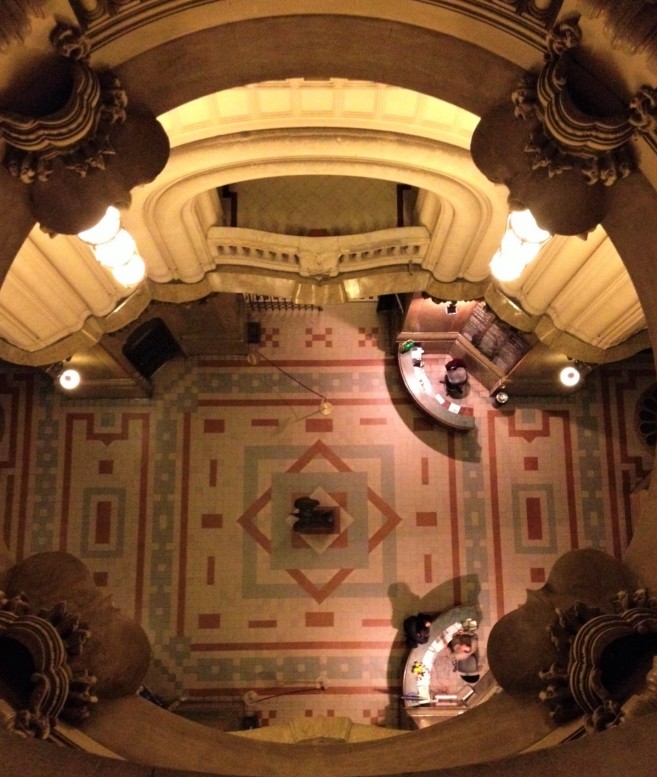
Palacio Barolo is perhaps the most overtly Masonic building that does not serve the order in all of Buenos Aires. Its developer, textile tycoon Luis Barolo and architect Mario Palanti were both Italian Masons, and Dante Allighieri, the literary inspiration for the building, was a member of Fede Santa, an order which went on to become Masonic. The office building’s design is based on Dante’s “Divine Comedy” and was inaugurated in 1923. It was one of the first skyscrapers in South America and was constructed over the course of four years, with every single element fabricated in Italy and shipped to Argentina for assembly. Divided into three sections that correspond to the poem’s structure over its 22 floors, the two basement levels and ground floor represent Hell, floors 1 – 14 equate to Purgatory and floors 15 – 22 correlate to Paradise. The ornate ground floor is inset with 9 glass circles and there are 9 arches which serve as entrances to Hell. The number 9 not only relates to Dante’s poem, but also to Freemasonry, being the result of 3 times 3, a number sacred to the Masons.
IMG_5402
Palacio Barolo. Photo by Sorcha O’Higgins

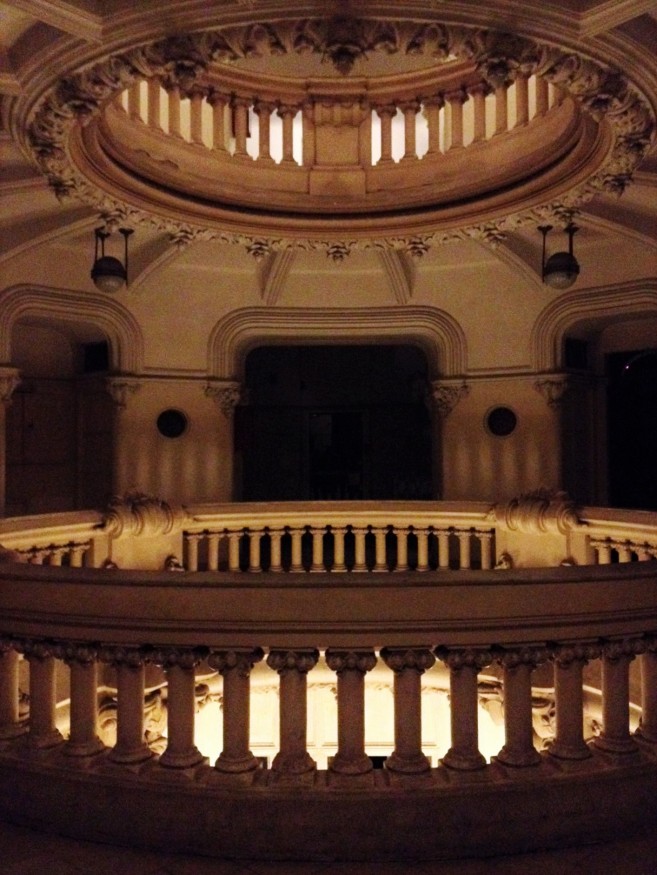
There are many aspects of the building’s decoration and organization that relate to Freemasonry, with most being centred around the elevator as it represents ascension, in both physical and figurative senses, a fundamental Masonic theme signifying enlightenment. The most obvious Freemason symbol is the compass within the A of “Ascensor”. Another is that the arrow indicating the floors ends in a Fleur de Lis, an emblem synonymous with secrecy, and used by Masons to show the path that should be followed, in this case rising through the floors of purgatory to get to heaven. The floor of the lift lobby is also laid with black and white checkerboard tiles, a typical Masonic reference meaning the duality of god and evil. There are 7 lifts that serve the 22 floors, and the division of the latter by the former gives Pi, which is used to calculate the area and circumference of a circle. In Freemasonry, the circle represents perfect order, and many elements in Palacio Barolo are circular, such as the elevator cars, balconies, windows, arches over doors and of course, the internal dome on the 3rd floor. Directly under the dome on the ground floor, a series of squares are inset into each other, again reinforcing the themes of ascension and enlightenment.

The crowning moment of the Barolo is the lighthouse at the top of the central tower. It serves not only to represent the arrival to God as The Divine Comedy, but also signifies the Masonic traits of illumination and enlightenment. A Fleur de Lis also graces the very top of the lighthouse, which aligns with the Southern Cross constellation every year at the start of June. Legend has it that this alignment creates a direct passage to heaven.
IMG_5397
Palacio Barolo. Photo by Sorcha O’Higgins

Teatro Colon

European architects designed the Teatro Colon like Palacio Barolo at a time when the general thinking in South America was that Europe was on the brink of collapse after World War I. In response, Buenos Aires, the self-styled “Paris of the South”, was intent on architecturally emulating its mother continent, resulting in numerous buildings that were a melange of styles aesthetically. Both Teatro Colon and Palacio Barolo evade stylistic definition because of this.

The current Teatro Colon, in between Av. 9 de Julio and Libertad, took 20 years and three architects to complete, with construction beginning in 1888 and finishing in 1908. However, its first incarnation was actually in front of the Plaza de Mayo, where the Argentine National Bank now sits. Perhaps not incidentally, the original Teatro Colon also housed the first Masonic Grand Lodge on its first floor.

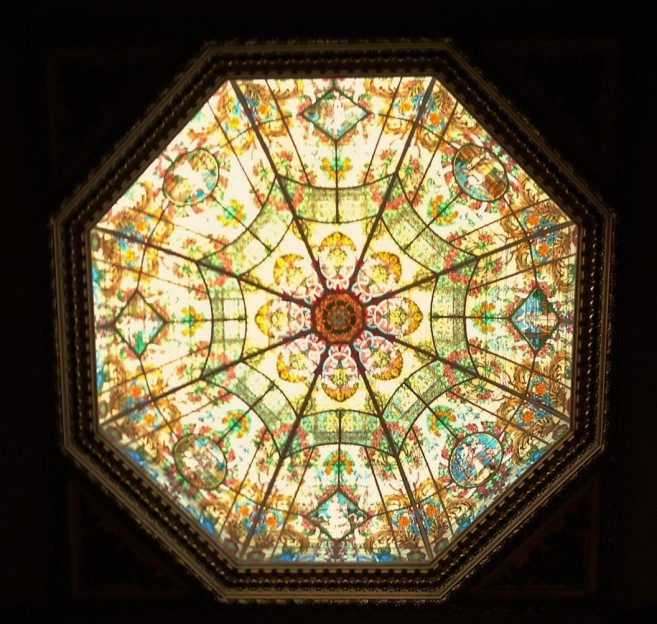
The original architect of the modern Colon was the Italian Francesco Tamburini, who also designed the lodge at Cangallo 1242 in Buenos Aires province. After his death he was succeeded by Victor Meano, a Mason who took Tamburini’s designs and embellished them to make the theatre more dramatic. This is most evident the entrance foyer, where the transition between the entrance and first floors is elevated to the realm of the divine. The stairs acts as a bridge between the mortal sphere below and the metaphysical dimension of music and entertainment above. Materially opulent, the floor is tiles with Venetian tessellations, while the stairs themselves are formed from Carrara marble. Yellow marble from Sienna and pink marble from Portugal are woven together in the balustrades. Structurally and decoratively, the ground floor is solid and terrestrial, with thick columns anchoring the building to the ground. But up above, on the first floor, home to the Gallery of Busts, the Golden Hall and the VIP entrances to the main auditorium, delicate fluted columns and gold leafed ceilings herald the crossover into the spiritual domain. Directly above the stairs is an ornate stained glass dome inset with the exquisite figures of eight of the nine Greek muses, the goddesses of the arts. The ninth is said to be metaphorically represented in the dome of the main auditorium. While not overtly Masonic in its symbolism, it could be assumed that it is a reference, because the number 9 in Freemasonry was consecrated to the Spheres and the Muses, and it would also follow that having this positioned directly above a passage of ascension would align with Masonic thinking on the themes of enlightenment.
FullSizeRender
Teatro Colón. Photo by Sorcha O’Higgins

Palacio del Congreso

The National Congress building was designed by Victor Meano, second architect of the Teatro Colon. It was built between 1898 and 1906 in the Neo-classical style common among congress buildings, and in fact was modelled after Capitol Hill in Washington DC. However, the decorations on its facade and many of its aesthetic details were not completed until 1946. The congress building commands western end of the Congressional Plaza, which was inaugurated in 1910. The plaza itself contains a bronze statue of Rodin’s famous sculpture “The Thinker”, which was one of three sculptures cast in the original mould and signed by the artist. This is notable as Rodin was a Mason and “The Thinker” employs many Masonic elements – it is designed according to the Golden Ratio but the Thinker himself sits on a slab of rough stone, or rough ashlar, representing man’s need for self-improvement which can be gained by adhering to Masonic principles.

Palacio del Congreso also sits at one point of a Masonic triangulation that exists in the city of Buenos Aires, which is a projection of the positioning of the Masons in the temple: the Casa Rosada (near original Teatro Colon) represents the seat of the master, Congreso represents the seat of the first guard and Tribunales (near new Teatro Colon) represents the seat of the second guard. These axes are present in Washington, Paris and in other Masonic cities throughout the world.

There are many other Masonic influences visible in Argentina, from the Obelisco and the Pyramide de Mayo to the entire city of La Plata, which is laid out on a diagonal grid. To find out more about this fascinating society and its legacy in Buenos Aires, take a tour with Tamara, an expert in Masonic symbolism.

Screen Shot 2016-05-21 at 2.28.36 PM
Masonic triangulation. Photo by Sorcha O’Higgins
https://therealargentina.com/en/freemasonry-and-buenos-aires-most-important-buildings/


Primer  Anterior  33 a 47 de 47  Siguiente   Último  
Respuesta  Mensaje 33 de 47 en el tema 
De: BARILOCHENSE6999 Enviado: 10/04/2025 16:08

La historia de la iglesia de San Nicolás de Bari, un ícono cultural que fue demolido hace 90 años para cederle el lugar al Obelisco

La antigua Iglesia de San Nicolás de Bari antes de ser demolida (Foto: Fundación Antorchas)

El tradicional Obelisco de la Ciudad de Buenos Aires, el mayor ícono porteño, tiene una inscripción en su frente que dice: “En este sitio en la Torre de San Nicolás fue izada por primera vez en la Ciudad la Bandera Nacional el 23 de agosto de 1812”.


El lugar es uno de los más visitados y transitados del país. Pero pocos saben de qué torre se trata. La respuesta trae un dejo de tristeza por la destrucción de un tesoro histórico único: la Iglesia de San Nicolás de Bari, que funcionó en la intersección de las actuales avenidas 9 de Julio y Corrientes hasta que fue demolida a fines de 1931 para dar paso a la traza popularmente conocida como Diagonal Norte.

Leé también: El Obelisco cumplió 85 años: el monumento porteño nació resistido, pero se convirtió en un ícono

Allí se levantaría, cinco años después, el Obelisco.

Estos días se cumplen precisamente 90 años de la caída final de la Torre de San Nicolás, parte de esta imponente iglesia colonial e histórica donde se escondieron municiones durante las invasiones inglesas y donde tomaron sus sacramentos personajes históricos como Mariano Moreno y Bartolomé Mitre.

La Torre de San Nicolás, el último vestigio de la Iglesia colonial que quedó en pie hasta su demolición a fines de 1931 (Foto: Arcón de Buenos Aires)

“Es la única iglesia colonial que fue demolida” en la Ciudad. Esto “significó un corte con nuestra historia y nuestra herencia española”, dijo a TN el historiador Patricio Lons.

Pero parte de su legado continúa vigente: el barrio, que en la época de la colonia era una zona marginal de la entonces pequeña aldea, aún conserva el nombre de San Nicolás por su imponente iglesia.

Leé también: Una enigmática intervención en las pantallas del Obelisco cambió las noches del centro porteño y dejó un mensaje sobre el arte en la pandemia

La historia de la Iglesia de San Nicolás de Bari que fue demolida hace 90 años y fue reemplazada por el Obelisco

La vieja iglesia fue construida en 1733 en honor a San Nicolás de Bari en la calle del Sol, la actual Corrientes, y su intersección con Carlos Pellegrini, que por entonces ni siquiera tenía nombre. Fue levantada con cal y ladrillos. Junto a la basílica funcionó en aquellos años un refugio para pobres. Treinta y cuatro años después fue reconstruida. También allí se levantó el primer convento de las monjas Capuchinas.

La zona era conocida como San Nicolás por la propia Iglesia, aunque popularmente la gente la llamaba también “El hueco de Zamudio”, por el apellido de los dueños de una quinta vecina, según el sitio El Arcón de Buenos Aires. Era un área pantanosa habitada por personas que sobrevivían con la matanza de ganado vacuno.

Durante las invasiones inglesas, la Iglesia funcionó como depósito de armas y municiones ya que se consideraba un lugar seguro y alejado de la ciudad y en especial del ejército enemigo. Poco después, el 23 de agosto de 1812, en su Torre fue izada por primera vez la bandera nacional en la Ciudad de Buenos Aires, un hecho histórico que se recuerda hoy en la fachada del Obelisco.

La histórica Iglesia sirvió de depósito de municiones y armas durante las invasiones inglesas

En la Iglesia además fue bautizado en 1913 Héctor Valdivieso, el primer santo argentino.

Cómo fue la demolición de la Iglesia de San Nicolás de Bari que dio paso al Obelisco porteño

La Iglesia funcionó hasta 1931 cuando se decidió su demolición para ensanchar y extender la traza de la avenida Roque Sáenz Peña o Diagonal Norte. La justicia falló entonces a favor de la municipalidad ante el fuerte rechazo de la Iglesia Católica.

El 20 de agosto de ese año comenzaron los trabajos de demolición. Para fines de ese mes ya se divisaba la futura traza de la avenida y dos meses después la Iglesia ya había perdido la mitad de su enorme estructura. En noviembre solo quedaba en pie el frente principal y la histórica Torre, que fue demolida a fines de diciembre.

Leé también: El “hombre drone”: así se ve el Obelisco “sin punta” desde el aire

El frente de la "nueva" iglesia de San Nicolás de Bari sobre la calle Santa Fe

Cuatro años después, el 29 de noviembre de 1935, fue inaugurada la nueva Iglesia de San Nicolás de Bari, ubicada en la Avenida Santa Fe 1352.

Para el historiador Patricio Lons, “la Iglesia era una belleza. La argumentación para demolerla siempre fue la modernización, pero Uruguay se modernizó y el Fuerte (la Fortaleza General Artigas construida en la cima del cerro de Montevideo) quedó. Todo lo que se pudo salvar se salvó. Y acá reducimos a la mitad el Cabildo”, indicó.

https://tn.com.ar/sociedad/2021/12/27/la-historia-de-la-iglesia-de-san-nicolas-de-bari-un-icono-cultural-que-fue-demolido-hace-90-anos-para-cederle-el-lugar-al-obelisco/

Respuesta  Mensaje 34 de 47 en el tema 
De: BARILOCHENSE6999 Enviado: 17/04/2025 04:33
MAPA: ¿Cuáles son los cortes de tránsito por los festejos del 25 de Mayo?

Respuesta  Mensaje 35 de 47 en el tema 
De: BARILOCHENSE6999 Enviado: 17/04/2025 04:52

Diagonal Norte

Con el objetivo de priorizar el transporte público, obtener mayor seguridad vial y mejorar la calidad ambiental de la zona, implementamos vías preferenciales en la avenida Diagonal Norte

Compartir en redes


Vías preferenciales para transporte público en Diagonal Norte

Implementamos vías preferenciales para transporte público entre San Martín y Suipacha. Están vigentes los días hábiles entre las 8 y las 20 horas y son de uso exclusivo de los vehículos afectados al servicio de transporte público de pasajeros (colectivos y taxis).

Cabe aclarar que durante los días y horarios en que operan los contracarriles está prohibido el ingreso, circulación y detención de autos particulares; el estacionamiento sobre la acera derecha de cualquier tipo de vehículos. Exceptuando lo antes mencionado, sí podrán ingresar los vehículos particulares que transporten personas discapacitadas que requieran detenerse en la acera derecha, los automotores que deban ingresar a garajes o playas de estacionamiento o dársenas de hoteles. También podrán circular ambulancias, patrulleros y autobombas.

https://buenosaires.gob.ar/movilidad/viaspreferenciales/diagonal-norte

Respuesta  Mensaje 36 de 47 en el tema 
De: BARILOCHENSE6999 Enviado: 28/07/2025 22:27


Respuesta  Mensaje 37 de 47 en el tema 
De: BARILOCHENSE6999 Enviado: 23/08/2025 20:41


Respuesta  Mensaje 38 de 47 en el tema 
De: BARILOCHENSE6999 Enviado: 23/08/2025 20:53


Respuesta  Mensaje 39 de 47 en el tema 
De: BARILOCHENSE6999 Enviado: 25/08/2025 18:22


Respuesta  Mensaje 40 de 47 en el tema 
De: BARILOCHENSE6999 Enviado: 31/08/2025 22:19


Respuesta  Mensaje 41 de 47 en el tema 
De: BARILOCHENSE6999 Enviado: 01/09/2025 15:51


Respuesta  Mensaje 42 de 47 en el tema 
De: BARILOCHENSE6999 Enviado: 01/09/2025 16:05


Respuesta  Mensaje 43 de 47 en el tema 
De: BARILOCHENSE6999 Enviado: 01/09/2025 16:31


Respuesta  Mensaje 44 de 47 en el tema 
De: BARILOCHENSE6999 Enviado: 02/09/2025 22:29


Respuesta  Mensaje 45 de 47 en el tema 
De: BARILOCHENSE6999 Enviado: 06/09/2025 04:58


Respuesta  Mensaje 46 de 47 en el tema 
De: BARILOCHENSE6999 Enviado: 10/11/2025 23:06


Respuesta  Mensaje 47 de 47 en el tema 
De: BARILOCHENSE6999 Enviado: 06/12/2025 06:28


Primer  Anterior  33 a 47 de 47  Siguiente   Último  
Tema anterior  Tema siguiente
 
©2025 - Gabitos - Todos los derechos reservados