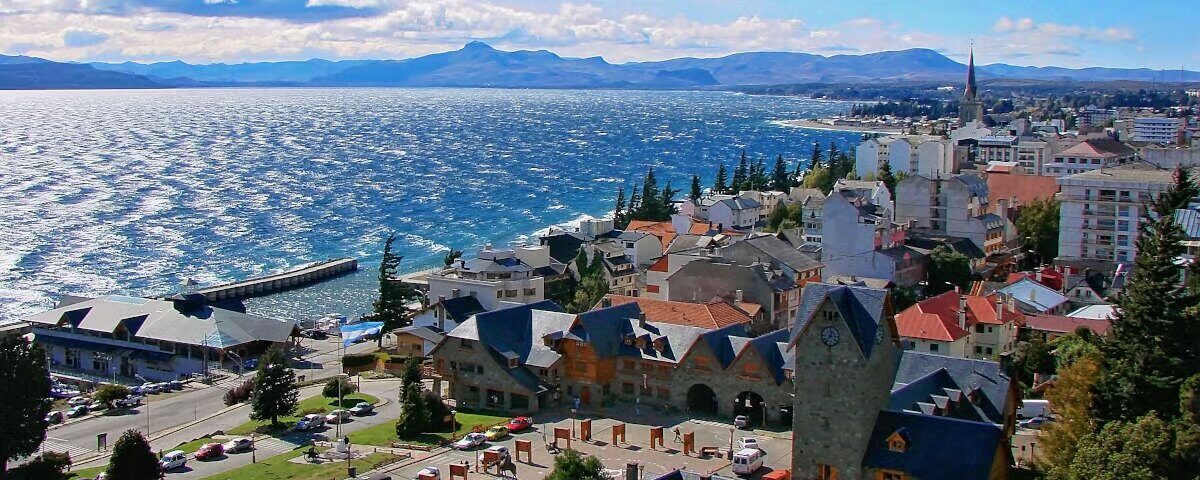
Es uno de los tours más económicos de Bariloche y con mejor relación de valor por el dinero. Realmente puede sorprender. Es conocido como Tour del Nazismo y la Huella Alemana en Bariloche o siemplemente como Tour Nazi Bariloche.
Decimal Watch by Robert Robin 1793. Musée des Arts et Métiers, Paris
If you take a close look at the watch shown above, you will begin to notice some oddities. This is a precision watch with decimal hours and seconds by Robert Robin from 1793. In this system there are 100 seconds in a minute and 100 minutes in an hour. Decimal time is the representation of the time of day using units which are decimally related. This term is often used to refer specifically to French Revolutionary Time.
French Revolutionary Metric Time
10 metric hours in a day 100 metric minutes in a metric hour 100 metric seconds in a metric minute 10 days in a metric week (called a décade)
In 1788, Claude Boniface Collignon proposed dividing the day into 10 hours or 1000 minutes, each new hour into 100 minutes, each new minute into 1000 seconds, and each new second into 1000 tierces. The distance the sun travels in one new tierce at the equator, which is one-billionth of the circumference of the earth, would be a new unit of length, provisionally called a half-handbreadth, equal to four modern centimeters. Further, the new tierce would be divided into 1000 quatierces, which he called “microscopic points of time”. He also suggested a week of 10 days and dividing the year into 10 “solar months”. The final French Republican Calendar was introduced in 1793 with 30 days in a month and 12 months/ 360 days in a year, using a decimal timescale, adding 5 days of festivities at the end of the year. The Republican Calendar was not a success and lasted only from 1793 until 1805.
Decimal Watch by George Auziere 1795. Musée des Arts et Métiers, Paris
This watch by George Auziere from 1795 shows three 10 day weeks (décades) and 30 days in a month. This particular watch also has the traditional 12 hour day and 60 minute hour for reference. You can tell it was actually used by the scratches on the watch crystal. Décades were abandoned in April of 1802 (Floréal an X).
Decimal Watch by André Féron 1795. Musée des Arts et Métiers, Paris
This watch by André Féron from 1795 shows the day of the month and the French Republican Calender. In France, it is known as the calendrier républicain as well as the calendrier révolutionnaire. Napoléon finally abolished the calendar with effect from 1 January 1806 (the day after 10 Nivôse an XIV), a little over twelve years after its introduction. The months were renamed in the French Republican calendar with descriptive names of the weather around Paris:
French Republican Calendar
The Republican calendar year began at the Southward equinox. In the Northern Hemisphere the Southward equinox is known as the autumnal equinox. In the Southern Hemisphere it is known as the vernal or spring equinox. This meant that the new year began in autumn in Paris.
Decimal Watch from Neuchtel Arts and History Museum. Wikipedia
This unusual watch from the Neuchtel Arts and History museum has the imperial 12 hours and 60 seconds with French Republican Days on the outer rim. It also seems to incorporate the fixed 30 days per month. I don’t really see how it works since there are only two hands. Official use of decimal time began in the Republican year III, September 22, 1794, and mandatory use was suspended on April 7, 1795 (18 Germinal of the Year III), in the same law which introduced the original metric system. Since the Revolutionary Calendar lasted until 1805, we can give an approximate date for this watch.
French Decimal Watch from Pierre Basile LePaute. Wikipedia
This watch from Pierre Basile LePaute from Paris, son of Jean André LePaute, shows French decimal time and two sets of 12 Roman numerals. It also has a hand for the 30 days of the month. I cannot tell if the seconds hand counts decimal seconds but the end of the hand suggests it does. A decimal second is .864 of a normal (60 second per minute) second. Similarly, the minutes hand measures decimal minutes, 1.44 of a normal (60 minutes per hour) minute. The hours hand is double ended to read either decimal or 12 hour/day hours since there are 10 decimal hours and 24 normal hours in a day, or one revolution. This watch is a little confusing to read.
Decimal Watch from 1793. Musée des Arts et Métiers, Paris
Here is another watch with a double ended hour hand from 1793 with the same principle described above. Even more confusing to read.
The metric system was conceived by a group of scientists to resolve troubling differences in weights and measures between countries. Antoine-Laurent Lavoisier (see my post), who is known as the “father of modern analytical chemistry”, was commissioned by the Assemblée nationale and Louis XVI of France to create a unified and rational system of measures. On December 10, 1799, a month after Napoleon’s coup d’état, the metric system was definitively adopted in France. The initial five units of the metric system dealt with length, area, volume of a solid (firewood specifically), volume of a liquid, and mass. The gram was the mass of a cubic centimeter of water. The meter was defined as a ten millionth the length of the distance between the North Pole and the Equator.
The 11th General Conference on Weights and Measures (1960) adopted the name Système International d’Unités (International System of Units, international abbreviation SI), for the recommended practical system of units of measurement.The “SI” is founded on seven units, from which all other units are derived. They are the meter, kilogram, second, ampere, kelvin, mole and candela. The second is currently defined as “the duration of 9 192 631 770 periods of the radiation corresponding to the transition between the two hyperfine levels of the ground state of the caesium 133 atom.”
Cafe Press Decimal Clock
For about $20 you can buy a decimal clock just like the one seen on the “Simpsons” and like the ones shown above (see references below). The sexagesimal system, which originated with the Sumerians and Babylonians, divides an hour into sixty minutes and minutes into sixty seconds. The word “minute” comes from the Latin pars minuta prima, meaning first small part, and “second” from pars minuta secunda or second small part. In angular measure, it is the degree that is subdivided into minutes and seconds, while in time, it is the hour.
La Residencia El Messidor, o simplemente El Messidor, es un pequeño castillo de estilo francés, rodeado de jardines, construido a metros del lago Nahuel Huapi en el casco histórico de Villa La Angostura, provincia del Neuquén, Argentina, por el arquitecto Alejandro Bustillo en 1942 a pedido de la Sra. Sara Madero de Demaría. Su nombre hace referencia al décimo mes del año en el antiguo calendario francés que había instaurado la Revolución Francesa y significa mes de oro, en alusión a las espigas que irradian una tonalidad dorada en esa época del año. Fue comprado por la Provincia del Neuquén en 1964 como residencia oficial del gobernador provincial y ha recibido la visita de personalidades extranjeras y del país.
Hacia el año 1939 Sara Madero de Demaría y su esposo visitaron la zona de Cumelén, de la cual le había hablado maravillas su primo Exequiel Bustillo que era director de Parques nacionales y se hizo beneficiaria de un lote en la zona pastoril, identificado como el n.º 9 (ubicado camino al puerto, frente a la actual Bahía Mansa). Por aquella época Parques nacionales, con la finalidad de poblar la zona de la naciente Villa La Angostura, entregaba lotes mediante licitación, con el compromiso de edificar antes de los 5 años.
Con el fallecimiento de sus padres, Sara Madero encomendó al reconocido arquitecto Alejandro Bustillo la realización de “El Messidor”, quien tomó de la casa del Doctor Schutz en San Isidro (Buenos Aires), algunas pautas para el diseño que se fue ampliando y mejorando, hasta finalizar en una imponente construcción de estilo francés (“manoir”: casa de campo). El arquitecto Bustillo, al tanto del temor al fuego que tenía la propietaria, utilizó material ignífugo, granito de la zona, para la terminación exterior y estructural. El techo es de pizarra gris y el revestimiento interior de madera fina de ciprés que fue traída en lanchones desde Bariloche. Inicialmente se hizo una pequeña casa de troncos, sobre la misma costa del lago y el primer casero fue el húngaro Alberto Bernas, quien además como excelente carpintero realizó trabajos de fina terminación para la propiedad. La construcción propiamente dicha se inició en febrero de 1940, el constructor fue Pedro Longaretti y los trabajos finalizaron en enero de 1942.
Sobre un predio de unas 36 hectáreas sobre la costa del lago Nahuel Huapi se levanta el edificio de dos plantas y sótano rodeado de hermosos y vistosos jardines, ordenados geométricamente al estilo francés, con variadas especies de árboles, autóctonos y exóticos -coihues, radales, pinos, arrayanes, castaños, abedules, robles, maitenes, nogales y ñires- además de coloridas flores. En la planta superior están las habitaciones que, al igual que la terraza, tienen una excelente vista al lago y a los alrededores. En la inferior se encuentran un gran comedor, living, otra salita de estar decorada con un cuadro de Juan Carlos Castagnino y otro de Antonio Berni y una biblioteca de forma circular. En otro sector más alejado de la misma planta están las habitaciones de huéspedes, una amplia cocina, despensa y algunas oficinas. Desde las ventanas se ve un panorama paisajístico fascinante que proviene de la Península de Quetrihué, y del muelle de la Bahía Mansa como entorno de ensueño natural. No está abierto al público aunque se permite, si no hay visitantes especiales, recorrer en vehículo el circuito que atraviesa sus jardines, sin descender ni detenerse.
En 1964 la provincia de Neuquén hace una oferta por la residencia, que estaba en venta, por diecisiete millones de pesos moneda nacional- que se consideraba por debajo del valor de mercado - y la Legislatura la aprobó por la Ley 388 para ser residencia oficial del Gobierno de Neuquén –condición que además impuso la propietaria- motivo por el cual para poder alojarse allí es necesario tener la invitación por parte del gobernador.
Residencia El Messidor en Villa La Angostura. Vista desde el Mirador de la Isla de Arrayanes
En la residencia se hospedaron para descansar dictadores y presidentes Argentinos. Dictador Juan Carlos Onganía, y Presidentes Raúl Alfonsín y Carlos Menem, además de visitantes extranjeros como el dictador paraguayo Alfredo Stroessner, el rey Juan Carlos I de España y el emperador japonés Hirohito. Fue allí cuando durante un paseo en gomón por el lago la picadura de un insecto llamado "chaqueta amarilla" le dejó la cara hinchada al presidente Menem, lo que fue utilizado después para intentar disimular los efectos de una cirugía estética. Durante el gobierno menemista el ministro del Interior Carlos Corach fue un visitante frecuente, al igual que el ministro Rodolfo Barra y el gobernador de la provincia de Buenos AiresCarlos Ruckauf.
Otros visitantes fueron Fernando de la Rúa cuando era senador, el exvicepresidente Carlos "Chacho" Álvarez y la exministra de Desarrollo Social, Graciela Fernández Meijide. En cuanto a los gobernadores de Neuquén, Jorge Sobisch pasó allí varios veranos y Jorge Sapag la utiliza para hacer un paréntesis entre los viajes que realiza a Buenos Aires y al interior de la provincia. El primero autorizó recitales gratuitos al aire libre por intermedio de la Secretaría de Cultura y hasta abrió las puertas de la residencia a los turistas nacionales y extranjeros, cuando intentaba ganar espacio en su frustrada campaña presidencia en tanto Sapag prefiere su uso discreto.
Un caso especial fue el de la presidenta argentina María Estela Martínez de Perón, a quien se mantuvo detenida en la residencia por la dictadura autodenominada Proceso de Reorganización Nacional, tras ser depuesta. Allí fue detenida por unos siete meses con la única compañía de su fiel ama de llaves andaluza, Rosarito, luego que el 24 de marzo de 1976 fuera depuesta por militares.
Benedict died on Saturday morning in the monastery in the Vatican gardens where he had retired.
Pope Francis has lead the tributes to his predecessor Pope Emeritus Benedict XVI, who has died at the age of 95.
The Vatican confirmed Benedict's death on Saturday morning, saying he passed away at a monastery on Vatican grounds where he had lived since 2013.
Giving his homily at the end of year celebration of Vespers and the Te Deum -- Catholic religious ceremonies -- Pope Francis remembered Benedict as a noble and kind man of faith.
"We are moved as we recall him as such a noble person, so kind. And we feel such gratitude in our hearts: gratitude to God for having given him to the Church and to the world; gratitude to him for all the good he accomplished, and above all, for his witness of faith and prayer, especially in these last years of his recollected life," said Pope Francis.
"Only God knows the value and the power of his intercession, of the sacrifices he offered for the good of the Church.”
Benedict became the first pope in 600 years to retire from the role and his health had declined in recent years. Over the last few days his health had deteriorated further, but the Vatican had indicated on Friday that his condition was "stable" and that he had participated in the celebration of mass in his room the previous day.
Funeral to take place next week
A Vatican spokesperson confirmed that the funeral of former Pope Benedict will take place next Thursday 5 January at 09:30 CET in St. Peter's Square, and be presided over by Pope Francis.
"From the morning on Monday, the body of the Pope Emeritus will be in the Basilica of Saint Peter, where the faithful can go with their prayers for a last meeting with the Pope Emeritus, to greet him and to say goodbye," Matteo Bruni added.
The funeral of the 265th pope, celebrated by his successor, will be an unprecedented event in the two thousand year history of the Catholic Church which tens of thousands of people are likely to attend, including heads of state.
European leaders paid tribute to Pope Emeritus Benedict on Saturday, including Italian Prime Minister Giorgia Meloni, French President Emmanuel Macron, German Chancellor Olaf Scholz, and British Prime Minister Rishi Sunak.
Who was Pope Benedict, the first German pope in a thousand years?
Pope Emeritus Benedict's death puts an end to the unusual cohabitation of two men in white: the German Joseph Ratzinger, a brilliant theologian not very comfortable with crowds, and the Argentinian Jorge Bergoglio, a Jesuit endowed with an incisive word who wanted put the poor and migrants back at the center of the Church's mission.
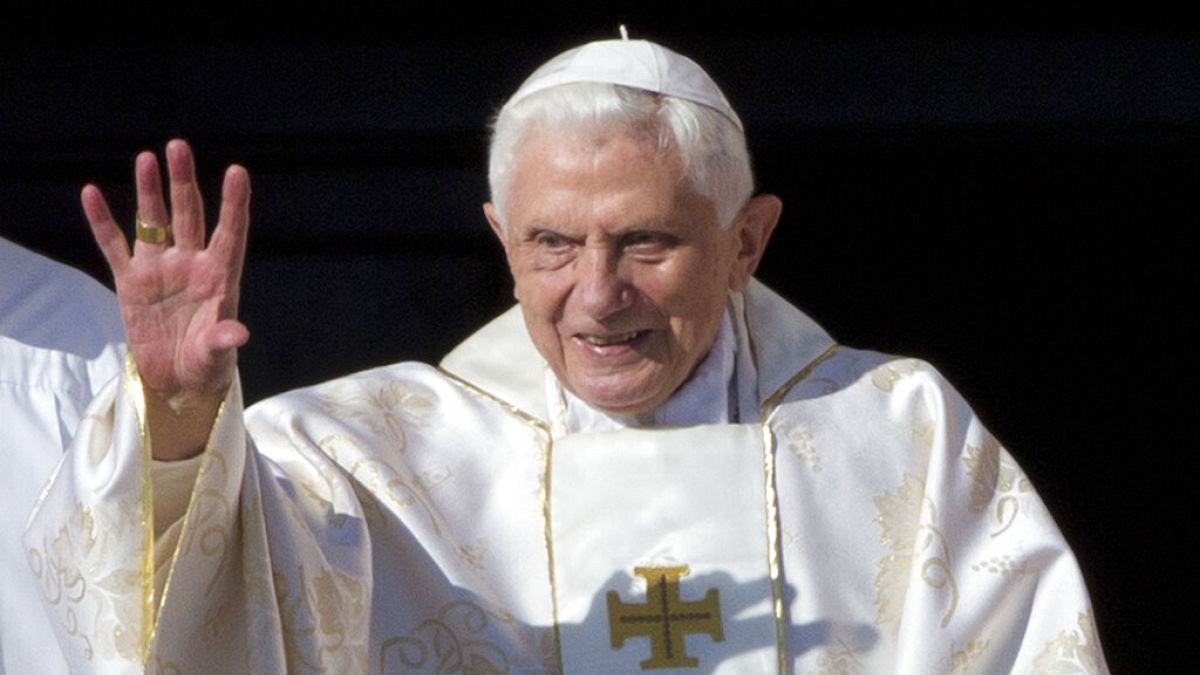
Benedict was the first German pope elected to head the Catholic church in thousand years when he succeeded John Paul II in April 2005.
Then known as German Cardinal Joseph Ratzinger, he became the 265th leader of the Roman Catholic Church, choosing the name Benedict XVI.
His appointment came after he had headed the Vatican's Congregation for the Doctrine of the Faith from 1982 to 2005.
At the time, Benedict was labelled by one cardinal as a “safe pair of hands” but his eight-year papacy was marked by missteps and scandals.
Benedict was also the first pope to retire in 600 years.
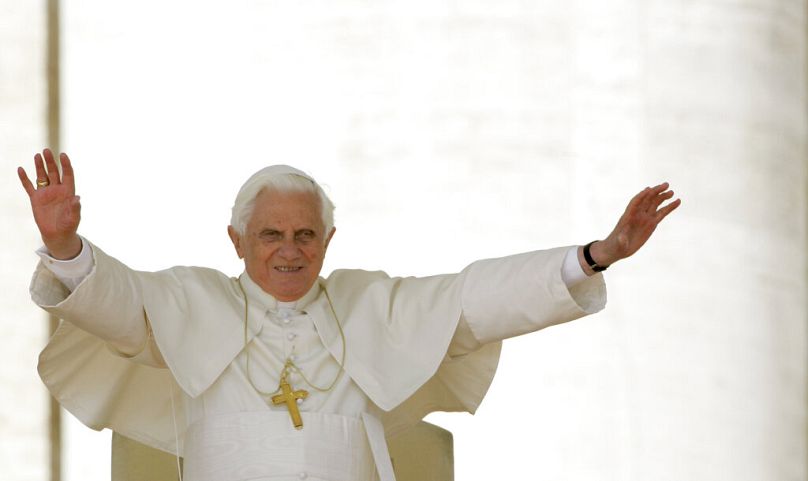
Pope Benedict XVI greets the faithful during the weekly general audience in St. Peter's Square at the Vatican, Wednesday April 29, 2009.Pier Paolo Cito/Copyright 2022 The AP. All rights reserved.
Joseph Ratzinger was born to a Catholic family on 16 April 1927 in Marktl am Inn, a small village in southeast Germany. He spent much of his adolescence here, near the Austrian border.
He often described himself as a “Mozartian” and enjoyed playing the piano throughout his life.
After his 14th birthday in 1941, Ratzinger enrolled in the Hitler Youth.
Membership in the Nazi organisation was legally required at the time, and the teenage boy remained in the Hitler Youth to avoid tuition fees, later enrolling in the auxiliary anti-aircraft service at the end of World War II.
Ratzinger was eventually exonerated and even embraced by some Jews -- he called the Holocaust a "dark time" in his life.
After studying philosophy and theology at the University of Munich, he was ordained a priest in 1951, alongside his brother Georg.
Abuse scandals
Cardinal Joseph Ratzinger then served as archbishop of Munich from 1977 to 1982.
This period of his life later came under particular scrutiny amid widespread allegations of sexual abuse within the Catholic Church.
Although his legacy was damaged by the scandal, Benedict was responsible for turning around the Vatican’s approach to abuse by the clergy.
He was the first pope to meet with victims of abuse and directed the church to pursue a path of humility by seeking forgiveness. In 2001, he ordered for all cases to be sent to his office for processing, once he saw that accused bishops were being moved from parish to parish and not being punished.
During the final two years of his pontificate, Benedict defrocked nearly 400 priests for abuse.
But in 2018, a church-commissioned report concluded that at least 3,677 people were abused by the clergy in Germany between 1946 and 2014.
Another long-awaited report then accused Benedict of mishandling four sexual abuse allegations in the Munich archdiocese. He was criticised for failing to remove priests, even after they had been criminally convicted.
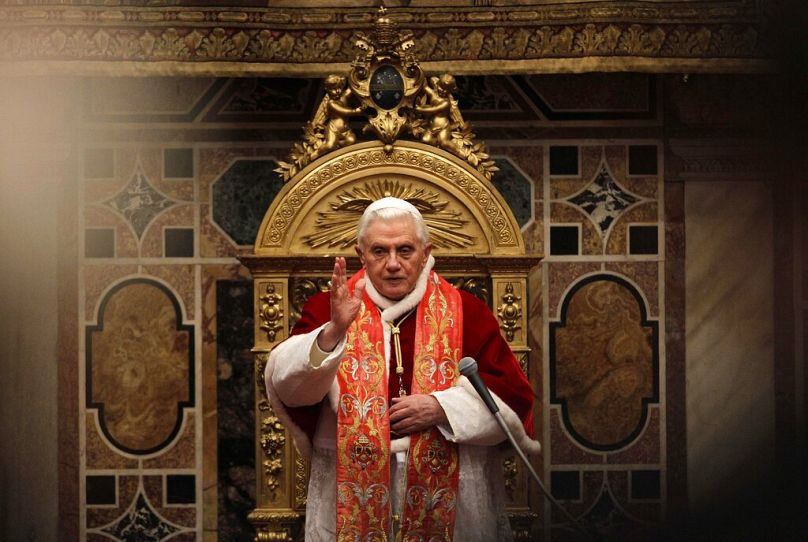
Pope Benedict XVI delivers his blessing on the occasion of the traditional exchange of Christmas greetings to the Curia, in the Regia Hall, at the Vatican, Monday, 2010.Alessandra Tarantino/AP2010
In February, Benedict asked for forgiveness for any “grievous faults”, but did not admit to any personal wrongdoing.
Earlier in his papacy, Benedict XVI had faced other criticisms and controversies.
In 2006, just one year after being elected, he caused ire when he suggested that Islam brought only evil to the world. Following days of protests, Benedict said he was "deeply sorry" and that his speech was misunderstood.
Less than three years later, he also angered Jews by rehabilitating four ultra-traditionalist bishops, including a Holocaust denier.
In 2012, the “Vatileaks” scandal – which unearthed financial corruption and blackmail – also shook Benedict’s papacy.
In a shock announcement in February 2013, the then-86-year-old said he lacked the "strength of mind and body" to run the Church and bowed out.
In his later years, Benedict grew increasingly frail as he dedicated his post-papacy life to prayer and meditation.
Francis, who visited the former pontiff shortly after his general audience on Wednesday (December 28), has often praised Benedict, saying it was like having a grandfather in the home.
One of the last known photographs of Benedict was taken on 1 December, when he met the winners of a prize for theologians named after him.
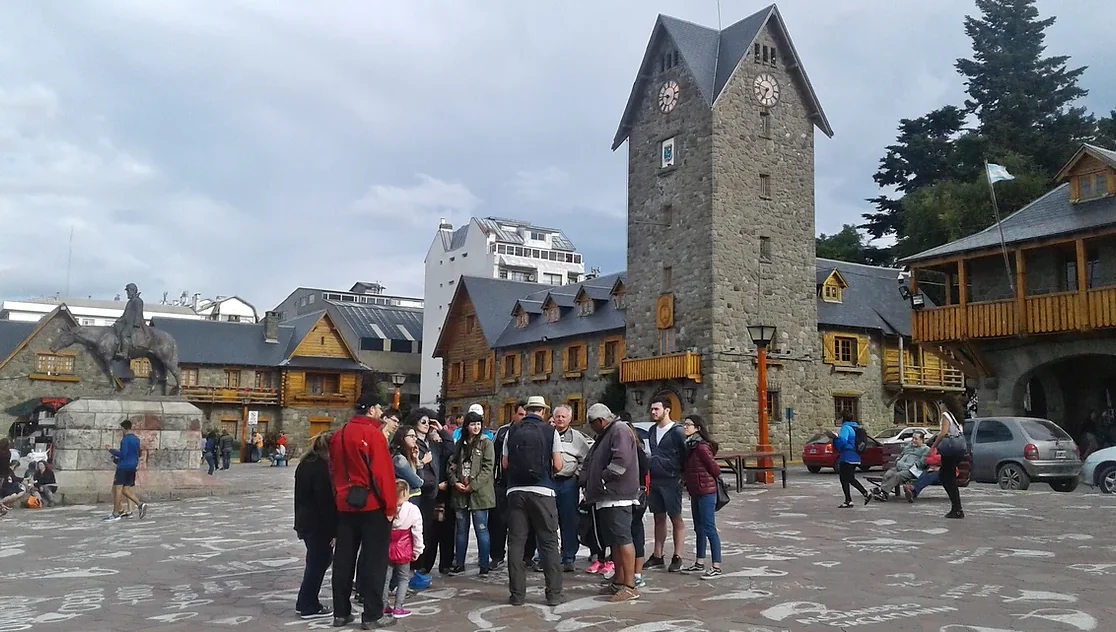
En este tour, se descubren los secretos de Bariloche, desde su fundación por inmigrantes alemanes hasta sus vínculos con la Alemania nazi. Se conocen historias sorprendentes mientras se recorren los puntos más emblemáticos de la ciudad, como el barrio alemán, el Club Andino Bariloche, la escuela alemana y la Plaza Belgrano.
Se explora cómo la inmigración alemana dio forma a la ciudad y se analiza la presencia nazi en la región, desentrañando mitos y el papel del gobierno argentino en ese contexto. Una experiencia única para comprender cómo estos eventos históricos dejaron una huella profunda en Bariloche.
Itinerario
Plaza del Centro Cívico.
Casco histórico de Bariloche.
Club Andino Bariloche.
Barrio alemán.
Escuela alemana y Plaza Belgrano.
¿Por qué reservar este tour?
Conoce la influencia de la inmigración alemana y la presencia nazi en Bariloche.
Aprende la historia de Bariloche y su contexto mundial con un guía experto.
Accede a mitos, hechos históricos y anécdotas sorprendentes que no se cuentan en otros tours.
Explora la ciudad a fondo en poco tiempo y disfruta de sus principales puntos históricos.
Información adicional
Se recomienda llevar calzado cómodo para caminar.
El clima en Bariloche puede ser impredecible, así que asegúrate de llevar ropa adecuada para cualquier condición climática.
El recorrido es al aire libre, por lo que te sugerimos llevar protector solar y agua.
No incluye traslados.
Punto de inicio de la excursión a confirmar al momento de la reserva.
No está adaptado para personas en silla de ruedas, pero es accesible para carritos de bebé.
Incluye
Guía disponible en español o inglés. Si necesitas el tour en inglés, por favor solicita la opción al momento de realizar la reserva.
Recorrido a pie por sitios históricos clave.
No incluye
Comida y bebidas.
Propinas.
Políticas de cancelación
Cancelaciones con 72 horas antes del inicio del tour: Reembolso del 90% del valor del tour (se aplica un cargo del 10% por gastos administrativos).
Cancelaciones dentro de las 72 horas antes del inicio del tour: No se realizan reembolsos.
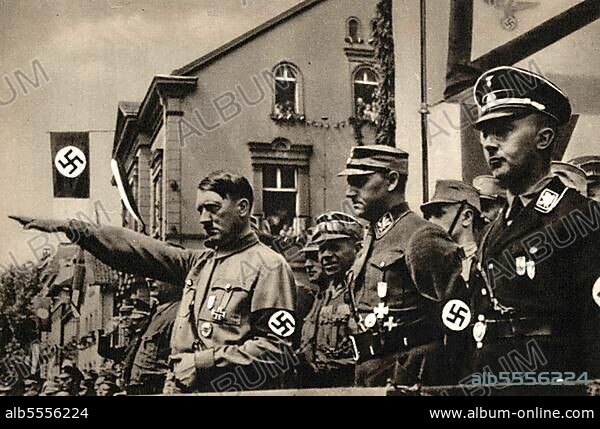
Adolf Hitler (* 20 April 1889 in Braunau am Inn) († 30 April 1945 Berlin), Leader of the Nazi Party, Reich Chancellor from 1933, also self-appointed "Fuehrer" and head of state of Germany.
Mary Magdalene, seeing that the stone of the tomb had been rolled away, ran to tell Peter and John. After receiving the shocking news, the two disciples also went out and — as the Gospel says — “the two were running together” (Jn 20:4). The main figures of the Easter narratives all ran! On the one hand, “running” could express the concern that the Lord’s body had been taken away; but, on the other hand, the haste of Mary Magdalene, Peter and John expresses the desire, the yearning of the heart, the inner attitude of those who set out to search for Jesus. He, in fact, has risen from the dead and therefore is no longer in the tomb. We must look for him elsewhere.
This is the message of Easter: we must look for him elsewhere. Christ is risen, he is alive! He is no longer a prisoner of death, he is no longer wrapped in the shroud, and therefore we cannot confine him to a fairy tale, we cannot make him a hero of the ancient world, or think of him as a statue in a museum! On the contrary, we must look for him and this is why we cannot remain stationary. We must take action, set out to look for him: look for him in life, look for him in the faces of our brothers and sisters, look for him in everyday business, look for him everywhere except in the tomb.
We must look for him without ceasing. Because if he has risen from the dead, then he is present everywhere, he dwells among us, he hides himself and reveals himself even today in the sisters and brothers we meet along the way, in the most ordinary and unpredictable situations of our lives. He is alive and is with us always, shedding the tears of those who suffer and adding to the beauty of life through the small acts of love carried out by each of us.
For this reason, our Easter faith, which opens us to the encounter with the risen Lord and prepares us to welcome him into our lives, is anything but a complacent settling into some sort of “religious reassurance.” On the contrary, Easter spurs us to action, to run like Mary Magdalene and the disciples; it invites us to have eyes that can “see beyond,” to perceive Jesus, the one who lives, as the God who reveals himself and makes himself present even today, who speaks to us, goes before us, surprises us. Like Mary Magdalene, every day we can experience losing the Lord, but every day we can also run to look for him again, with the certainty that he will allow himself to be found and will fill us with the light of his resurrection.
Brothers and sisters, this is the greatest hope of our life: we can live this poor, fragile and wounded existence clinging to Christ, because he has conquered death, he conquers our darkness and he will conquer the shadows of the world, to make us live with him in joy, forever. This is the goal towards which we press on, as the Apostle Paul says, forgetting what lies behind and straining forward to what lies ahead (cf. Phil 3:12-14). Like Mary Magdalene, Peter and John, we hasten to meet Christ.
The Jubilee invites us to renew the gift of hope within us, to surrender our sufferings and our concerns to hope, to share it with those whom we meet along our journey and to entrust to hope the future of our lives and the destiny of the human family. And so we cannot settle for the fleeting things of this world or give in to sadness; we must run, filled with joy. Let us run towards Jesus, let us rediscover the inestimable grace of being his friends. Let us allow his Word of life and truth to shine in our life. As the great theologian Henri de Lubac said, “It should be enough to understand this: Christianity is Christ. No, truly, there is nothing else but this. In Christ we have everything” (Les responsabilités doctrinales des catholiques dans le monde d'aujourd'hui, Paris 2010, 276).
And this “everything” that is the risen Christ opens our life to hope. He is alive, he still wants to renew our life today. To him, conqueror of sin and death, we want to say:
“Lord, on this feast day we ask you for this gift: that we too may be made new, so as to experience this eternal newness. Cleanse us, O God, from the sad dust of habit, tiredness and indifference; give us the joy of waking every morning with wonder, with eyes ready to see the new colours of this morning, unique and unlike any other. […] Everything is new, Lord, and nothing is the same, nothing is old” (A. Zarri, Quasi una preghiera).
Sisters, brothers, in the wonder of the Easter faith, carrying in our hearts every expectation of peace and liberation, we can say: with You, O Lord, everything is new. With you, everything begins again.

 Tema anterior