|
|
2012 transit of Venus
 Image of the transit taken by NASA's Solar Dynamics Observatory spacecraft. Venus is in the upper right quadrant
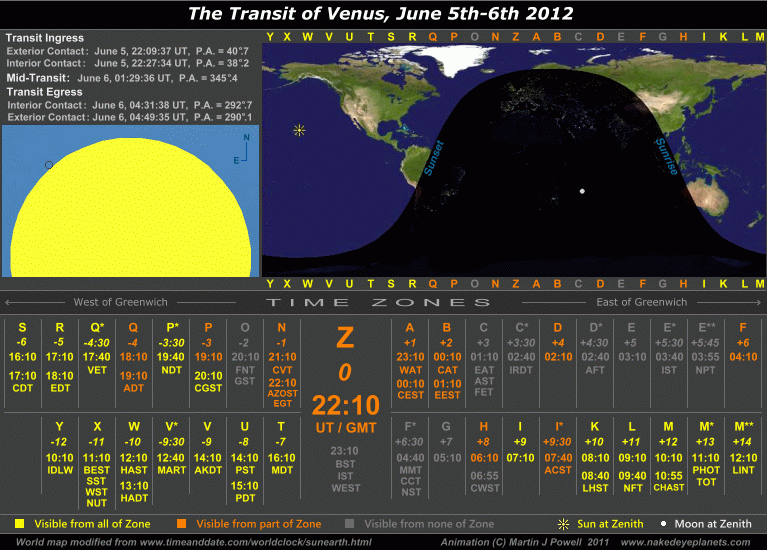
The 2012 transit of Venus, when the planet Venus appeared as a small, dark spot passing across the face of the Sun, began at 22:09 UTC on 5 June 2012, and finished at 04:49 UTC on 6 June.[1] Depending on the position of the observer, the exact times varied by up to ±7 minutes. Transits of Venus are among the rarest of predictable celestial phenomena and occur in pairs. Consecutive transits per pair are spaced 8 years apart, and consecutive pairs occur more than a century apart:[2] The previous transit of Venus took place on 8 June 2004 (preceded by transits on 9 December 1874 and 6 December 1882); the next pair of transits will occur on 10–11 December 2117 and December 2125 within the 22nd century.[3]
Observations of the event
[edit]
 Path across the Sun, with contact times and other data  Visibility map
The entire transit was visible from the western Pacific Ocean, northwesternmost North America, northeastern Asia, Japan, the Philippines, eastern Australia, New Zealand, and high Arctic locations including northernmost Scandinavia, and Greenland.[4] In North America, the Caribbean, and northwestern South America, the beginning of the transit was visible on 5 June until sunset. From sunrise on 6 June, the end of the transit was visible from South Asia, the Middle East, east Africa, and most of Europe. The phenomenon was not visible from most of South America, nor from western Africa. There were a number of live online video streams with footage from telescopes around the world. Midway through the transit one of the NASA streams had nearly 2 million total views and was getting roughly 90,000 viewers at any given moment.
In Los Angeles, crowds jammed Mount Hollywood where the Griffith Observatory set up telescopes for the public to view the transit. In Hawaii, hundreds of tourists watched the event on Waikiki Beach where the University of Hawaii set up eight telescopes and two large screens showing webcasts of the transit.[5] The transit was also observed and historically photographed by NASA astronaut Don Pettit aboard the International Space Station.[6]
NASA's Solar and Heliospheric Observatory could not see the transit as it was not in between the Earth and the Sun at the time of the event, but high-definition images of the event were obtained by Solar Dynamics Observatory, from 36,000 km (22,000 mi) above the Earth. Agency astrophysicist Dr. Lika Guhathakurta said, "We get to see Venus in exquisite detail because of SDO's spatial resolution, SDO is a very special observatory. It takes images that are about 10 times better than a high-definition TV and those images are acquired at a temporal cadence of one every 10 seconds. This is something we've never had before".[7]
 Children in Dili observing the transit of Venus
The 2012 transit gave scientists a number of research opportunities. These included:[8][9][10]
- Measurement of dips in a star's brightness caused by a known planet transiting a known star (the Sun). This will help astronomers when searching for exoplanets. Unlike the 2004 Venus transit, the 2012 transit occurred during an active phase of the 11-year activity cycle of the Sun, and would have provided practice in detecting a planet's signal around a "spotty" variable star.
- Measurement of the apparent diameter of Venus during the transit, and comparison with its known diameter. This will have given information on how to estimate exoplanet sizes.
- The number of locations documenting the event will provide much data via parallax that will generate more accurate measurements.
- Observation of the atmosphere of Venus simultaneously from Earth-based telescopes and from the Venus Express spacecraft. This gave a better opportunity to understand the intermediate level of Venus's atmosphere than is possible from either viewpoint alone, and should provide new information about the climate of the planet.
- Spectrographic study of the atmosphere of Venus. The results of analysis of the well-understood atmosphere of Venus will be compared with studies of exoplanets with atmospheres that are unknown.
- The Hubble Space Telescope used the Moon as a mirror to study the light reflected from Venus to determine the makeup of its atmosphere. This may provide another technique to study exoplanets.
- Experimental reconstruction of Lomonosov's discovery of Venusian atmosphere (1761) with antique refractors.[11] The researchers observed the "Lomonosov's arc" and other aureole effects due to Venus's atmosphere and concluded that Lomonosov's telescope was fully adequate to the task of detecting the arc of light around Venus off the Sun's disc during ingress or egress if proper experimental techniques as described by Lomonosov in his 1761 paper are employed.[11]
North America:
Europe:
Asia:
Australasia:
-
-
Wagga Wagga
00:49 UTC
-
Clayton
01:06 UTC
Others:
-
Solar Dynamics Observatory Ultra-high Definition View
-
This visualization shows the orbital paths of Venus and Earth that led to this rare alignment on 5–6 June 2012
-
Venus transit, seen from the International Space Station.
-
Close-up of Venus by the Japanese Hinode spacecraft on the Sun-synchronous orbit.
-
Visualization generated by compositing the small field-of-view, high-cadence closeups of Venus with the full-disk, low-cadence imagery from SDO.
|
|
|
|
|
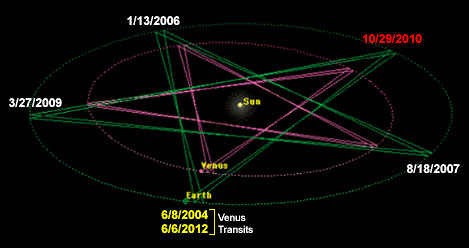
El pentagrama es una firma geométrica de Venus, lo que tiene mucho sentido en el contexto actual.
On June 5-6, 2012, a transit of Venus occurred, where Venus appeared as a small, dark spot passing across the face of the sun. This rare astronomical event happens in pairs, eight years apart, and is separated by 105 or 121 years. The transit began at 22:09 UTC on June 5, 2012, and ended at 04:49 UTC on June 6, 2012. The exact times varied by up to ±7 minutes depending on the observer's location.
|
|
|
|
|
Enterprise Moves to Intrepid
JUN 07, 2012
IMAGE ARTICLE
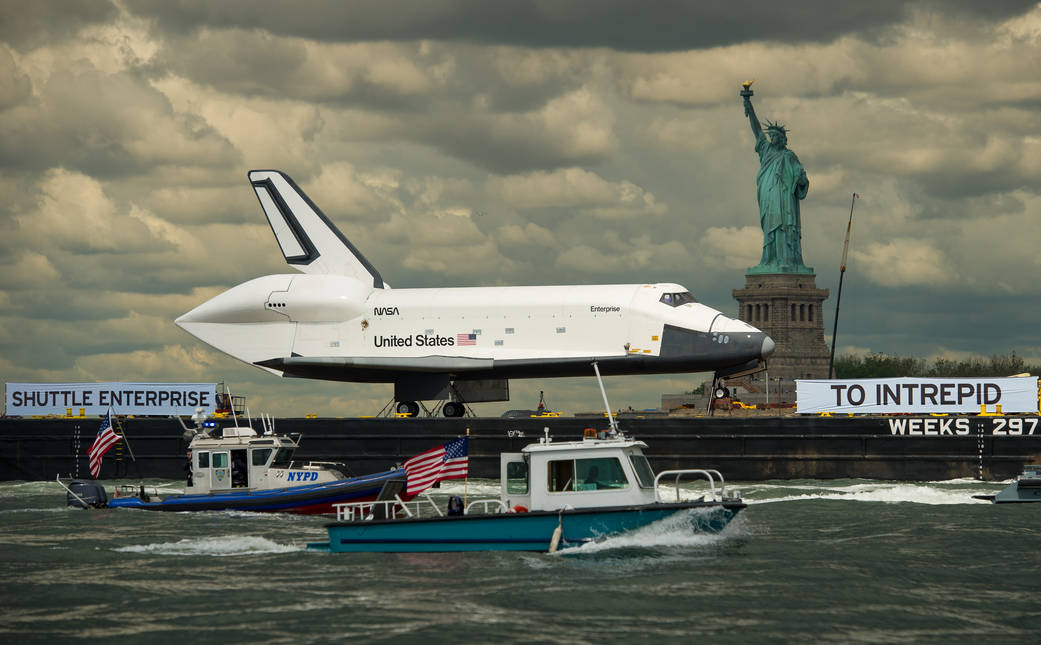
Atop a barge on Wednesday, June 6, 2012, the space shuttle Enterprise was towed on the Hudson River past the Statue of Liberty on its way to the Intrepid Sea, Air and Space Museum, where it will be permanently displayed.Image Credit: NASA/Bill Ingalls
https://www.nasa.gov/image-article/enterprise-moves-intrepid/ |
|
|
|
|
Space Shuttle Enterprise makes final landing
New YorkCNN —
The Space Shuttle Enterprise made its final descent Wednesday, landing at its new home at New York City’s Intrepid Sea, Air and Space Museum.
Though it never traveled into outer space, the Enterprise did make its way from a Smithsonian Institution museum near Washington, above the New York skyline mounted atop a 747 jumbo jet, and up the Hudson River by barge to the museum where it will be displayed for the public.
On Wednesday, the shuttle was hoisted by crane and then lowered onto the flight deck of the Intrepid, the decommissioned U.S. aircraft carrier that has been transformed into a museum.
Dragon returns to Earth after ‘grand slam’ mission
As the shuttle moved through the waterways of Lower Manhattan, it made an appearance near the Statue of Liberty.
A wingtip of the shuttle was damaged slightly on Sunday during its transit from John F. Kennedy Airport to Weeks Marine in Jersey City, New Jersey, where it was held until Tuesday, according to a statement by Intrepid museum officials. It has since been repaired.
The shuttle was on display at a Smithsonian Institution museum before being flown from Virginia’s Dulles International Airport on April 27 and making its final flight to New York’s John F. Kennedy Airport.
Discovery – the most traveled of the shuttles – is replacing Enterprise in the Smithsonian facility.
Completed in 1976, Enterprise was designed as a prototype test vehicle. Test pilots demonstrated that it could fly and land in the atmosphere like airplanes, but the Enterprise never flew in space.
The shuttle was originally to be named the Constitution, but a write-in campaign by fans of the television series “Star Trek” persuaded officials to rename it in honor of the show’s main starship.
NASA sent the shuttle on a tour of Europe and Canada in 1983, and it appeared at the 1984 World’s Fair in New Orleans. The craft made a brief return to service as a ground test vehicle in 1984 before retiring to the Smithsonian’s collection in 1985.
NASA is preparing to fly Space Shuttle Endeavour to Los Angeles sometime in the second half of the year. The final remaining shuttle, Atlantis, is being readied for display at the Kennedy Space Center Visitor Complex in Florida.
The other two shuttles in the NASA program, Challenger and Columbia, were destroyed in flight.
https://edition.cnn.com/2012/06/06/us/new-york-shuttle-enterprise/index.html
|
|
|
|
|
On June 6th, 2020, Venus would have been a faint, illuminated crescent visible in the early morning sky, just before sunrise. It was a crescent phase with only 0.3% of its surface illuminated. The planet was also relatively low in the sky, close to the eastern horizon. Additionally, Mars would have been reaching quadrature, meaning it was 90 degrees away from the sun in the sky.
|
|
|
|
|
Learn about Venus's weird transit cycle.
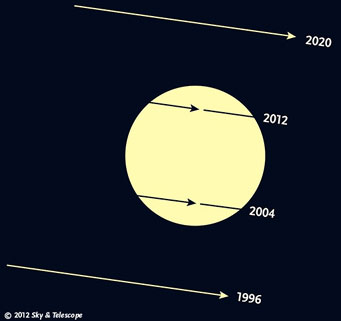
Venus took these tracks across the Sun in 2004 and 2012. Earth missed seeing a transit in 1996, and will miss another in 2020.
S&T: Gregg Dinderman
People attuned to the rhythms of the night sky know that certain cycles in astronomy repeat themselves over and over. These include the annual seasonal cycle as Earth orbits the Sun, the 29½-day cycle of lunar phases, and the fact that Mars comes to opposition every 26 months. Even solar and lunar eclipses come in saros cycles.
But compared to these other cycles, the current cycle for transits of Venus is weird. Make that really weird. This article explains why transits of Venus are so rare that the transit coming up on June 5th/6th will be the last one you'll ever see, why the cycle has such an odd pattern, and why the current cycle won't last forever. (The transit occurs on June 5th in the Western Hemisphere and June 6th in the Eastern Hemisphere.)
How to Get a Transit of Venus
For a transit of Venus to occur, two events must occur simultaneously, and it's rare to have such perfect synchrony.
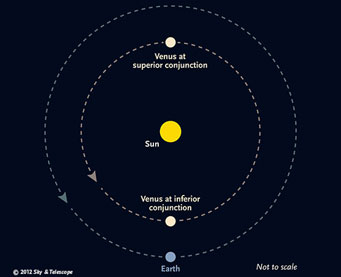
Transits of Venus can only occur when Venus passes between the Sun and Earth, a point on its orbit known as inferior conjunction.
S&T
First, and most obvious, Venus has to move directly between Earth and the Sun so that an imaginary observer looking “down” on the solar system from above would see the three bodies form a perfectly straight line. When this happens, astronomers say that Venus has come to inferior conjunction. Venus orbits the Sun faster and in a smaller orbit, and it comes to these inferior conjunctions every 584 Earth days.
If Venus and Earth orbited the Sun in the same plane, we'd enjoy a transit of Venus every 584 days, and the June 5th transit wouldn't be such a big deal. But in reality, Venus's orbital plane is tipped 3.4 degrees relative to Earth's orbital plane. The planes cross each other at two points called nodes. To get a transit, Venus has to be at inferior conjunction at the exact same time it's at a node. This perfect 3-D lineup doesn't happen very often. Normally, Venus's inclined orbit means it is located “above” or “below” the Sun when it comes to inferior conjunction.
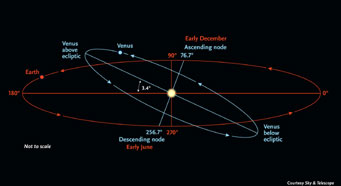
Venus's orbit around the Sun is inclined relative to Earth's orbit (exaggerated here for the sake of clarity). Transits of Venus can only occur at the two nodes, where the orbital planes of Venus and Earth intersect.
S&T: Gregg Dinderman
One of these nodes occurs in early June and the other in early December, meaning these are the only times that transits of Venus can occur. In early June, Venus appears to be diving “downward” (or south), so astronomers call this the descending node. In early December, Venus is moving “up” (or north) in its orbit, so this is an ascending node.
A Bizarre Cycle
So far, things probably seem rather simple and straightforward. But here's where the transit of Venus cycle starts getting weird (but also quite interesting).
For the past few centuries and the next few centuries, these perfect 3-D alignments occur at intervals of 8, 105½, 8, and 121½ years. In reality, think of this as a 243-year cycle, with pairs of transits separated by only 8 years, but with each pair separated by more than a century.
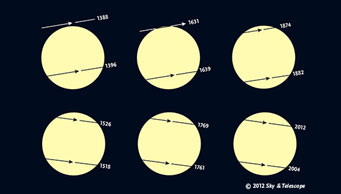
Venus tracks across the Sun are shown for years 1388 through 2012. The top row shows December transits at Venus's ascending node and the bottom row shows June transits at Venus's descending node.
S&T
Ascending-node transits occurred in December 1631, 1639, 1874, and 1882. The next ones occur in December 2117 and 2125. Descending-node transits occurred in June 1761, 1769, and 2004, with the next one coming June 5/6, 2012. After that, the next descending-node transits occur in June 2247 and 2255.
For the descending-node transits separated by 8 years, Venus crosses the southern part of the Sun's disk in the first transit, and the northern part the second time around. That's why Venus will cross the northern part of the Sun's disk on June 5th/6th. When Venus came to inferior conjunction in 1996, it was too far below the Sun to transit its disk. And in 2020, it will be too high.
The opposite is the case for ascending-node transits. The first transit in an 8-year pair crosses the northern part of the Sun, the second one crosses the southern half.
So why does Venus take “only” 105½ years to go from a pair of June transits to a pair of December transits, whereas it takes 121½ years to go from a pair of December transits to a pair of June transits? This asymmetry is due to the fact that Earth's orbit around the Sun is not quite a perfect circle. It's slightly elongated (the technical term is eccentric), deviating from a perfect circle by about 3 percent. In contrast, Venus's orbit is so close to being a perfect circle that its minuscule elongation can be ignored in this discussion.
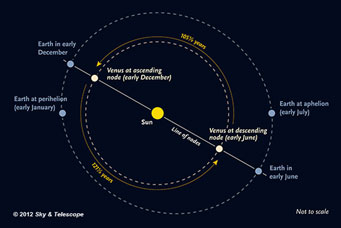
The Earth's elongated (eccentric) orbit (exaggerated in the diagram) explains why there is an asymmetry in the amount of time from one transit pair to the next.
S&T
The diagram on the right (in which Earth's orbital eccentricity is exaggerated for the sake of clarity) shows what's going on. Basically, Earth is near its farthest point from the Sun (aphelion) in June and near its closest point to the Sun (perihelion) in December. When Earth is closer to the Sun's powerful gravity, it moves slightly faster in its orbit than when it's farther from the Sun. The difference in Earth's orbital speed from perihelion to aphelion produces a longer gap (121½ years) between the time it takes to line up between the December and Junes transits than the 105½ years it takes to line up from the June to December transits.
Nothing Good Lasts Forever
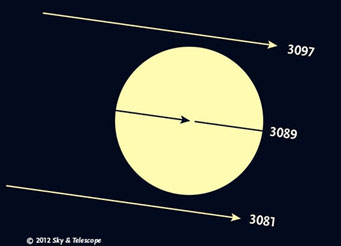
In the future, transits of Venus will become even more rare. This diagram shows the track Venus will take across the Sun in 3089. In 3081 and 3097, Venus's path will miss the Sun (from Earth's perspective).
S&T
Unfortunately for astronomers living in the distant future, the frequency of transits will decrease. Both Venus's and Earth's orbits precess, meaning they rotate over long time periods to produce a rosette-like pattern. In other words, Earth's perihelion shifts in its orbit, and so does Venus's. Because of precession, Earth-bound astronomers will only be able to enjoy one ascending-node transit for centuries after the year 3000. They will see a descending-node transit in 3089, but 8 years later, in 3097, Venus will come to inferior conjunction too far above the Sun to transit its disk.
And over tens of thousands of years, the 243-year cycle will eventually change as the eccentricity of Venus's and Earth's orbits evolve due to the gravitational perturbations of other planets. Over even longer timescales, chaotic effects take over, and the mathematics becomes so uncertain that today's astronomers can no longer predict when these rare celestial alignments will take place, and what future cycles will be like.
But for now, you can rest assured that there will be a transit of Venus on June 5th/6th, and unless modern medicine comes up with a miracle, this will be the last chance you'll ever have to see a transit of Venus from the surface of Earth.
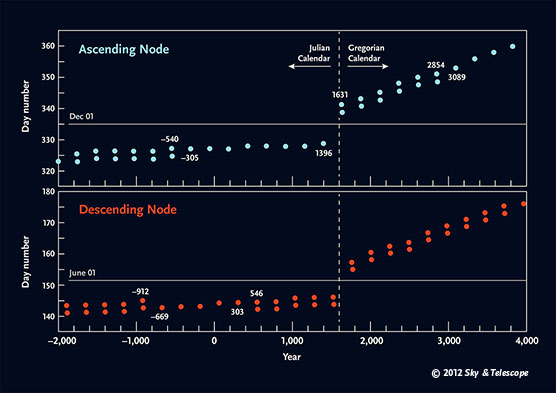
By plotting the number of days into each year when a transit of Venus occurs, it's easy to see the long-term behavior of transits of Venus, and the fact that we're fortunate to live during a period when we get to see two transits at both the ascending and descending nodes. Note the change from the Julian Calendar to the Gregorian Calendar around the year 1600. Retired NASA astronomer Fred Espenak provided S&T with the data for this diagram.
Courtesy Sky & Telescope
https://skyandtelescope.org/astronomy-news/observing-news/transits-of-venus-explained/ |
|
|
|
|
Aprenda sobre el extraño ciclo de tránsito de Venus.
Venus siguió estas trayectorias a través del Sol en 2004 y 2012. La Tierra no vio un tránsito en 1996 y no verá otro en 2020.
Ciencia y tecnología : Gregg Dinderman
Quienes conocen los ritmos del cielo nocturno saben que ciertos ciclos astronómicos se repiten una y otra vez. Estos incluyen el ciclo estacional anual de la Tierra en su órbita alrededor del Sol, el ciclo de 29 días y medio de las fases lunares y el hecho de que Marte entra en oposición cada 26 meses. Incluso los eclipses solares y lunares se producen en ciclos de saros.
Pero comparado con estos otros ciclos, el ciclo actual de tránsitos de Venus es extraño. ¡ De verdad, extraño! Este artículo explica por qué los tránsitos de Venus son tan raros que el que se producirá el 5 y 6 de junio será el último que verás, por qué el ciclo tiene un patrón tan peculiar y por qué el ciclo actual no durará para siempre. (El tránsito ocurre el 5 de junio en el hemisferio occidental y el 6 de junio en el hemisferio oriental).
Cómo obtener un tránsito de Venus
Para que se produzca un tránsito de Venus, deben ocurrir dos eventos simultáneamente, y es raro tener una sincronía tan perfecta.
Los tránsitos de Venus sólo pueden ocurrir cuando Venus pasa entre el Sol y la Tierra, un punto en su órbita conocido como conjunción inferior.
CALLE
En primer lugar, y lo más obvio, Venus debe moverse directamente entre la Tierra y el Sol para que un observador imaginario que mirase el sistema solar desde arriba vea los tres cuerpos formando una línea perfectamente recta. Cuando esto ocurre, los astrónomos dicen que Venus ha alcanzado una conjunción inferior . Venus orbita el Sol más rápido y en una órbita más pequeña, y alcanza estas conjunciones inferiores cada 584 días terrestres.
Si Venus y la Tierra orbitaran alrededor del Sol en el mismo plano, disfrutaríamos de un tránsito de Venus cada 584 días, y el tránsito del 5 de junio no sería tan importante. Pero en realidad, el plano orbital de Venus está inclinado 3,4 grados con respecto al plano orbital de la Tierra. Los planos se cruzan en dos puntos llamados nodos . Para que se produzca un tránsito, Venus debe estar en conjunción inferior al mismo tiempo que está en un nodo. Esta alineación tridimensional perfecta no ocurre muy a menudo. Normalmente, la órbita inclinada de Venus significa que se encuentra "encima" o "debajo" del Sol cuando se trata de conjunción inferior.
La órbita de Venus alrededor del Sol está inclinada respecto a la órbita de la Tierra (exagerada aquí para mayor claridad). Los tránsitos de Venus solo pueden ocurrir en los dos nodos, donde se intersecan los planos orbitales de Venus y la Tierra.
Ciencia y tecnología : Gregg Dinderman
Uno de estos nodos ocurre a principios de junio y el otro a principios de diciembre, lo que significa que estos son los únicos momentos en que pueden ocurrir tránsitos de Venus. A principios de junio, Venus parece estar descendiendo (o hacia el sur), por lo que los astrónomos lo llaman nodo descendente . A principios de diciembre, Venus se mueve hacia arriba (o hacia el norte) en su órbita, por lo que se trata de un nodo ascendente .
Un ciclo extraño
Hasta ahora, las cosas parecen bastante sencillas y directas. Pero aquí es donde el tránsito del ciclo de Venus empieza a volverse extraño (aunque también bastante interesante).
Durante los últimos siglos y los próximos, estas alineaciones tridimensionales perfectas se producen a intervalos de 8, 105½, 8 y 121½ años. En realidad, considérelo un ciclo de 243 años, con pares de tránsitos separados por tan solo 8 años, pero con cada par separado por más de un siglo.
Se muestran las trayectorias de Venus a través del Sol desde el año 1388 hasta el 2012. La fila superior muestra los tránsitos de diciembre en el nodo ascendente de Venus y la fila inferior muestra los tránsitos de junio en el nodo descendente de Venus.
CALLE
Los tránsitos de nodos ascendentes ocurrieron en diciembre de 1631, 1639, 1874 y 1882. Los siguientes tránsitos ocurrieron en diciembre de 2117 y 2125. Los tránsitos de nodos descendentes ocurrieron en junio de 1761, 1769 y 2004, y el siguiente tuvo lugar el 5 y 6 de junio de 2012. Posteriormente, los tránsitos de nodos descendentes ocurrieron en junio de 2247 y 2255.
En los tránsitos de nodos descendentes con una separación de 8 años, Venus cruza la parte sur del disco solar en el primer tránsito y la parte norte en el segundo. Por eso, Venus cruzará la parte norte del disco solar el 5 o 6 de junio. Cuando Venus llegó a la conjunción inferior en 1996, estaba demasiado por debajo del Sol para transitar su disco. Y en 2020, estará demasiado alto.
Lo contrario ocurre con los tránsitos de nodos ascendentes. El primer tránsito de un par de ocho años cruza la parte norte del Sol, mientras que el segundo cruza la mitad sur.
Entonces, ¿por qué Venus tarda “solo” 105 años y medio en pasar de un par de tránsitos de junio a un par de tránsitos de diciembre, mientras que tarda 121 años y medio en pasar de un par de tránsitos de diciembre a un par de tránsitos de junio? Esta asimetría se debe a que la órbita de la Tierra alrededor del Sol no es exactamente un círculo perfecto. Es ligeramente alargada (el término técnico es excéntrica ), desviándose de un círculo perfecto en aproximadamente un 3 %. En cambio, la órbita de Venus está tan cerca de ser un círculo perfecto que su minúscula elongación puede ignorarse en este análisis.
La órbita alargada (excéntrica) de la Tierra (exagerada en el diagrama) explica por qué hay una asimetría en la cantidad de tiempo entre un par de tránsitos y el siguiente.
CALLE
El diagrama de la derecha (en el que se exagera la excentricidad orbital de la Tierra para mayor claridad) muestra lo que está sucediendo. Básicamente, la Tierra está cerca de su punto más alejado del Sol ( afelio ) en junio y cerca de su punto más cercano al Sol ( perihelio ) en diciembre. Cuando la Tierra está más cerca de la poderosa gravedad del Sol, se mueve ligeramente más rápido en su órbita que cuando está más lejos del Sol. La diferencia en la velocidad orbital de la Tierra desde el perihelio hasta el afelio produce una brecha más larga (121½ años) entre el tiempo que tarda en alinearse entre los tránsitos de diciembre y junio que los 105½ años que tarda en alinearse entre los tránsitos de junio y diciembre.
Nada bueno dura para siempre
En el futuro, los tránsitos de Venus serán aún más raros. Este diagrama muestra la trayectoria que Venus seguirá frente al Sol en 3089. En 3081 y 3097, la trayectoria de Venus no tocará el Sol (desde la perspectiva terrestre).
CALLE
Desafortunadamente para los astrónomos que viven en un futuro lejano, la frecuencia de los tránsitos disminuirá. Tanto las órbitas de Venus como las de la Tierra precesan, lo que significa que giran durante largos períodos de tiempo para producir un patrón similar a una roseta. En otras palabras, el perihelio de la Tierra se desplaza en su órbita, al igual que el de Venus. Debido a la precesión, los astrónomos terrestres solo podrán disfrutar de un tránsito de nodo ascendente durante siglos después del año 3000. Verán un tránsito de nodo descendente en 3089, pero ocho años después, en 3097, Venus alcanzará una conjunción inferior demasiado por encima del Sol como para transitar su disco.
Y a lo largo de decenas de miles de años, el ciclo de 243 años acabará cambiando a medida que la excentricidad de las órbitas de Venus y la Tierra evolucione debido a las perturbaciones gravitacionales de otros planetas. En escalas de tiempo aún mayores, se imponen efectos caóticos, y las matemáticas se vuelven tan inciertas que los astrónomos actuales ya no pueden predecir cuándo ocurrirán estas raras alineaciones celestes ni cómo serán los ciclos futuros.
Pero por ahora, puedes estar seguro de que habrá un tránsito de Venus el 5 o 6 de junio y, a menos que la medicina moderna haga un milagro, esta será la última oportunidad que tendrás de ver un tránsito de Venus desde la superficie de la Tierra.
Al representar gráficamente el número de días de cada año en que ocurre un tránsito de Venus, es fácil observar su comportamiento a largo plazo y la suerte de vivir en un período en el que podemos observar dos tránsitos tanto en el nodo ascendente como en el descendente. Observe el cambio del calendario juliano al gregoriano alrededor del año 1600. El astrónomo jubilado de la NASA, Fred Espenak, proporcionó a S&T los datos para este diagrama.
Cortesía de Sky & Telescope
|
|
|
 Primer
Anterior
2 a 8 de 23
Següent
Primer
Anterior
2 a 8 de 23
Següent Darrer
|


 Tema anterior
.jpg)


.jpg)






 6
6