|
|
La petite mais insurmontable différence entre les approximations de Phi² telles que 55/21 et Phi² lui-même est comme l'écart entre les mains d'Adam et de Dieu, sur le plafond de la Chapelle Sixtine.
The Creation of Adam by Michelangelo
.https://fr.mercurialpathways.com/post/49-marques-irr%C3%A9gulieres-sur-une-coud%C3%A9e
|
|
|
|
|
https://www.willemwitteveen.com/the-royal-cubit/ |
|
|
|
|
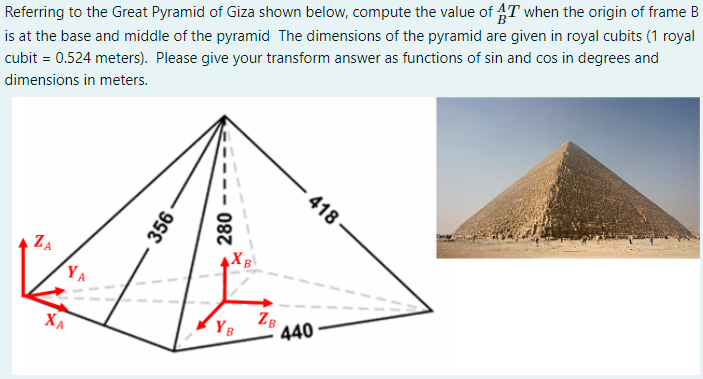
The Great Pyramid of Giza was built using 280 royal cubits as a unit of measurement for height, and 440 royal cubits for the base length. The royal cubit was an ancient Egyptian unit of measurement that was slightly longer than the common cubit. |
|
|
|
|
The dimensions of the pyramid were 280 royal cubits (146.7 m; 481.4 ft) high, a base length of 440 cubits (230.6 m; 756.4 ft), with a seked of 512 palms (a slope of 51°50'40"). The Great Pyramid was built by quarrying an estimated 2.3 million large blocks, weighing 6 million tonnes in total. |
|
|
|
|
|
PART 2 - THE GOLDEN SECTION
The Greek letter phi (φ) signifies the golden section, also known as the divine proportion of 1.618 to one. The mathematical formula for φ is the square root of five plus one, divided by two. If a line is divided with the ratio of φ between the longer segment and the shorter segment, the ratio between the whole line and the longer segment is also φ. Given a length of one for the shorter segment, the length of the longer segment is φ and the length of the entire segment is φ plus one. φ plus one is also equal to φ²:
1.618 + 1 = 2.618 and
1.618 x 1.618 = 2.618
Given a length of one for the longer segment, the shorter segment is 1/φ (.618) and the length of the entire segment is φ. 1/φ is also equal to φ minus one:
1 ÷ 1.618 = .618 and
1.618 minus 1 = .618
There is also an extremely close mathematical relationship between φ and π expressed as φ² x 6 = π x 5 (2.618 times 6, divided by 5, equals 3.1416). There is an ongoing dispute about whether or not there was an ancient awareness of φ and π. In the ancient world, φ existed naturally in the proportions and growth rates of plant and animal species, as well as spirals ranging from microscopic to flowering plants and seashells to the spiral arms of the galaxy. The π ratio between the diameter and the circumference of a circle also existed naturally in the ancient world. It has also been shown that φ and π existed in many man-made ancient buildings, including the great pyramid of Giza.
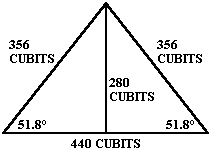
The ancient Egyptian royal cubit, equal to 20.625 English inches, was used to build the great pyramid. The height of the pyramid is 280 cubits and the baselength of the sides at ground level is 440 cubits. The ratio between the height and two baselengths of the pyramid is an accurate expression of π (880/280 = 3.1428). The slant height of the pyramid is 356 cubits. The ratio between the baselength of the pyramid and the two slant heights that form the pyramid triangle is an accurate expression of φ (712/440 = 1.618).
Ninety miles northeast of Angkor Wat are the Angkor temples at Prassat Preah Vihear. Preah Vihear is 4754 miles from the Great Pyramid. The line of ancient sites crosses over the Great Pyramid and Angkor Vihear.
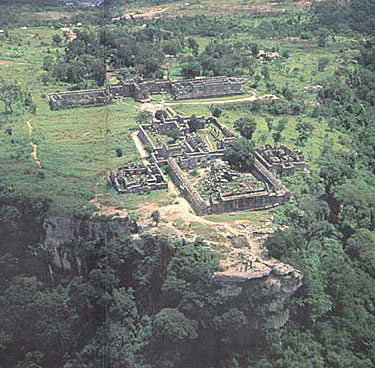
Angkor Prassat Preah Vihear
Twenty five miles northwest of the city of Nazca is a figure known as the Hummingbird. The Hummingbird is 7,692 miles from the Great Pyramid. The line of ancient sites also crosses over the Hummingbird.
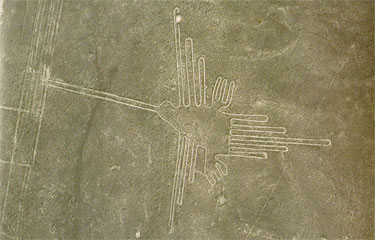
The Hummingbird
The relationship between the distances from Angkor Vihear to the Great Pyramid and from the Great Pyramid to the Nazcan Hummingbird is also a precise expression of φ:
4,754 x 1.618 = 7,692
Because the Hummingbird and Angkor Vihear are antipodal sites, with a distance between them of one-half of the circumference of the earth, two Golden Section relationships between these three sites are shown by the circumference of the earth along the line of ancient sites:
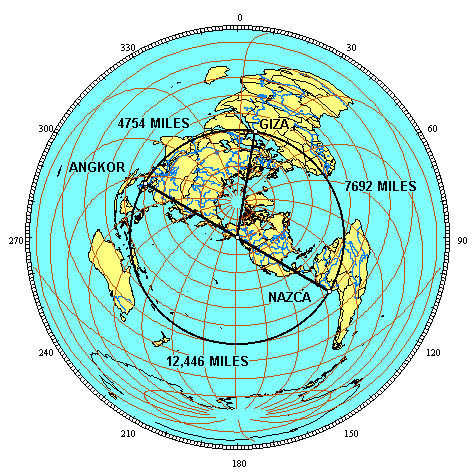
4,754 x 1.618 = 7,692
4,754 + 7,692 = 12,446, and
7,692 x 1.618 = 12,446
These Golden Section relationships may also be diagramed on a straight line:

The line of ancient sites is a line, from the perspective of the first illustration in Part One, and it is a circle, from the perspective of the azimuthal projection above. The line and the circle are found in the greek letter φ and the number 10. Zero and one are also the first two numbers and the only two numbers in the binary code.
The φ relationships between these sites are reflected repeatedly in the first 500 Fibonacci numbers. The first three prime numbers, 2, 3 and 5, approximate the intervals along the circumference of 20%, 30% and 50%, between these three sites. This same percentage of the circumference relationship, accurate to three digits, is found in Fibonacci numbers 137-139:
| Percentage of circumference: |
First three digits of Fibonacci numbers: |
| Angkor to Giza: 19.1% |
#137: 191... (Prime) |
| Giza to Nazca: 30.9% |
#138: 309... |
| Nazca to Angkor: 50.0% |
#139: 500... |
The next prime Fibonacci number after #137 is #359. The distances between these sites, in miles, is reflected by Fibocacci numbers 359-361, accurately to five digits:
| Distance between sites: |
First five digits of Fibonacci numbers: |
| Angkor to Giza: 4,754 miles |
#359: 47542... (Prime) |
| Giza to Nazca: 7,692 miles |
#360: 76924... |
| Nazca to Angkor: 12,446 miles |
#361: 12446... |
http://home.hiwaay.net/~jalison/phi2.html |
|
|
|
|
|
Dimensions of the Cheops-pyramid (Khufu's pyramid)
Numbers and figures of the Cheops (Khufu) pyramid:
The pyramid of Khufu - Output / performance - Building material - Dimensions of the pyramid - Dimensions in Royal Cubits - Sources
 Cheops-pyramid (pyramid of Khufu) Cheops-pyramid (pyramid of Khufu)
Of the the famous Seven Wonders of the Ancient World the Great Pyramid of Khufu (Cheops) at Giza is the only one still standing. Even for modern men it is amazing how this man-made structure lasted so long.
The Giza pyramids must have made an incredible visual impact - at the edge of the desert three abstract geometrical symbols were rising, huge luminous white triangles reflecting the blinding light of the sun!
The pyramids on the Giza plateau are with 146.59m (Khufu / Cheops) and 143.87m (Khafre / Chefren) respectively the largest, however there are over 30 major pyramids and a myriad of smaller pyramids in Egypt.
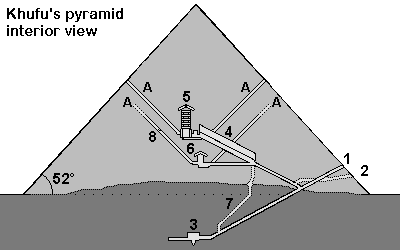
Cheops-Pyramid
1. Entrance 2. Entrance cut by grave robbers 3. Subterranean chamber 4. Grand Gallery 5. King's chamber, relieving chambers, granite portcullis slabs 6. Queen's chamber 7. Shaft 8. Limestone plugging the air shaft A= "Air shafts"
Output / performance
 Detailed calculations how many workers were necessary to build the pyramid Detailed calculations how many workers were necessary to build the pyramid
Overview pyramid building
Builder
------------------- |
|
Khufu (Chuefui-Chnum or Khnum-Khuf, Cheops in Greek) during the 4th dynasty of the old kingdom |
| Time to build |
|
Probably max. 23 years (Khufu reigned from 2551 to 2528 before Christ *). Herodotus writes about 10 years of preparation and 20 years of building (details of the text) |
| Per day |
|
With 2'500'000 stones 342 stones have to be moved daily (working during 365 days a year) or 431 stones daily (working during 290 days a year). |
|
Per minute
|
|
10-hour day: every 2 minutes a stone (34 to 43 per hour)
8-hour day: nearly a stone every minute (42 to 53 stones per hour)
|
| Rule of thumb |
|
| While construction the pyramid the rate of delivery was 1 stone weighting 2.5 tons every minute. |
For our calculations we assume 500 stones a day. This is a rough estimate, assuming a 8-hour day, during 290 days a year, with 20 years to build the pyramid. Also assuming, that more time had to be used for the huge granite blocks for the King's chamber and for the more difficult upper part of the pyramid, where work went slower than in the lower parts. There probably were also other factors delaying the building of the pyramid such as the weather or a temporary shortage of certain building materials.
|
Building materials for the Cheops-pyramid
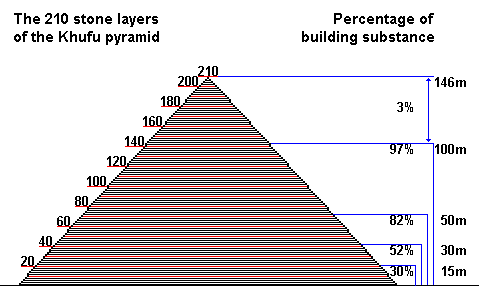
The Khufu-pyramid (Cheops) probably originally had 210 stone layers. At 50m height already 82% of the entire pyramid was built [3].
Quarrying stones for the pyramid
Shipping the stone blocks down the Nile to Giza
Transporting the stone blocks using a sledge on tracks
Löhner's rope roll
Stone blocks
------------------- |
|
2'300'000 stones |
| Casing blocks |
|
115'000 to 200'000 stones or 67'390m³ [1] |
| Total blocks |
|
2'500'000 stones |
| Stone layers |
|
Originally probably 210 stone layers, now only 201 layers [2] |
| Stone size |
|
The stone blocks usually are larger in the lower layers (1.5m = 3 cubit) and smaller in the upper layers. Most are between 1.5 and 2 cubit large (average of 127 x 127 x 71cm). 1 cubit = 0.524m - Details |
| Weight of the stone blocks |
|
With an average density of 2,6 - 2,9 t/m³ the large limestone blocks weighted 6.5 - 10 tons and the smaller ones about 1.3 tons. For all calculations on this website an average weight of 2.5 tons was used. |
| Special blocks |
|
For the King's chamber granite blocks weighting 40 to 50 tons were used |
| Total weight |
|
6'500'000 tons (average weight of a block was about 2.5 tons) |
| Pyramidion |
|
The final stone on the top was a large block in the shape of a pyramid. It was perhaps around 1.5m by 1.5m wide and 1.3m high (about 3 cubits). It was made from white Tura limestone (Turah), granite or perhaps diorite and perhaps gold plated. More information |
| Building materials |
|
Pyramid: Nummulite limestone from quarries about 200-400m south of the pyramid were used for the core stones.
Casing: light white limestone, so called Tura-limestone from quarries from the eastern shores of the Nile
King's chamber: Rose granite from Aswan 900km away
Further materials: Graywacke from the Wadi Hammamat (Eastern desert), basalt from the northern Faiyum
Map of quarries in Egypt
|
Dimensions of the pyramid of Khufu
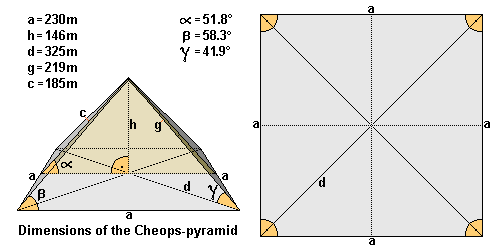
Length (a)
------------------- |
|
The average length of the edge is ~ 230.360m (230,12m = 440 cubits). Northern edge 230.328m - eastern edge 230.369m - southern edge 230.372m - western edge 230.372m. Largest difference is only 4.4cm. [3] |
| Height (h) |
|
Originally 146.59m high (= 280 cubits), the pyramid is now only 138.75m high [7] |
| Diagonal (d) |
|
325.77m |
| Ridge (g) |
|
219m |
| Height of the lateral surface |
|
186.42m |
| Pyramid angle α |
|
51° 50' 40' = inclination of the lateral surface (= 52° rounded off) [3] which corresponds to a seked of 5½ palms |
| Pyramid angle β |
|
58.3° = the two angles of the triangular lateral surface (62° = angle of the apex or tip of the pyramid) - nearly forming an equilateral triangle! |
| Pyramid angle γ |
|
41.9° = angle of the ridge |
| Corner angle |
|
Right angle base with angles from 89° 59' to 90° |
| Base area |
|
53'065.73m² |
| Superficies surface |
|
85'890.69m² |
| Pyramid volume |
|
2'592'968.43m³ including the rock core. This would be a cube with a length of 137.38m. Probable volume of stones used: 2'583'283m³ [1] or 2'326'501m³ [2]. |
| Alignment |
|
Exactly to the north (deviation only 2' 28') |
| Latitude and longitude |
|
N 29° 58’ 44.3830” latitude and E 31° 07’ 57.0194” longitude [5] |
| Altitude |
|
The base of the pyramid of Khufu lies about 60m above sea level, so the tip of the pyramid used to be on 206m above sea level [6]. |
Alignment of the pyramids and controlling the shape of the pyramid (north-south alignment etc.)
Dimensions of the pyramid of Khufu in Egyptian Royal Cubits
 |
Length (a) |
|
440 Royal Cubits |
| Height (h) |
|
280 Royal Cubits |
| Height of the lateral surface (c) |
|
356 Royal Cubits (356.09) |
| Diagonal (d) |
|
622.25 Royal Cubits |
| Ridge (g) |
|
418.56 Royal Cubits |
| Pyramid angle α |
|
51.843° |
| Pyramid angle β |
|
58.3° |
| Pyramid angle γ |
|
41.9° |
| Corner angle |
|
90° |
It is suggested, that the Egyptians used a right angled triangle to determinate the angle of inclination of the pyramid, using the numbers a=11 and b=14 with c=17.8 (or a=22 - b=28 - c= 35.6). This determines a so called seked of 5½ palms.
Alignment of the pyramids and controlling the shape of the pyramid (seked)
Sources
[1] M. Lehner The Complete Pyramids of Egypt
[2] G. Goyon Die Cheops-Pyramide
[3] R. Stadelmann Die grossen Pyramiden von Giza
[4] F. Abitz Der Bau der grossen Pyramide mit einem Schrägaufzug
[5] GPS-coordinates of a brass disk on top of the pyramid of Khufu, Giza Plateau Mapping Project (GPMP)
[6] Maps of the Giza Plateau Mapping Project show the altitude as 60m
[7] D. Arnold Building in Egypt
* Dates according to conventional Egyptian chronology are used in this website. These are based on several list of the dynasties of pharaohs, for example the Aegyptiaca of Manetho of Sebennytos.
https://www.cheops-pyramide.ch/khufu-pyramid/khufu-numbers.html |
|
|
|
|
72. The Egyptian Royal Cubit, the Inch, the Metre, and 254
Updated: Apr 16, 2024
A centimetre is 2.54 inches. At Giza, the number 254 is found as a factor which links various linear dimensions. What does it mean to multiply or divide a linear measure by 254? What does it mean to convert inches to metres, or vice versa?
254 is not the only factor that links the key dimensions at Giza, but it is a common theme. The other factors seem to be based in geometry (such as π , √3), and astronomy (such as 223, 235 and 29.53059).
As 29.53059 x 4/3 inches are close to 10 000 / 254 inches, as are 365.242199 / 354.36708 x 100 / 2.61803 inches, they can be used almost interchangeably to interpret the dimensions at Giza.
10000 / 254 = 39.3700787402
29.53059 x 4/3 = 39.37412
365.242199 / 354.36708 x 100 / 2.61803 = 39.368871
The number 254 is linked to both astronomy and geometry. It is linked to pi, to Phi squared, and to the solar and lunar years, as well as being the number of sidereal months in a Metonic period.
When linear dimensions at Giza are multiplied or divided by 254, it's not necessarily that in one place inches were used and in another metres were used. The metre and the inch can both be said to co-exist at Giza, and even if the metre hadn't appeared in the 18th century it would still appear at Giza. But the use of 254 could in fact be a reference to the ratio between the solar and lunar years combined with Phi squared, or to pi divided by the mean number of lunations in a year.
If we think of possible links between the metre, the inch and the Egyptian royal cubit, the number 254 also makes an appearance, since 2.54 cm are an inch. Converting between inches and metres allows us to see ways of thinking about the Egyptian royal cubit, in relation to geometry and astronomy.
The links between these three units, inch, metre and cubit, and to astronomy and geometry, may hint at something of the symbolic and religious significance of the cubit in ancient Egyptian cosmology and astronomy. It could also explain some of the enduring appeal of the metre and the inch.
Another interesting connection to be made to the number 254 is that, as Howard Crowhurst points out in his book Carnac the Alignments, there are 127 kerb stones around the base of Knowth, in Ireland.
127 is a major prime number (...) and as such is a mirror of the fundamental prime number, One. But it is also half of 254 which is the number of lunar orbits in the 19 year Metonic cycle which also counts 235 full moons. The exact relationship between the metre length and the foot is also to be found through this number since 1 inch = 2.54 cm. Also a right angled triangle with a hypotenuse of 254 m and a base of 235 m has a third side measuring 100.0037 x √10 feet. (1)
The presence of the number 127 in Ireland seems to suggest a link to the repeated presence of 254 at Giza. The 127 stones at Knowth also suggest we should take the inch - metre connection seriously when analysing ancient sites.
https://www.mercurialpathways.com/post/72-the-egyptian-royal-cubit |
|
|
 Primer
Anterior
2 a 9 de 24
Següent
Primer
Anterior
2 a 9 de 24
Següent Darrer
|


 Tema anterior