

 Previous subject

 First
First 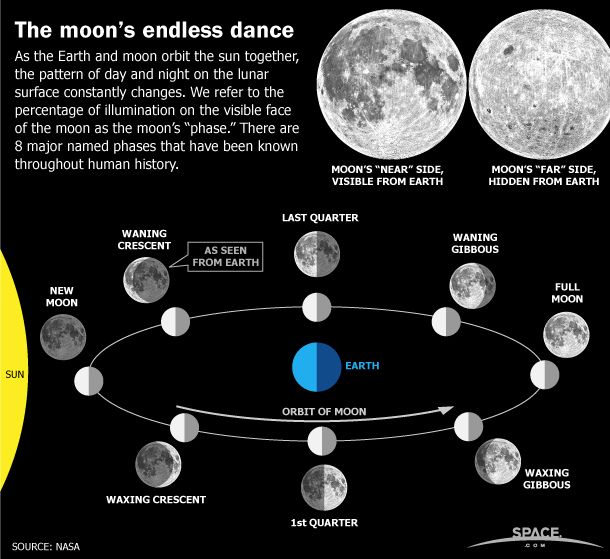


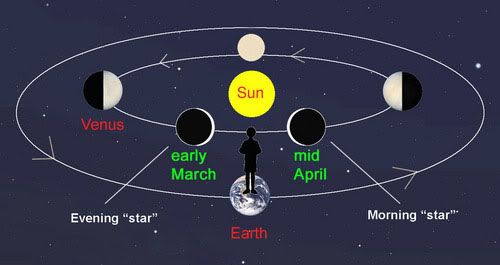
Venus always looks bright, right? Well, yes and no. Its brightness varies with its phase and distance from the Earth. The planet is faintest when located on the opposite side of the sun from the Earth. Ironically, that’s also when it’s in “full moon” phase. But because it’s so far away at that time the Full Venus is tiny and about three times fainter than when it’s a crescent. At crescent phase the planet is much closer to the Earth (see diagram below).
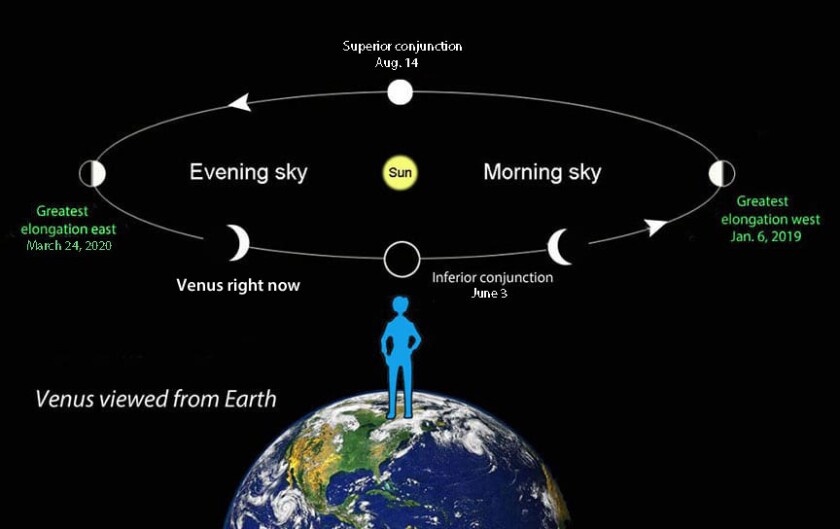
On Monday night, April 27th Venus achieved greatest brilliancy at magnitude –4.7, the same brightness of a day-old moon if you could scrunch it down into a point of light. Greatest brilliancy strikes a balance between the size of the planet and how much of it is illuminated. Venus is brightest when relatively near the Earth at the same time it’s a thick crescent. While the planet will continue to approach the Earth in the coming weeks its crescent will enlarge but also thin. With less area illuminated by sunlight Venus will fade slightly.

You can see the planet’s phase easily in any telescope or spotting scope. Skywatchers with 10x binoculars should also be able to discern the crescent during early dusk when the still-blue sky tempers its glare.
Why is Venus so darn bright in the first place? In a word — clouds. Overcast skies have been the rule across the planet for probably millions of years. While clouds keep the planet’s surface in perpetual gloom the view from this side is nothing short of amazing. Sunlight reflected off that cloud cover is responsible for Venus’s brilliance.
Earthly clouds are made of droplets or crystals of water but Venusian clouds are composed of toxic sulfuric acid droplets and sulfur dioxide. We see the planet’s upper cloud deck some 37-43 miles 60-70 km above the surface, about 3-4 times the altitude of high cirrus clouds on Earth. The planet’s water boiled off long ago, leaving sulfur dioxide from past (and possibly present) volcanic eruptions as the source of its clouds.
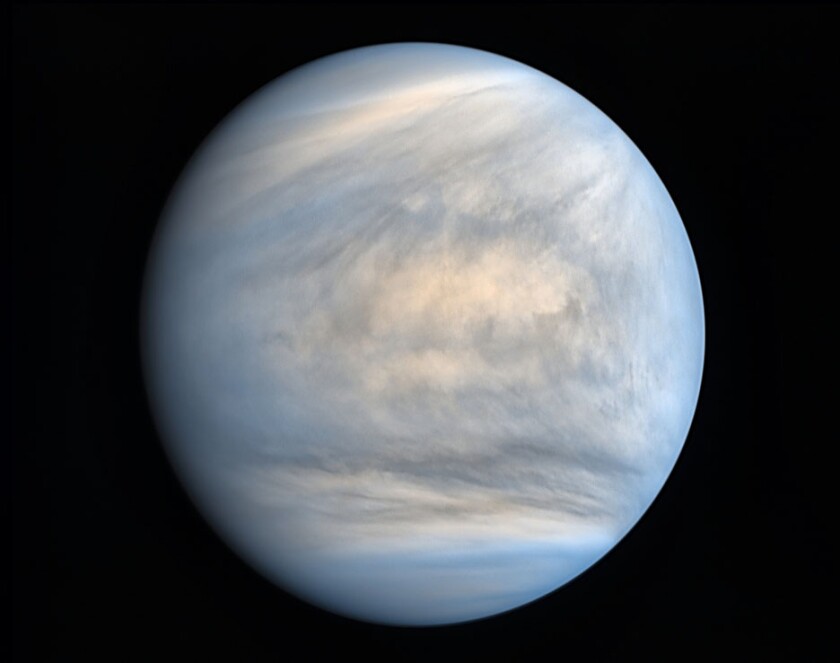
Although Venus spins very slowly, taking 243 to turn once on its axis, the upper clouds rotate around the planet once every four Earth days. The planet’s atmosphere is composed of 96.5 percent carbon dioxide which combines forces with sulfur dioxide to trap heat and drive up the surface temperature to 864° F (462° C). Not what you’d call friendly to life.
But at the height of the clouds the temperature is much like that at the surface of the Earth making Venus’s upper atmosphere one of the most potentially habitable locales in the solar system. Even the late Carl Sagan considered the possibility that they might harbor vast colonies of bacteria. In a 1963 paper he hypothesized that the dark patches seen in ultraviolet light photographs of the planet called “ unknown UV absorbers ” could be made of bacteria that absorbed the light. Exactly what the dark splotches are remains a mystery to this day.
Mystery. Now there’s a fine word. It’s mystery that fuels curiosity and the urge to seek answers to our questions. Mystery is at the heart of everything. Nature is forever handing out business cards inviting us to “call”. I hope you call on Venus tonight.