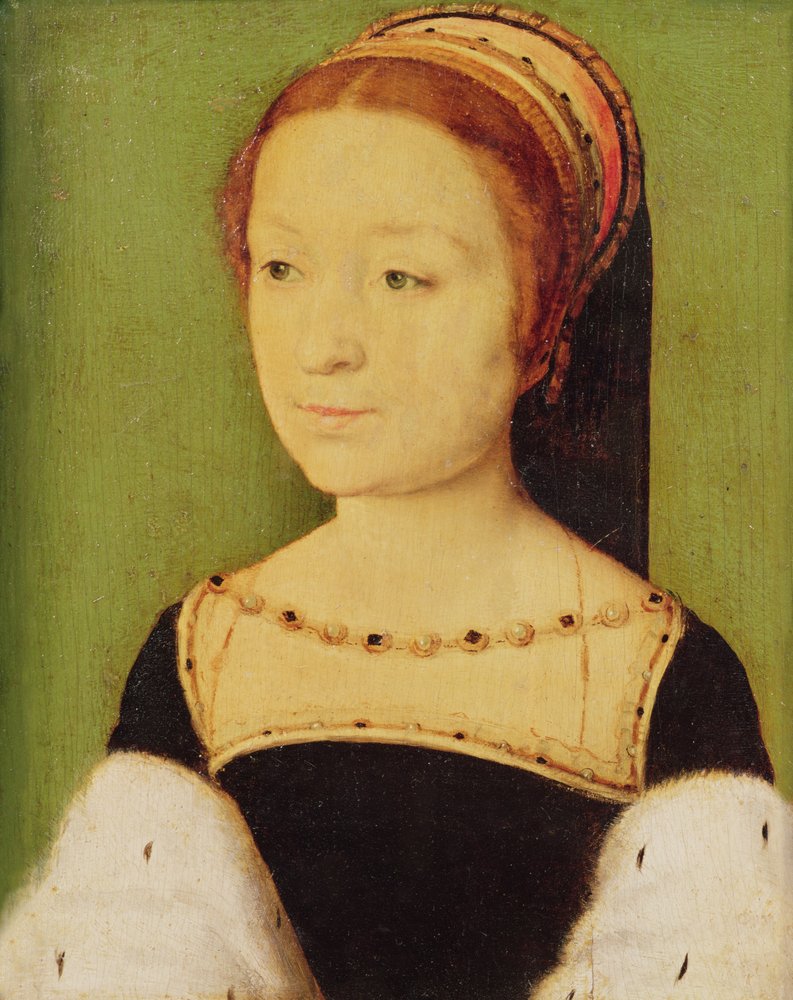
Madeleine of Valois (10 August 1520 – 7 July 1537) was a French princess who briefly became Queen of Scotland in 1537 as the first wife of King James V. The marriage was arranged in accordance with the Treaty of Rouen, and they were married at Notre-Dame de Paris in January 1537, despite French reservations over her failing health. Madeleine died in July 1537, only six months after the wedding and less than two months after arriving in Scotland, resulting in her nickname, the "Summer Queen".
She was frail from birth, and grew up in the warm and temperate Loire Valley region of France, rather than at Paris, as her father feared that the cold would destroy her delicate health. Together with her sister, Margaret, she was raised by her aunt, Marguerite de Navarre until her father remarried and his new wife, Eleanor of Austria, took them into her own household.[1] By her sixteenth birthday, she had contracted tuberculosis.[2]
Three years before Madeleine's birth, the Franco-Scottish Treaty of Rouen was made to bolster the Auld Alliance after Scotland's defeat at the Battle of Flodden. A marriage between a French princess and the Scottish King was one of its provisions.[3] In April 1530, John Stewart, Duke of Albany, was appointed commissioner to finalize the royal marriage between James V and Madeleine.[4] However, as Madeleine did not enjoy good health, another French bride, Mary of Bourbon, was proposed.[5]
James V sent his herald James Atkinhead to see Mary of Bourbon,[6] and a contract was made for James to marry her. King James travelled to France in 1536 to meet Mary of Bourbon, but smitten with the delicate Madeleine, he asked Francis I for her hand in marriage. Fearing the harsh climate of Scotland would prove fatal to his daughter's already failing health, Francis I initially refused to permit the marriage.[7]
James V met Francis I and the French royal household between Roanne and Lyon on 13 October.[8] He continued to press Francis I for Madeleine's hand, and despite his reservations and nagging fears, Francis I reluctantly granted permission to the marriage only after Madeleine made her interest in marrying James very obvious. The court moved down the Loire Valley to Amboise, and to the Chteau de Blois, and the marriage contract was signed on 26 November 1536.[9]
In preparation for the wedding, Francis I bought clothes and furnishings for Madeleine; jewels and gold chains were supplied by Regnault Danet, linen and cloths by Marie de Genevoise and Phillipe Savelon, clothes by the tailors Marceau Goursault and Charles Lacquait, veils by Jean Guesdon, and trimmings by Victor de Laval, who also made passementerie for a bed that Francis gave the couple. The goldsmith Thibault Hotman made silver plate for Madeleine.[10][11] The merchants of the royal "argenterie", René Tardif and Robert Fichepain supplied silks and woollen cloth.[12] A quantity of gold and silver trimmings for embroidering the clothes of Madeleine and her ladies were ordered from Baptiste Dalverge, a wire-drawer.[13] A platform walkway was constructed from the Bishop's Palace to Notre-Dame de Paris.[14]
Francis I provided Madeleine with a generous dowry of 100,000 écu, and a further 30,000 francs settled on James V. According to the marriage contract made at Blois, Madeleine renounced her and any of her heirs' claims to the French throne. If James died first, Madeleine would retain for her lifetime assets including the Earldoms of Fife, Strathearn, Ross, and Orkney with Falkland Palace, Stirling Castle, and Dingwall Castle, with the Lordship of Galloway and Threave Castle.[19]
Coat of arms of Madeleine of Valois as Queen consort of Scots
In February the couple moved to Chantilly, to Senlis and Compiègne, where James received the Papal gift of hat and sword.[20][21][22] They stayed two nights at the Chteau de La Roche-Guyon.[23] After months of festivities and celebrations, the couple left France for Scotland from Le Havre in May 1537. The French ships were commanded by Jacques de Fountaines, Sieur de Mormoulins.[24] On 15 May, English sailors sold fish to the Scottish and French fleet off Bamburgh Head.[25] Madeleine's health deteriorated even further, and she was very sick when the royal pair landed in Scotland. They arrived at Leith at 10 o'clock on Whitsun-eve, 19 May 1537.[26]
According to John Lesley the ships were laden with her possessions;
"besides the Quenes Hienes furnitour, hinginis, and appareill, quhilk wes schippit at Newheavin and careit in Scotland, was also in hir awin cumpanye, transportit with hir majestie in Scotland, mony costlye jewells and goldin wark, precious stanis, orient pearle, maist excellent of any sort that was in Europe, and mony coistly abilyeaments for hir body, with mekill silver wark of coistlye cupbordis, cowpis, & plaite."[27]
A list or inventory of wedding presents from Francis I also survives, including Arras tapestry, cloths of estate, rich beds, two cupboards of silver gilt plate, table carpets, and Persian carpets.[28][29] Francis I also gave James V three of the ships, the Salamander, Morsicher, and Great Unicorn.[30] Madeleine took up residence at Holyrood Palace on 21 May 1537.[31]
The French courtiers who came with her to Scotland to form her household included; her former governess, Anne de Boissy Gouffier, Madame de Montreuil; Anne de Viergnon, Madame de Bren or Bron; Anne Le Maye; Marguerite de Vergondois her chamberer; Marion Truffaut, her nurse; her secretary, Jean de Langeac, Bishop of Limoges; master household, Jean de St Aubin; squires and cupbearers Charles de Marconnay and Charles du Merlier; the physician Master Partix; pages John Crammy and Pierre de Ronsard; furrier Gillan; butcher John Kenneth; barber Anthony.[32][33][34] A physician from Paris, Jacques Lecoq, set out later to join her in Scotland.[35]
Madeleine wrote to her father from Edinburgh on 8 June 1537 saying that she was better and her symptoms had diminished. James V had written to Francis I asking him to send the physician Master Francisco, and Madeleine wrote that he was now needed only to perfect her cure. She signed this letter "Magdalene de France".[36] However, a month later, on 7 July 1537, (a month before her 17th birthday), Madeleine, the so-called "Summer Queen" of Scots, died in her husband's arms at Holyrood Palace.[37]
James V wrote to Francis I informing him of his daughter's death.[38] He called Madeleine "my dear companion" – votre fille, ma trés chére compaigne.[39]
Queen Madeleine was interred in Holyrood Abbey in Edinburgh, next to King James II of Scotland. Black mourning clothes were worn at her funeral, and an order was sent to the merchants of Dundee to provide black cloth. Her household servants were provided with "dule gowns", and horses at the procession had black cloths and trappings.[40][41] The chapel at Holyrood Palace was draped with cloth from Milan.[42] The grave was desecrated by a mob in 1776 and her allegedly still beautiful head was stolen.[43]
One of her gentlewomen, Madame de Montrueil or Motrell, visited London on her way back to France. She said that Madeleine "had no good days after her arrival there (in Scotland), but always sickly with a catarrh which descended into her stomach, which was the cause of her death".[44]
An inventory made of the king's goods in 1542 includes some of her clothes, furnishings for her chapel, six stools for her gentlewomen to sit upon, and gold cups and other items made for her when she was a child.[45]
Madeleine's marriage and death were commemorated by the poet David Lyndsay's Deploration of Deith of Quene Magdalene; the poem describes the pageantry of the marriage in France and Scotland:
O Paris! Of all citeis principall! Quhilk did resave our prince with laud and glorie, Solempnitlie, throw arkis triumphall. [arkis = arches] * * * * * * Thou mycht have sene the preparatioun Maid be the Thre Estaitis of Scotland In everilk ciete, castell, toure, and town * * * * * * Thow saw makand rycht costlie scaffalding Depaynted weill with gold and asure fyne * * * * * * Disagysit folkis, lyke creaturis devyne, On ilk scaffold to play ane syndrie storie Bot all in greiting turnit thow that glorie. [greiting = crying: thow = death][46]
Less than a year after her death, following negotiations completed by David Beaton, James V married the widowed Mary of Guise. She had attended his wedding to Madeleine, and perhaps her uncle, Jean, Cardinal of Lorraine, suggested her to Francis I as a bride for the Scottish king.[48] Twenty years later, listed amongst the treasures in Edinburgh Castle were two little gold cups, an agate basin, a jasper vase, and crystal jug given to Madeleine when she was a child in France.[49]
Pope Francis waves to the crowd from the Speakers Balcony at the US Capitol, September 24, 2015, in Washington, DC. Pool/Getty Images
If President Barack Obama had delivered the text of Pope Francis’s speech to Congress Thursday as a State of the Union address, he would have risked being denounced by Republicans as a socialist.
While most Republicans chose not to complain, and Democrats tried not to gloat, Francis’s speech to Congress was stunning in the breadth, depth, and conviction of its progressivism. That might not have been fully and immediately appreciated by everyone in the House chamber because the combination of Francis’s sotto voce delivery and his heavily accented English made it difficult, lawmakers said, to grasp everything he was saying.
But there was no mistaking his thrust. He made detailed arguments for openness to immigrants, addressing the human roots of climate change, closing the gap between the rich and the poor, and ending the death penalty — all of which invigorated the Democrats in the room.
“It was pretty progressive. He had a little right-to-life stuff in it,” Rep. James Clyburn, the third-ranking House Democrat, said as he cracked a smile thinking about how Republicans would receive the speech. “That’s enough for them.”
The pope isn’t going to change many hearts and minds in the badly divided Congress, lawmakers said, but the moment provided a brief respite from political warfare. Several presidential candidates, including Sens. Bernie Sanders, Lindsey Graham, Marco Rubio, and Ted Cruz, as well as Ben Carson, attended.
Rubio, a Roman Catholic, said in a brief interview that Francis “struck the right tone.” Sanders, a self-described socialist, seemed to like the content even more.
“Pope Francis is clearly one of the important religious and moral leaders not only in the world today but in modern history,” he said in a statement released after the speech. “He forces us to address some of the major issues facing humanity: war, income and wealth inequality, poverty, unemployment, greed, the death penalty and other issues that too many prefer to ignore.”
Democrats were eager enough to present Congress as united that they joined a Republican-led standing ovation when Francis told lawmakers of “our responsibility to protect and defend human life at every state of its development.” Several of them said it was out of respect for the pope. But there was another good reason: It strengthened the perception that the whole speech — most of which they liked — carried unifying themes.
Unity was good for Democrats because the speech favored their policies
Francis was interrupted a few times by whoops from the Democratic side of the chamber — by Steve Cohen, a Jewish Memphis Democrat who got excited about Francis’s mention of the Golden Rule; by New York’s Nydia Velázquez when he called for an end to the death penalty; and by Philadelphia Rep. Chaka Fattah when he mentioned his upcoming visit to that city. The Republicans in the room were a bit more staid. Cruz often appeared unmoved during moments when Rubio, who was sitting nearby, applauded. That was the case when Francis asked whether the greater opportunities sought by past generations of immigrants are “not what we want for our own children?”
It was a home crowd. Rep. Paul Gosar (R-AZ) had announced he would boycott the event over climate change, and there was a brief murmur when it became obvious that three conservative Catholic Supreme Court justices — Antonin Scalia, Samuel Alito, and Clarence Thomas — had not shown up. But it seemed that everyone in attendance just wanted to catch a glimpse of Francis and hear what he had to say.
Big-name guests filed into the public galleries above the House chamber long before the pope’s arrival: Former House Speaker Newt Gingrich, former Rep. Gabby Giffords, mega-donor Tom Steyer, and Carson. House members filled the seats in their chamber, followed by the Senate and four Supreme Court justices. At about a minute past 10 am, Francis strode down the center aisle of the House chamber, clad in his familiar white robe and skullcap.
Lawmakers, who had been admonished not to touch the pope, refrained from trying to shake his hand or pat his back. There was no rush to crowd him the way members of Congress try to get into pictures with the president during the annual State of the Union address. When he got to the end of the aisle, he quietly shook hands with Secretary of State John Kerry and then made his way to the rostrum.
Samantha Power, the US ambassador to the UN, pulled out a baby blue iPhone and began snapping pictures. Though she later took to Twitter to commemorate the moment, Power hadn’t posted any of her photos by midday.
For his part, Francis warmed up the audience by describing America as “the land of the free and the home of the brave.” He was slow to move into more politically charged territory but unimpeded when he did. There were 10 standing ovations after his initial greeting, and they were bipartisan.
Francis tackled tough issues at the heart of the US political debate and gently admonished lawmakers to build bridges
At times, Francis seemed to be speaking directly into the headlines and newscasts of the day.
Less than a week after Carson said that America shouldn’t elect a Muslim president, Francis warned that “a delicate balance is required to combat violence perpetrated in the name of a religion, an ideology or an economic system, while also safeguarding religious freedom, intellectual freedom and individual freedoms.”
As Republican presidential frontrunner Donald Trump promises to build a wall between Mexico and the US, and to prevent Syrian refugees from being admitted to America, Francis compared the current refugee crisis to the one that arose in World War II and said that “we the people of this continent are not fearful of foreigners, because most of us were once foreigners.” That drew a standing ovation. Rubio, who has shifted his emphasis on immigration reform over time, leaped to his feet.
And while Democrats continue to bask in this summer’s Supreme Court decision protecting same-sex marriage, the pope said he was concerned that “fundamental relationships are being called into question, as is the very basis of marriage and the family.” The issue that caused the biggest stir before the speech — climate change — factored prominently in Francis’s remarks. He spoke of the human roots of global warming and said, “I am convinced we can make a difference.”
But perhaps the most unexpected run in the speech was an admonishment as gentle as it was clear: Politics is about building bridges, not destroying them. Francis never mentioned the international nuclear nonproliferation deal with Iran by name or the gridlock in American politics, but he seemed to be speak to both matters.
“When countries which have been at odds resume the path of dialogue — a dialogue which may have been interrupted for the most legitimate of reasons — new opportunities open up for all,” he said. “A good political leader is one who, with the interests of all in mind, seizes the moment in a spirit of openness and pragmatism. A good political leader always opts to initiate processes rather than possessing spaces.”
Pennsylvania Republican Rep. Joe Pitts, speaking about the pope’s limited remarks on abortion and same-sex marriage, said he was displeased that Francis had been “unfortunately politically correct.”
For liberals, though, he was simply correct about politics.
LA HISTORIA DE LAS BOISERIES DEL PALACIO ERRÁZURIZ EN BUENOS AIRES
Si tienen la oportunidad de visitar el Museo Nacional de Arte Decorativo de Buenos Aires, antiguo Palacio Errázuriz, les sorprenderá saber que las boiseries de uno de sus salones (los paneles de madera tallada que recubren la pared) no son reproducciones del siglo XX como sucede en la mayor parte de los edificios de estilo francés en Buenos Aires, sino que son autenticas reliquias del siglo XVIII procedentes de una importante residencia parisina.
Esta residencia conocida como el Hôtel Letellier se sitúa en el Nº11 de la Rue Royale, en pleno centro de París.
Foto satelital de París con el Hôtel Letellier señalado en rojo, la Plaza de la Concorde en verde, la iglesia de la Madeleine en rosa y el Museo del Louvre en azul:
Fuente: Google Earth.
Fotografía del Hôtel Letellier:
La residencia fue construida en 1781 por Luís Letellier, arquitecto del Rey Luís XV que estuvo a cargo del diseño y la edificación de la Rue Royale, nombrada así en honor a Su Majestad. Curiosamente ocho años después de haber sido terminado el hôtel, a 300 metros del mismo se levantó la famosa guillotina que acabó con la vida de los reyes Luís XVI y Maria Antonieta.
Grabado de la ejecución de Luís XVI el 21 de enero de 1793 en la Plaza de la Concorde. La Rue Royale está marcada en rojo, y a pocos metros de allí se encuentra el Hôtel Letellier:
Posteriormente, a principios del siglo XX el hôtel fue habitado por Natalie Keshko, Reina de Serbia, quien falleció en 1941. Una placa conmemorativa colocada en el edificio recuerda su paso por la residencia.
Retrato de la Reina de Serbia:
Fuente: forum.alexanderpalace.org
Fotografía de la placa colocada en la fachada del Hotel Letellier:
Aproximadamente en 1910 las boiseries del Salón de Compagnie y de la habitación principal fueron desmontadas y vendidas, al igual que los paneles de madera del Gran Salón de la residencia Nº13, vecina del 11, también construida y habitada por Luís Letellier.
Luego de haber sido despojado de sus paneles de madera se colocaron copias en yeso de los originales y se declaró al Hôtel Letellier Monumento Histórico de Francia.
Pero lo más curioso es lo que sucedió con las boiseries. El primer grupo de paneles correspondientes al Gran Salón del hôtel Nº13 fueron comprados por Alexander Hamilton Rice y llevados a su residencia de la Quinta Avenida en New York. Años mas tarde, cuando la residencia fue vendida, la señora Rice donó las boiseries al Philadelphia Museum of Art donde se encuentran actualmente.
Frente del Philadelphia Museum:
Fuente: wikipedia.org
Las boiseries del Gran Salón del hôtel Nº13 exhibidas en el museo:
El segundo grupo de paneles correspondientes al Salón de Compagnie del Hôtel Letellier fueron adquiridos por el Conde Moïse de Camondo y colocados en el Gran Salón de su nueva residencia parisina en la Rue Monceau Nº 63. En 1935 el conde donó al estado francés la residencia con toda su colección para transformarla en el Museo Nissim de Camondo, llamado así en honor a su hijo muerto en la Primer Guerra Mundial.
Si comparamos las boiseries del Nissim de Camondo con las del Philadelphia Museum, podemos observar que a pesar de encontrarse originalmente las primeras en el Nº11 y las segundas en el Nº13 de la Rue Royale, son prácticamente idénticas:
Comparación Nº1:
Comparación Nº2:
El tercer grupo de boiseries, las que correspondían a la habitación principal del Hôtel Letellier, fueron adquiridas por Matías Errázuriz y su esposa Josefina de Alvear para su nueva residencia en Buenos Aires, que casualmente había sido diseñada por René Sergent, el mismo arquitecto que construyó la mansión de Moïse de Camondo, y al igual que este, en 1937 los Errázuriz donaron el palacio con la mayor parte de la colección al estado argentino, quien lo transformó en el Museo Nacional de Arte Decorativo.
Frente del Palacio Errázuriz:
Fuente: sobreargentina.com
Los cuatro paneles de madera tallada de la habitación principal del Hôtel Letellier fueron colocados en el salón Luís XVI del Palacio Errázuriz, llamado el Salón de Madame.
Ubicación del Salón de Madame en la planta baja del museo:
La primera expedición en llegar al polo sur geográfico fue liderada por el explorador noruego Roald Amundsen. Él, junto a otros cuatro noruegos que integraron la expedición (Olav Bjaaland, Helmer Hanssen, Sverre Hassel y Oscar Wisting), llegaron al polo sur el 14 de diciembre de 1911 y plantaron la bandera noruega. Amundsen denominó Haakon VII's Vidde al total de la meseta polar que rodea el polo sur y la reclamó para el rey Haakon VII de Noruega. Sin embargo, el Gobierno noruego no aceptó la reclamación del polo sur debido a que contradecía sus posiciones en la disputa con la Unión Soviética en el ártico, al haber rechazado la teoría de los sectores polares.
El empresario ballenero Lars Christensen financió 9 expediciones a la Antártida realizadas con los barcos Odd, Norvegia y Torshavn con el objetivo de explorar en busca de cetáceos. El Odd al mando de Anton S. Anderssen y de Eyvind Tofte expedicionó en 1927 a las Shetland del Sur y al mar de Bellingshausen. El Norvegia realizó 4 expediciones: en 1927-1928 al mando de Harald Horntvedt a las islas Georgias del Sur y Bouvet; en 1928-1929 al mando de Nils Larsen a las islas Bouvet, Shetland del Sur y Pedro I; en 1929-1930 al mando de Hjalmar Riiser-Larsen y de Nils Larsen a la isla Bouvet y la Tierra de Enderby en donde el 22 de diciembre de 1929 plantaron la bandera noruega, y luego descubrieron y mapearon la costa del Príncipe Olaf y la costa de la Princesa Marta; y en 1930-1931 al mando de Gunnar Isachsen y de Hjalmar Riiser-Larsen a la costa de la Princesa Ragnhild.[4] El Torshavn realizó 4 expediciones entre 1931-1937. En esas expediciones el 1 de diciembre de 1927 Noruega reclamó la subantártica isla Bouvet y el 2 de febrero de 1929 la isla Pedro I. El área costera desde los 37° Este hasta los 49°30′ de longitud Este descubierta en 1930 por Hjalmar Riiser-Larsen como parte de los esfuerzos por cartografiar la Antártida fue denominada Dronning Maud Land en homenaje a la reina Maud (1869–1938), esposa del rey Haakon VII de Noruega.
Hjalmar Riiser-Larsen, Finn Lützow-Holm y Viggo Widerøe realizaron fotografías aéreas y mapearon la Tierra de la Reina Maud entre 1929 y 1937. Estas expediciones exploraron completamente la costa de la Tierra de la Reina Maud entre los 16°30′ O y los 45° E, incluyendo gran parte del interior. Durante la expedición de 1936-1937 Viggo Widerøe voló sobre la zona costera llamada costa del Príncipe Harald.
Reclamación de Noruega
El 15 de abril de 1929 el Gobierno noruego expresó mediante una nota a los Estados Unidos que sobre la base de los descubrimientos realizados por Amundsen en el polo sur, tenía:[5]
base válida para una reivindicación de prioridad para adquirir esos territorios siempre que las exigencias del derecho internacional en cuanto a la ocupación efectiva de un nuevo territorio se hayan cumplido.
Luego de conversaciones en 1934 Noruega obtuvo tácitamente el consentimiento británico a reclamar los territorios entre las Dependencias de las Islas Malvinas y el Territorio Antártico Australiano, pero no lo hizo efectivo hasta que en diciembre de 1938 el Gobierno noruego tomó conocimiento de la partida en secreto de la Expedición Antártica Alemana dirigida por Alfred Ritscher hacia la Tierra de la Reina Maud con propósitos de anexión del área. Esta situación hizo que Noruega hiciera efectiva su declaración de soberanía sobre la Tierra de la Reina Maud mediante un decreto real del 14 de enero de 1939 (aprobado unánimemente por el parlamento el 3 de marzo de 1939):[6]
Kongen samtykkjer og skriv under eit framlagt utkast til kongeleg kunngjering om at den parten av fastlandsstranda i Antarktis som tøyer seg ifrå grensa for Falkland Islands Dependencies i vest (grensa for Coats Land) til grensa for Australian Antarctic Dependency i aust (45° austleg lengd) med det landet som ligg innafor denne stranda og det havet som ligg innåt, blir dregen inn under norsk statsvelde Traducción: El Rey aprueba y firma un borrador del Real Orden que proclama que la parte de la costa continental de la Antártida que se extiende desde los límites de las Dependencias de las islas Malvinas en el oeste (el límite de la Tierra de Coats) a los límites del Territorio Antártico Australiano en el este (45° de longitud este), con la tierra situada en la costa y el mar circundante, se pondrá bajo la soberanía de Noruega.
Los derechos aducidos por Noruega para reclamar el área estaban justificados por la exploración geográfica llevada a cabo por ciudadanos noruegos en ella, así como por el interés noruego sobre la pesca de cetáceos en vista de prevenir que otras naciones pudieran tomar allí medidas para impedirla. El Gobierno noruego tuvo cuidado de dejar en claro que su reclamación no constituía un sector polar, ya que desde principios del siglo XX el rechazo de la teoría de los sectores polares era una de sus principales políticas exteriores, por lo que el decreto real no definió el límite sur de la reclamación ni la extensión del área marítima. El decreto dio al ministro de Justicia autoridad para establecer regulaciones en el área.
Noruega comunicó el decreto real a países con los que tenía relaciones diplomáticas, de los cuales recibió objeciones de Estados Unidos, Chile, la Unión Soviética y Alemania. El Reino Unido respondió el 1 de septiembre de 1939 aceptando la reclamación y sugiriendo que el límite oeste fuera fijado en los 20° Oeste, ya que la definición en el límite de la Tierra de Coats era vaga, lo cual fue aceptado por Noruega.[7] En una nota del ministro de Asuntos Exteriores de Alemania, Joachim von Ribbentrop, de 23 de enero de 1939, el Gobierno alemán disputó el reclamo noruego. Ritscher llegó a la costa de la Princesa Martha el 19 de enero de 1939 y los expedicionarios alemanes fotografiaron un área de aproximadamente 350 000 km² que fue denominada Neuschwabenland (Nueva Suabia), hasta su partida de regreso el 6 de febrero de 1939. Fuentes noruegas afirman que Alemania habría anunciado la formación de un Sector Antártico Alemán en agosto de 1939, entre los 4°59′ E y los 16°30′ E y hasta los 75° S.[8]
En respuesta a la proclamación, el 27 de enero de 1939 el Comisariado Popular de Asuntos Exteriores de la Unión Soviética rechazó categóricamente todos los actos unilaterales en relación con la soberanía sobre los territorios antárticos y subrayó sus derechos históricos al descubrimiento de la Antártida en virtud de las expediciones de Bellingshausen y Lázarev.[9] La reclamación noruega solo fue reconocida explícitamente por cuatro países: Francia, Australia, Nueva Zelanda y el Reino Unido, todos los cuales reconocen mutuamente sus reclamaciones antárticas.[10][11]
Desde la entrada en vigor el 23 de junio de 1961 del Tratado Antártico -del que Noruega es miembro signatario original- ninguna reclamación territorial preexistente puede ampliarse, por lo que el área de la reclamación permanece indefinida. Sin embargo, el Gobierno noruego sostiene que el propósito de su reclamación fue el de establecer la posesión de la tierra que hasta entonces había estado sin gobierno y que nadie más que los noruegos habían estudiado y mapeado, por lo que las autoridades noruegas no se oponen a la interpretación de que el reclamo noruego se extiende hasta el polo sur.[12][13]
El 21 de junio de 1957 el parlamento noruego definió el estatus de la Tierra de la Reina Maud como dependencia, enmendando la ley del 27 de febrero de 1930 que dio ese estatus a las islas Bouvet y Pedro I. Un área con el estado de dependencia es parte del territorio noruego, pero no forma parte del Reino de Noruega.
Entre 1949 y 1952 se llevó a cabo la primera expedición internacional noruego-sueco-británica, comúnmente llamada expedición Maudheim, liderada por el noruego John Giæver. La expedición realizó una serie de investigaciones científicas basadas en la estación de investigación Maudheim, construida en febrero de 1949 en la barrera de hielo Jelbart en la costa de la Princesa Marta. El 15 de enero de 1952 la base Maudheim fue abandonada.[15]
Extendiendo los sectores limitados por meridianos hasta el Polo Sur, según el Comité Consultivo sobre Nomenclatura Antártica de Estados Unidos la Tierra de la Reina Maud comprende las áreas expresadas en la siguiente tabla (de oeste a este):
Los límites intermedios pasaron a ser de oeste a este: Lengua de hielo Troll/Trolltunga, cabo Sedov/Sedovodden, fondo de la bahía Vestvika, y glaciar Shirase/Shirasebreen.
En 1948 Noruega y el Reino Unido acordaron que el nombre Tierra de la Reina Maud se redujera al sector noruego y no se extendiera al Territorio Antártico Británico, mientras que el nombre británico Tierra de Coats fue omitido en el sector noruego y reducida hasta el límite entre ambas reclamaciones. La costa Bruce, que era la parte de la Tierra de Coats que se hallaba al oriente de los 20° Este, desapareció de la cartografía británica.[17]
La Tierra de la Reina Maud (Dronning Maud Land) es un vasto sector de la Antártida Oriental reclamado por Noruega desde 1939, bautizado en honor a la reina Maud de Gales. Esta zona de ~2.5 millones de km² es siete veces mayor que Noruega y es considerada un "santo grial" para la investigación polar y montañismo debido a sus picos rocosos, como el Jøkulkyrkja (
), que atraviesan la inmensa capa de hielo.
Aspectos clave:
Ubicación y Territorio: Abarca entre los meridianos
y
, limitando con los sectores británico y australiano.
Reclamación Noruega: Noruega la considera un territorio dependiente, gobernado por el Ministerio de Justicia desde Oslo, aunque está regulado por el Tratado Antártico que limita su uso a fines pacíficos y científicos.
Geografía: Mayormente cubierta de hielo, presenta una pared costera de
de altura. A
interior se elevan montañas y nunataks.
Historia: Explorada y mapeada por expediciones noruegas, el navegante Hjalmar Riiser-Larsen fue el primero en pisar la zona en 1930.
Conexión Cultural: El nombre proviene de la reina Maud (1869-1938), consorte del rey Haakon VII.


 Previous subject





.jpg)